

This edition, “In a Persian Garden: A Song Cycle for Four Solo Voices (Soprano, Contralto, Tenor, and Bass”, is a musical score that uses various stanzas from The Rubáiyát of Omar Khayyàm. The score contains no artwork outside the cover art. The cover art is a garden like image with pillars on the bottom half sides of the cover, with a flower arch across the top half of the cover. (See Figure 1) It is a very fitting cover for the title’s theming of “In a Persian Garden”. The cover, along with the title, give the expectation of a kind of nature imagery in the lyrics, as well as giving the expectation of a Romantic, and romantic, theme in the piece. This expectation from the cover art is both true and slightly lacking. Many of the stanzas from the musical score contain themes and phrases around nature, as well as sometimes being romantic. The selected stanza from the musical score helps confirm expectations one might get from the cover and stylized title of the piece. The stanzas also go beyond these expectations, using nature themes to discuss the passing of time and the passing of youth. The selected stanza and the cover art contribute to the larger meaning of the edition as a whole by reinforcing the theme of nature and garden imagery in the musical score. The score uses the stanzas that are filled with the nature imagery to convey larger meanings about life and the passing of time.
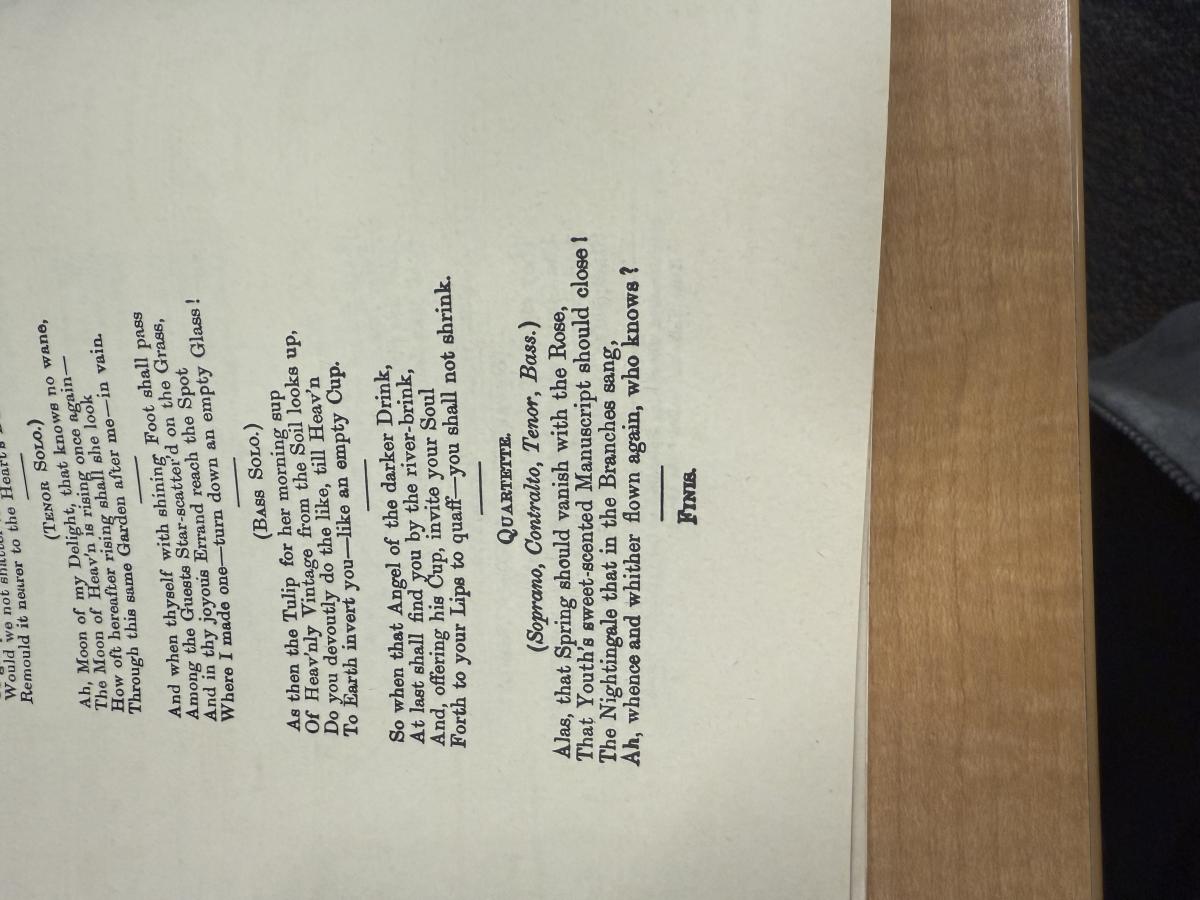
For this close reading, I am going to focus on the final stanza featured in the score. The final stanza is sung as a quartette, using the four voices of soprano, contralto, tenor, and bass. (See Figure 2) It reads:
“Alas, that Spring should vanish with the Rose,
That Youth’s sweet-scented Manuscript should close!
The Nightingale that in the Branches sang,
Ah, whence and whither flown again, who knows?”
This stanza is Stanza LXXIII from the first edition of Fitzgerald’s Rubáiyát. The stanza fulfills the expectation the reader might have from the cover of the musical score. It is full of nature imagery, fitting for the concept of “In a Persian Garden”, and aligning with the only piece of art present in the score, the cover. The passing of spring can be likened to the passing of youth, with the line “Alas, that Spring should vanish with the Rose” being a metaphor for the passing of youth. The themes of passing time are common in the Rubaiyat. The nature imagery is also used to portray questions about life and the passing of time, which can be seen in the lines: “The Nightingale that in the Branches sang, / Ah, whence and whiter flown again, who knows?” These metaphors both contribute to the garden theme of the piece, while also staying true to the Rubáiyát’s themes of existence and the passing of time.
This stanza is also very fitting as the final lyrics of the piece. The final line of the stanza contains a kind of finality, an acceptance of time passing and it being inexplicable. As a musical score, the final lines are very fitting for the standard end of a piece. The piece ends with a kind of final lament, a superb ending to the nature themed rendition of The Rubáiyát of Omar Khayyàm.