
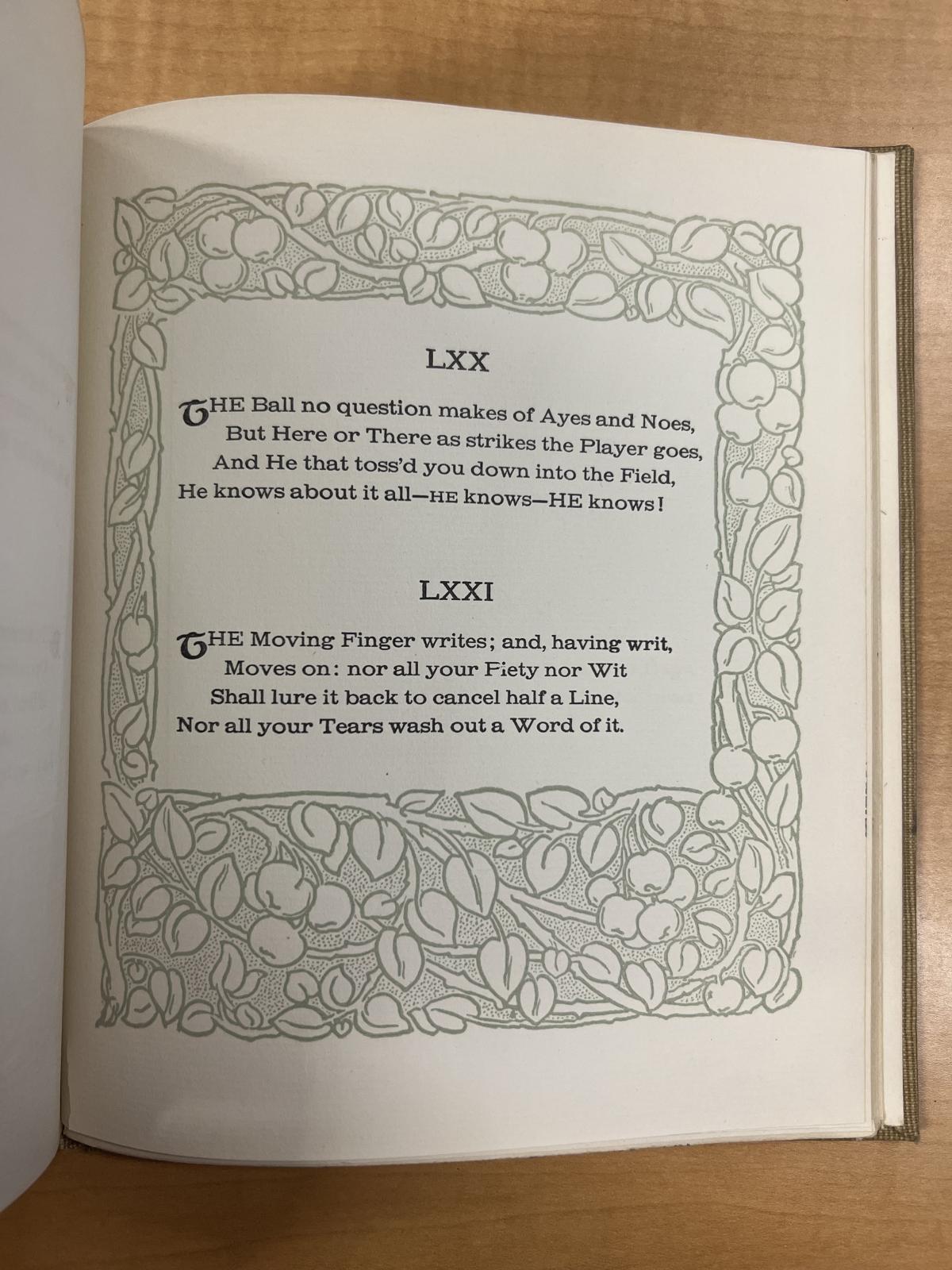
In the 1916 Dodge Publishing Company Edition of the Rubaiyat of Omar Khayyam, there is photo-poetry displayed throughout the book. This form of illustrative art, which creates a relationship between the photo and the text, was done by an artist of the name Adelaide Hanscom Leeson. Quatrain LXXI and the illustration it is paired with have a symbiotic relationship that helps emphasize the main theme of the poem – to live in the present moment.
The notion of living in the present moment, and fate versus free will, is first implied when the quatrain describes how “The Moving Finger writes.” These lines explore the idea of a higher power or an unseen deity that dictates fate and human actions. This is seen in the diction as well as the capitalization of the letters. The moving finger appears to be an otherworldly force that is writing a story and recording actions done on earth. The speaker’s perspective on this mirrors that of determinism. According to Simply Psychology, determinism is a philosophical theory and behavioral approach that suggests that all behavior has a cause thus making free will an illusion. The idea that human behavior is governed by external forces beyond one’s control differs from the religious doctrines of various faiths or traditions that encourage humans to take action in order to alter their fate. An example of this would be one doing good deeds and acts of kindness to earn a place in heaven or the afterlife. The speaker in quatrain LXXI suggests that a deity or creator dictates all actions and events for a purpose that may have no relevance to human beings on earth. The lines that read “nor all your Feity nor Wit / Shall lure it back to cancel half a Line, / Nor all your Tears wash out a Word of it” cements the idea that humans cannot change fate through intellect, religious devotion, or a tearful plea. The theme of the present moment is parallel to fate being unchangeable and written down. Similarly, to how the finger progresses in one direction and cannot go back a line, fate can only unfold and progress. These lines communicate to readers that the past is fixed and the future is changeable.
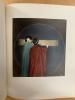
The illustration done by Hanscom Leeson helps breath life and meaning into the text. In the picture, there are two women standing side by side in front of a golden scroll. One woman is touching the circle on the scroll while the other is pointing her finger. What the audience might immediately take to notice is the content of the picture in relation to the text, but it extends further than that with the softer lighting and the warm vs cool tones. The blue background that the circle encompasses and the light blue cloak of the woman recede in space providing calmness, peace, and despair. This is in sharp contrast to the woman in an orange red cloak which gives the art piece energy. As the color blue recedes in space, the color red advances forward. Colors like red are stand out to audiences and draw emotion since they are often associated with fire, action, passion, and anger. The woman in this warm toned cloak and bejeweled head piece is also carrying a sword. All of these elements represent perhaps a deity with power. This woman in particular is “The Moving Finger” who governs behavior with intent and writes unchangeable fates. The woman standing next to her attempts to draw the finger back.
Quatrain LXXI and Adelaide Hanscom Leeson's illustration in the 1916 Dodge Publishing Company Edition are bridged together in meaning. The stanza itself and the picture amplifies the speaker’s message about living in the present moment since fate has already been decided by a higher power.