


Introduction: The one story that depicts the aspect of a split or dual personality the best way is Robert Louis Stevenson’s The Strange Case of Dr. Jekyll and Mr. Hyde. There have been numerous depictions of the character over the years, some of them good and some of them not very good. A few of the good adaptations of this classic story include the two movies titled Jekyll and Hyde, one from 1920 and another from 1931. The 1920 silent film we did not watch in class but is still worth a watch. The 1931 adaptation was the #1 notable version to Stevenson’s iconic 19th century story.
There will be further adaptations discussed, and they too evolve around the psychological aspect of the story. That aspect being the dual/split personality, good and bad, proper and wild, or even boring and fun. This timeless story is all about the psychological need to let go and give in to your innermost impulses and needs. Throughout the 20th century, the creations of a few comic book characters were inspired by Dr. Jekyll and Mr. Hyde. One of them being The Incredible Hulk from Marvel Comics and the other being Two-Face from DC Comics. The differences being that Marvel’s character is driven by anger only and not any sexual impulses. Two-Face is literally a person split in half and bases all his decisions on the flip of a coin. Heads means he does something good or at least spares a person’s life, tails he does something bad. Throughout movies and television, this Jekyll/Hyde character has gone through many different transformations, a few of them with a comedic tone. One version that will not be included in this gallery was a hulk-looking monster from A League of Extraordinary Gentleman in 2003.
Works Cited:
Stevenson, Robert Louis. Strange Case of Dr. Jekyll and Mr. Hyde. Ed. Martin A. Danahay. 3rd ed. Ontario: Broadview Editions. 2015.
Stevenson, Robert Louis. Strange Case of Dr. Jekyll and Mr. Hyde. Ed. Katherine Llneham. New York: W.W. Norton & Co., 2003
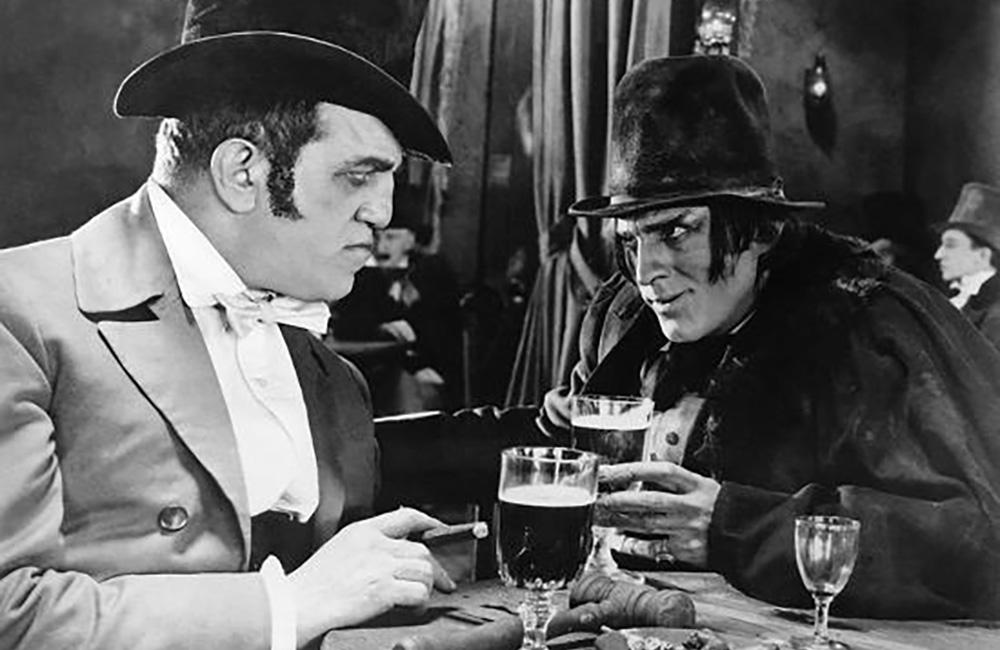
Dr. Jekyll and Mr. Hyde (1920)
One adaptation that this class has not gone over was a second silent film. This one was released 20-25 years after the first silent film. This version of Mr. Hyde stuck closer to his description in the book. He’s ugly, but not too ugly and he’s slouching like he’s supposed to. Just like in future adaptations, he is very sociable. In this one, he is clearly not just talking to woman. He seems to target men as well. In fact, it’s not determined in the novel if he targets women at all, other than that little girl that he trampled over in the book’s opening. Truthfully, all you need to make a good Mr. Hyde is a slouched-over man with mutated/green skin. It’s hard to tell if they did that in this film, since it’s in black and white.
Dr. Jekyll and Mr. Hyde (1931)
There’s no better way to introduce a classic film than to show its poster. The 1931 adaptation of this horror story is not only the most notable, but quite possibly the best. Not only are the characters very convincing, but the gothic atmostphere of the suberbs of London really help sell the horror of Mr. Hyde's playground. All the foggy streets and twisted designs of the small buildings gives the film a kind of dream-like feel to it. Here, in the image you see above, the pov transformation was something future filmmakers wouldn't dare to copy. Speaking of Copy, there was a 1941 adaptation that used a lot of scenes from this version.
The Nutty Professor (1963)
Some might say that this is a spoof or parody, others would call it a comedic interpretation of Stevenson's novel. Either way, having a bullied and wimpy professor to create a hansome and bad boy alter ego was unheard of, but also typical for the 1960s. The image that see above with the dancing shows a softer side to the "bad" alter ego. Both faces are totally attracted to this woman, but only one of them can have her for good.
The Mummy (2017)
Despite the bad reception this film got upon it's release, this is actually one of my favorite versions of Mr. Hyde. The main reason being that he's played by Russel Crowe. You might say that his performance here is what almost saved the film. Not only is he super strong and intimitating, but he also has some clever and witty dialogue that makes this Mr. Hyde a good brief antagonist.