
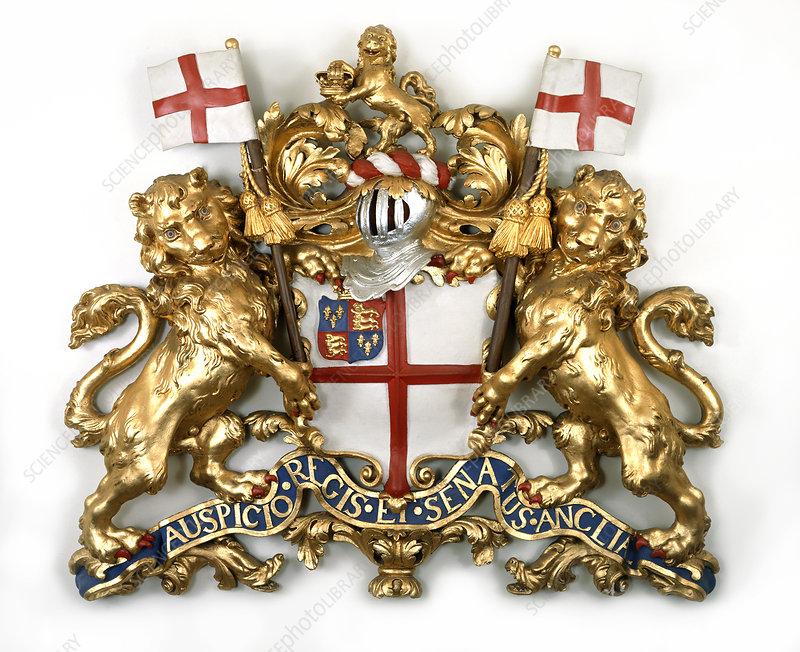
Originally known as Governor and Company of Merchants of London Trading into the East Indies, the East India Company was formed, according to Britannica, “for the exploitation of trade with East and Southeast Asia and India.” The East India Company formed on December 31, 1600 when Elizabeth I agreed to grant a group of English businessmen a charter that would allow them to travel to the East Indies in exchange for a monopoly on the spice trader in the region. Though it started as a monopolistic trading body, the East India Company eventually expanded its activities and territory to become a political entity and leader of British imperialist efforts in India.
With this royal charter, the East India Company received the ability to “wage war”: a permission, though initially used as a means to protect itself and fight rival traders, which ultimately enabled it to build an army of 260,000 soldiers and forcibly seize control of the Indian subcontinent. These imperialist efforts began in 1756 with Bengal, but spanned almost all of India in less than half a century. This unregulated private company achieved massive profits at the expense of its subjects, while also contributing to other global issues from the Opium Wars to the international slave trade.
The East India Company’s presence in Mill’s autobiography helps to contextualize his life experiences in the broader scope of British and world history. Though Mill conveniently glosses over his employer’s imperialist presence or the actions it was taking overseas, his involvement in the company as one of the great thinkers of his generation shows the sort of manpower that went into making the East India Company the political entity it once was.
Sources:
Blakemore, Erin. “How the East India Company Became the World's Most Powerful Business.” Culture, National Geographic, 10 Feb. 2021, www.nationalgeographic.com/culture/article/british-east-india-trading-c…;
Dalrymple, William. “The East India Company: The Original Corporate Raiders.” The Guardian, Guardian News and Media, 4 Mar. 2015, www.theguardian.com/world/2015/mar/04/east-india-company-original-corpo…;
“East India Company.” Encyclopædia Britannica, Encyclopædia Britannica, Inc., www.britannica.com/topic/East-India-Company.
“The East India Company and Its Role in Ruling India.” Historic UK, www.historic-uk.com/HistoryUK/HistoryofEngland/The-East-India-Company/.