
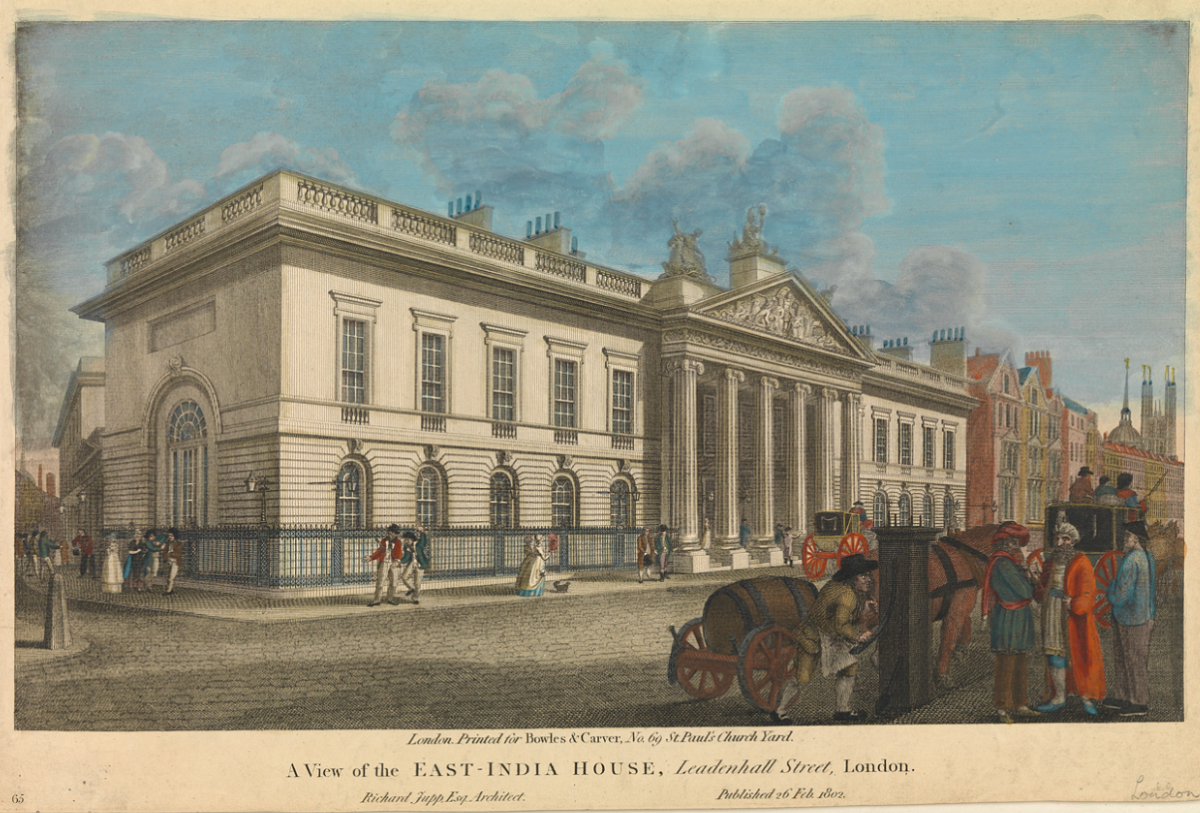
The East India House was the London headquarters of the East India Company, which governed much of British India until 1858 when the British government took control of the Company’s territory in India. In fact, there were two East India Houses, the “Old” East India House and the “New” East India House, both of which were located in London on Leadenhall Street. The Old East India House was an Elizabethan mansion which was previously known as the Craven House. It was first occupied by the East India Company in 1648. The building was entirely rebuilt between 1726 and 1729, creating the New East India House and was extended between 1796 and 1800. It was demolished in 1861. The massive and imposing size of the East India House served as a symbol of the power and influence of the East India Company in England and over India.
John Stuart Mill worked for the East India Company for 35 years of his life and makes frequent references to his work at the India House throughout his autobiography. Before him, his father worked in the East India House, and Mill writes of him that “he ended by taking up his residence in London, and devoting himself to authorship. Nor had he any other means of support until 1819, when he obtained an appointment in the India House” (chapter 1). Mill’s father eventually found Mill his first job in the East India House. The Mill family worked for the East India Company in the East India House on Leadenhall Street for much of their lives, and this building would have been very familiar to them.
Sources:
Makepeace, Margaret. “How the East India Company Shaped London.” Adam Matthew Digital, www.amdigital.co.uk/about/blog/item/margaret-makepeace-east-india-company.
“The World's Most Powerful Corporation.” BBC Worklife, BBC, www.bbc.com/worklife/article/20160330-the-worlds-most-powerful-corporation.
“John Stuart Mill.” MANAS, 13 Oct. 2016, southasia.ucla.edu/john-stuart-mill/.