
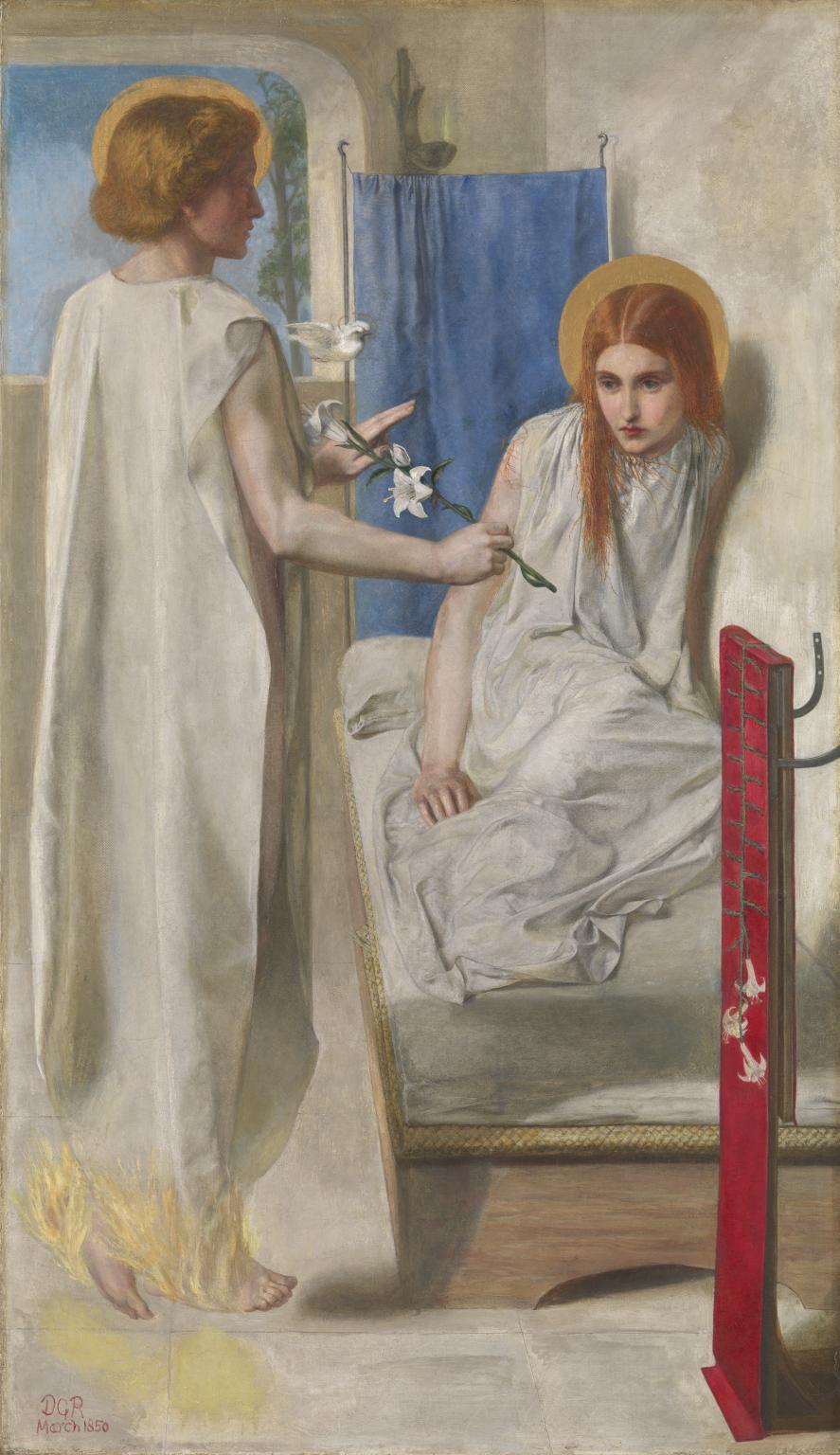
Ecce Ancilla Domini!, later known as The Annunciation, is an oil painting created by Dante Gabriel Rossetti between 1849-1850, and its original dimensions were 72.7 cm x 41.9 cm (Ash 20). The painting contains a considerable amount of religious symbolism, which is also reflected through its title. Ecce Ancilla Domini is a Latin phrase that translates to “Behold the handmaid of the Lord” in English (Prettejohn 51). As a part of the Pre-Raphaelite Brotherhood, Rossetti debuted this painting at the Portland Gallery in 1850. Following the criticism the painting received at its debut, its name was changed to The Annunciation (Ash 20). The original purpose of this painting was to serve as a sequel to Rossetti’s PRB debut painting, The Girlhood of Mary Virgin, and it was assumed that a third painting would follow The Annunciation; however, no such painting was ever released (Ash 12, 20).
Like The Girlhood of Mary Virgin, The Annunciation contains a considerable amount of religious symbolism. It exemplifies the Bible verses Luke 1:28-38 where Mary is told by an angel that she will soon give birth to a child, the Son of God (Prettejohn 51). That being said, the two characters in the painting, left to right, are the angel and then Mary.
Given that this picture was released in 1850, Mary’s clothing is very unlike typical women's clothing during that time. In The Annunciation, Mary is seen wearing a plain white, high-neck slip, whereas women at the time typically wore more elegant, detailed dresses. Even though women’s clothing was becoming looser, the skirts to these dresses were becoming wider and cone-shaped (Shrimpton 12). This style is near the opposite of what Mary is seen to be wearing since her clothing gives no shape to her body and has no volume. These stark contrasts are likely due to the inspiration and symbolism behind Rossetti’s work and that it was not meant to reflect the current period but rather a Biblical scene.
Additionally, unlike the styles of the times, Mary’s hair in Rossetti’s The Annunciation is loose and hangs around her shoulders. Because it seems as though she just woke up or was startled awake by the presence of the angel, her hair also looks as though it is unbrushed with loose tendrils around her neck and shoulders. Opposingly, during the late 1840s and early 1850s, women often wore their hair in short ringlets close to their heads (Shrimpton 11). Again, because this painting tells a Biblical story, it is not entirely reminiscent of the time in which it was produced, which could account for some of the fashion discrepancies.
As can be seen, the woman in this painting, Mary, is posed sitting on a bed, though it appears as though she was recently awoken. The shape of Mary’s body in The Annunciation is difficult to make out since the majority is covered by her loose-fitting slip. Her right arm and her head are the only body parts that are easily distinguishable, but these are in normal proportions and are not overly emphasized. The angel in the painting is the same way, though their figure is more exposed due to the large slit on the side of the slip.
Equally important, the colors in Rossetti’s The Annunciation are especially interesting in that he uses a very limited color palette. While predominantly white, the other main colors used are primary colors-- blue, red, and yellow. The white, present in the clothing, bedding, and wall color, appears to symbolize Mary’s purity and innocence (Prettejohn 51). This is in stark contrast to the red present on the fabric embroidery piece, which was also seen in Rossetti’s The Girlhood of Mary Virgin. In other pieces, red can be viewed as a color symbolizing power or dominance or, in some causes, sexuality. This embroidery also has lilies on it, which are flowers symbolic of purity. This creates an interesting paradox between the sexuality displayed by the red and purity symbolized by the white.
Though complex in symbolism, Rossetti has structured this piece in a very simplistic way. There are only two figures and very little extra items or icons. In general, one of the more fascinating aspects of the layout of this painting is the way that Mary is shrugged off to one side as if she is leaning away from the angel. She is also positioned behind the angel, which seems fitting considering she is not being displayed as a powerful icon. Another unique factor is the dimensions of this painting. At barely sixteen inches wide, Rossetti creates an allusion that these characters are more spread apart than they actually are, and this is accomplished through the strategic placement of the branch of flowers, which serves almost as a barrier between the figures. Additionally, because viewers are only able to see the angel’s back, the main focus of attention is Mary, specifically Mary’s face and facial expression. Knowing that she, a virgin, is being told that she will soon birth a child, Mary seems to have a very subtly shocked and slightly depressed facial expression.
Overall, Rossetti’s Ecce Ancilla Domini!, also known as The Annunciation, is one of his simplest yet symbolically complex and detailed pieces. It is full of rich Biblical symbolism which is displayed in an almost hauntingly simple way. With its limited characters and simple and purposeful color palette, The Annunciation tells a fascinating story, much like the Pre-Raphaelite artist who created it.
Works Cited
Ash, Russell. Dante Gabriel Rossetti. Harry N. Abrams, 1995.
de la Sizeranne, Robert. The Pre-Raphaelites. Translated by Andrew Byrd, Parkstone International, 2014.
Prettejohn, Elizabeth. The Art of the Pre-Raphaelites. Princeton University Press, 2000.
Shrimpton, Jayne. Victorian Fashion. Shire Publications, 2016.