
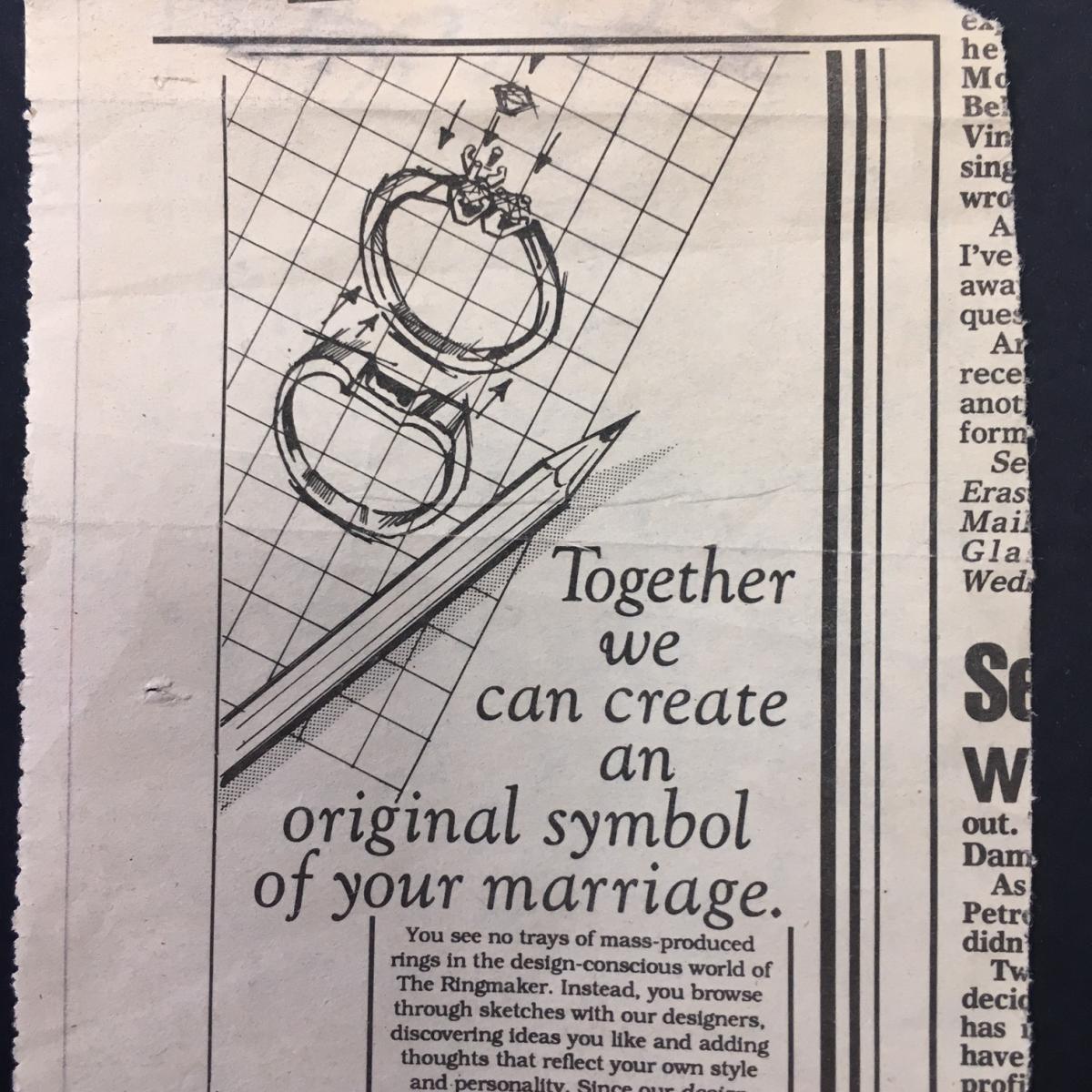
As I was sitting in my living room reading the paper, this ad for engagement rings stood out. Throughout my life, I have disapproved of society's expectations for men to buy engagement rings for women. I believe that a ring symbolizes expectation and wealth rather than love. This page struck an unexpected anger in me, and I believe it’s because I feel that a ring has no meaning besides bondage. A marriage united with love is wonderful, but engagement rings seem to represent money and finances rather than love. The ring itself is supposed to be exciting and glorious, but really it is just a financial bond that the woman becomes the property of the man presenting her with this gift. The excitement is deceiving because the ring is actually just something society has created a meaning for. Oftentimes, it seems it is not out of true love that the man buys this for his future wife, it is just expected of him to do so. If the gift of an engagement ring is accepted, the woman gives away her life in submission to her husband. She will live with her husband who will control her life because he is her source of financial support, as a woman simply cannot take care of her dainty self. A proposal and acceptance of an engagement ring is a woman giving in to expectations and following the traditional, socially accepted life of every woman to fit in and be like everyone else. I think the expectation should be to get married to the love of your life, not marry for money.
Editorial Commentary: Mary Erle clearly has a strong distaste for not only engagement rings, but towards the idea of marriage as a whole. She does not see a marriage as a holy matrimony or a devotion of loving someone till death do them part, but rather as a transaction of property. In the case of marriage, the woman herself is the property. At the time Ms. Erle lived, it was expected for women to grow up, get married, and have children. That was the traditional path most women followed. Most Victorian age women went to some schooling and then in their mid-20s, they typically got married and became their husband’s property instead of their father’s or brother’s. Ms. Erle seemed to not only reject this standard but despise it. She brings up the idea of women being the property and only gaining financial support, if that, in this bond that is symbolized by the engagement ring. Ms. Erle clearly is strongly against the societal expectations that are placed on women at the time. This can be seen through her aggression towards the engagement ring ad, a symbol of marriage, but her deeper frustration underlies in the gender expectations. She uses sarcasm as she writes, “because a woman simply cannot take care of her dainty self.” Here she is using “dainty” to reference that women are weak and can not be responsible for caring for themselves, so they must accept an engagement ring from a man who can take care of her. Through her writing it can be seen that Mary Erle strongly suggests that women were expected to get married and by doing so, would essentially be owned by their spouse.
Citation:
“Our History.” The Ringmaker - Engagement Ring Design Glasgow & Edinburgh. www.theringmaker.co.uk/ourhistory/n3fi94fpmnmh4ia829dwb24e1sqjpp.
Dixon, Ella Hepworth. The Story of a Modern Woman. 1894. COVE, 2020.