
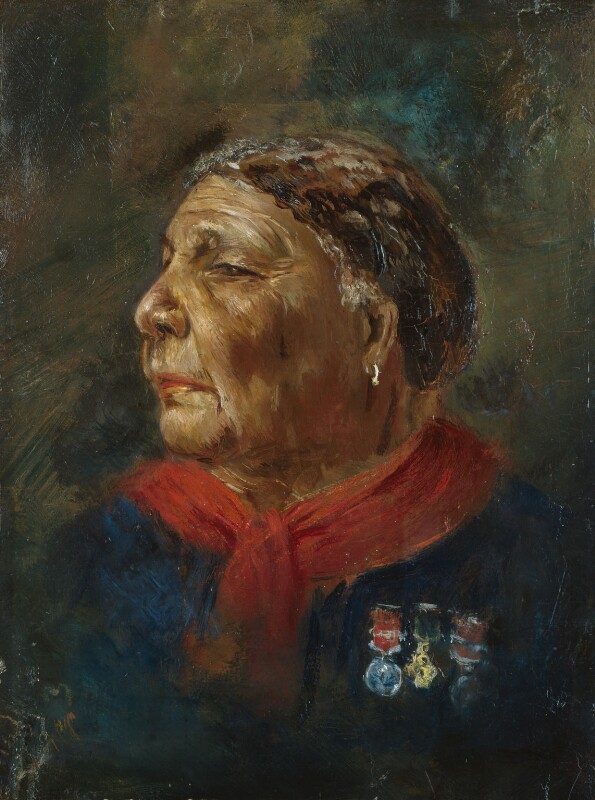
During the Crimean War, there were many wounded soldiers in need of aid and Mary Seacole was more than willing to attend to them, but this did not come easy for her. “On the outbreak of the Crimean War Mary set sail for England where she hoped to join the company who would soon depart under the guidance of Miss Nightingale. Her application was turned down despite her education, her nursing skills, her herbal remedies—she dressed flamboyantly, was too old, too brash, and dare one say it, too black!” (Dublin History Record). Mary Seacole had just as much knowledge as Florence Nightingale and had all the motivation to good intentions to help during the Crimean War but was unfairly denied. Her skills were questioned, and she wasn’t given the chance to prove how good she was at what she did because of her skin color. In the end, Mary Seacole did make her way into helping soldiers during the war but it wasn’t easy and neither was her gaining recognition. “In the intervening years, however, Mary Seacole’s heroic contributions during that ‘dawn of modern nursing’ have been conspicuously forgotten by all but the most scrupulous medical historians” (Indianapolis Star). There have been some changes since then but overall, Mary Seacole didn’t get the recognition that she deserved. She did just as much work as Nightingale and was appreciated by many of the soldiers for being a sort of mother figure to them and yet she continued to live in Nightingale’s shadow. Additionally, Mary Seacole wrote her book a certain way in order to get recognized. “While Wonderful Adventures was marketed as a travel book, a genre enjoying high popularity at the time, it was in fact, a kind of autobiography in which Seacole conscious of audience expectations, employed sophisticated rhetorical strategies to establish herself as a perfect Victorian heroine” (Journal of Narrative Theory). Mary Seacole knew that in order for her book to sell, she would have to market it a certain way to appeal to the audience. Mary Seacole was more than capable of helping those around her and working as a nurse. In fact, a lot of the time soldiers preferred her treatment over the medication because she was a mother figure to them and was always caring. Despite all of this, she had to fight her way into helping those people and eventually take matters into her own hands. This all leads back to the events with Will Smith at the Oscar. It begs the question of whether the public’s reaction would have been different if it was a white man who did it. This also leads to the fact that most of the time, people of color have to work harder than white people to get what they want no matter what it is. Will Smith was completely oved by the public before the incident at the Oscars occurred. If this had been a white man, chances are that an apology would’ve been enough for others to forget about it. Additionally, although a white man might not get as severe of a punishment for his actions.
References:
"May 23, 1970 (Page 21 of 52)." Indianapolis Star (1923-2004), May 23, 1970, pp. 21. ProQuest, http://ulib.iupui.edu/cgi-bin/proxy.pl?url=http://search.proquest.com/historical-newspapers/may-23-1970-page-21-52/docview/1893152572/se-2?accountid=7398.
Mercer, Lorraine. “I Shall Make No Excuse: The Narrative Odyssey of Mary Seacole.” Journal of Narrative Theory, vol. 35, no. 1, 2005, pp. 1–24, http://www.jstor.org/stable/30224618. Accessed 1 May 2022.
- M. Dublin Historical Record, vol. 59, no. 2, 2006, pp. 213–14, http://www.jstor.org/stable/30101658. Accessed 1 May 2022.
Related links:
The Crimean War (1853 - 1856)
The Charge of the Light Brigade Poem by Lord Alfred Tennyson