
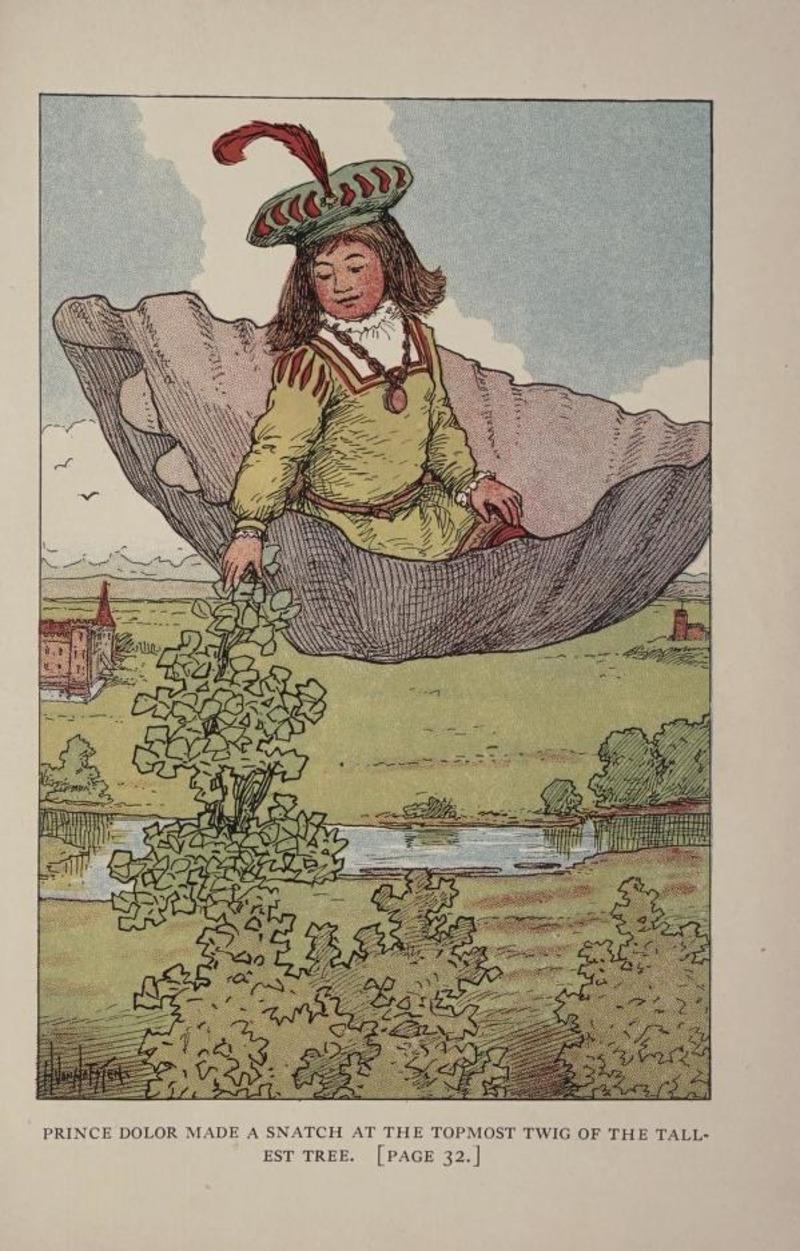
Various editions of The Little Lame Prince and His Travelling Cloak feature an image of Prince Dolor on his cloak, sometimes wearing his spectacles, reaching out to “snatch at the topmost twig of the tallest tree” (Craik 24). Several critics, such as Philipose, suggest that the prince's cloak can be equated with the imagination, allowing him to overcome his physical limitations. On the other hand, Hingston claims, “Dolor’s lack of control over his gifts…suggests that they exist outside of him rather than as part of his imagination” (373). Though the prince’s cloak exists as a real object, it might be an oversimplification to equate it with his imagination. Instead, the cloak may function as a way for the prince to engage in imaginative play. With his godmother's help, Prince Dolour can leave his tower and engage, to an extent, with the outside world. Using the cloak can be classified as imaginative play because the prince can only observe what’s below him rather than actively participating in this world.
This illustration depicts the prince when he is most able to physically engage in his surroundings. When he later sees the shepherd boy, he can only watch him and cannot communicate with him, an inherently isolating experience. Hingston uses the example of the shepherd boy to demonstrate Prince Dolor’s lack of control of the cloak, suggesting it exists outside of the imagination. However, the prince’s observation of the boy and his desire to meet on equal levels, whether in the ground or sky, suggests his engagement with imaginative play. Thus, the cloak functions not as the faculty of imagination but as a facilitator of imagination. The prince can only imagine himself as a part of the outside world, and his inability to interact with it causes a state of isolation. Imagination and isolation, particularly imaginative play and isolation, are intimately linked, ultimately suggesting the limitations of imagination: it does not have the power to allow him to play with the shepherd boy literally and, therefore, cannot combat his isolation.
References
1. Craik, Dinah Maria Mulock. The Little Lame Prince. Brewer, Barse & Co, 1907. Internet Archive, https://archive.org/details/littlelameprince00crai_1.
2. Hingston, Kylee-Anne. “Prosthesis and Narrative Perspective in Dinah Mulock Craik's The Little Lame Prince."Women’s Writing, vol. 20, no. 3, 2013, pp. 370–386, doi:10.1080/09699082.2013.801125.
3. Philipose, Lily. "The Politics of the Hearth in Victorian Children's Fantasy: Dinah Mulock Craik's The Little Lame Prince." Children's Literature Association Quarterly, vol. 21 no. 3, 1996, pp. 133-139. Project MUSE, https://dx.doi.org/10.1353/chq.0.1268.