
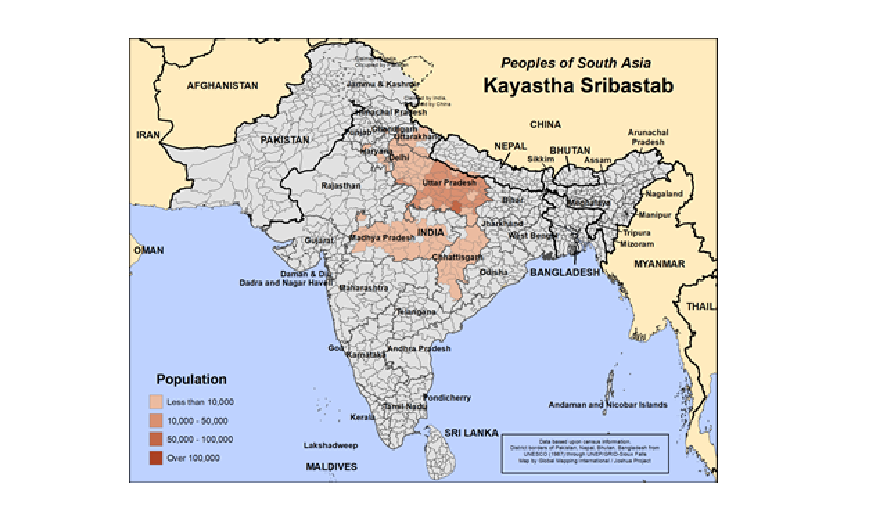
Bengali Kayasthas represent an elite sub-caste of the Hindu religion with a much disputed social ranking and history. Different sources place Kayasthas at different rankings, with some placing them directly after the Brahmins, others according them the same status as Brahmins, and others claiming that they form a fifth varna in the caste structure. Kayasthas can be further divided into kulin Kayasthas, which were higher rank, and moulik Kayasthas, which were lower rank. The five kulin Kayastha lineages are Bose, Ghosh, Mitra, Datta, and Gina. Since Sen’s maiden name is Ghosh, that means that her family is kulin Kayastha.
There is a legend of migration of kulin Kayasthas from Kannauj to Bengal. The five kulin Kayastha lineages are said to have descended from the Kayasthas who accompanied the five Brahmins from Kannauj, but it is unclear what the exact relationship between these two groups was. The kulin Kayastha lineages reject any suggestion that their ancestors were servants of the five Brahmins, which would imply a lower caste, and instead assert that they belong to the scribal/administrator/warrior strata of the caste hierarchy of Northern India.
According to “Because I Am A Woman,” the Kayasthas are part of the Sudra varna and thus below Brahmins: “We are so close to them they pay no attention to the fact that they are brahmins and we are kayasthas and seen as belonging to the sudra varna” (Sen 79). Though their social ranking varies from source to source, it is nonetheless critical to examine where the Kayasthas fit into the Hindu caste system to understand the rules and customs Sen follows throughout her text, as well as the treatment she receives from others based on their caste.
My apologies for the small images- resizing them compromised their quality too much, so I added white space to hit COVE's image size minimum.
Sources:
Pagani, Luca, et al. “Kayasthas of Bengal: Legends, Geneaologies, and Genetics.” Shram, www.shram.org/uploadFiles/20171208110232.pdf.
Kaminsky, Arnold P. “India Today: An Encyclopedia of Life in the Republic.” Google Books, Google, books.google.com/books?id=wWDnTWrz4O8C&pg=PA404#v=onepage&q&f=false.
“Kayastha.” Banglapedia, en.banglapedia.org/index.php/Kayastha.
Inden, Ronald. “Marriage and Rank in Bengali Culture: A History of Caste and Clan in Middle Period Bengal.” Google Books, Google, books.google.com/books?id=P8b9A7J_v-UC&pg=PA1#v=onepage&q&f=false.