

Display Explanation:
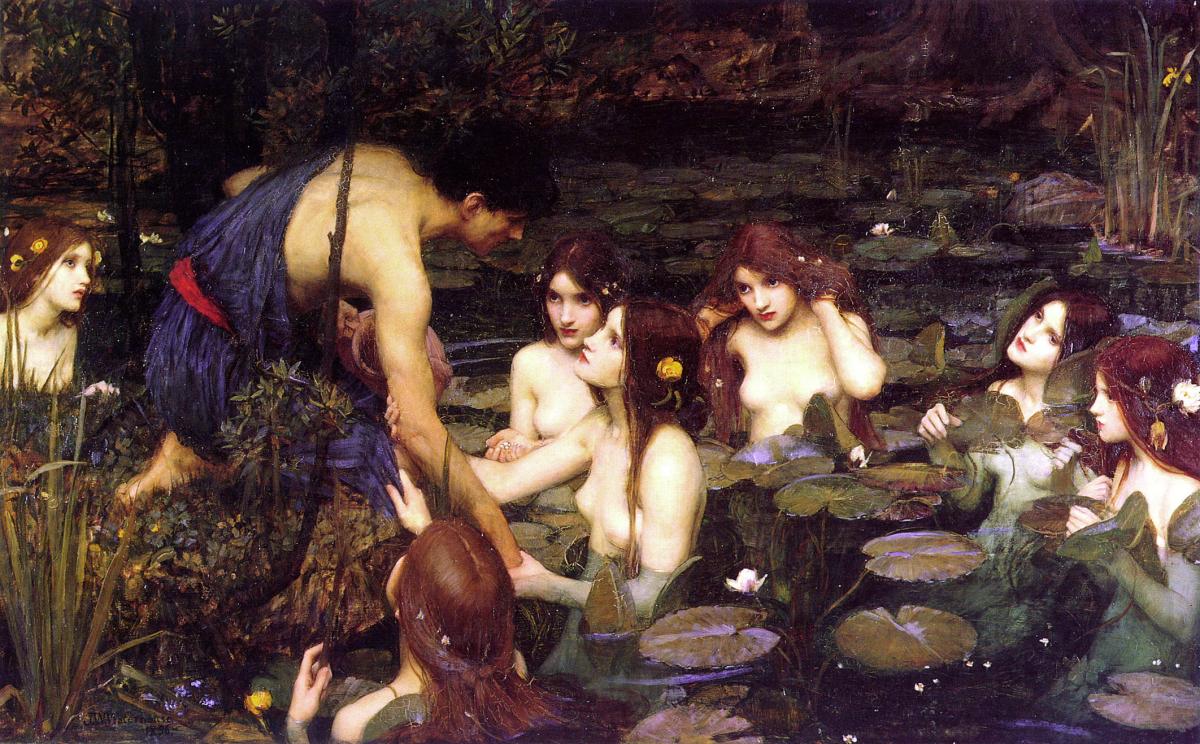
My installation will be in a very small room, fitting only about 10 people in it at once. The room will have no particular or intentional smell and I will have control over the lights, sounds, and tone of the walk. I will be sure to speak in a soft tone to keep people from talking over me, and I’ll be the only one giving the tour. Once my eight or nine viewers enter the purposefully chilled room, the lights will dim and a soft, humming white noise sound will play from an overhead speaker. The hardwood floor will have enough lighting to create a visible path from the door to the center of the wall on my viewer’s right. The floor will be lined with small yellow roses and the wall, in which the oil painting Hylas and the Nymphs by John William Waterhouse (approximately 39 x 64 inches) will be placed, will be painted a deep blue. The painting will not be visible until I turn on the light that will be positioned above the painting. Once the dim light is turned on I will begin to describe the painting and the facts about it as a docent would. The soft sound will continue until I guide the viewers to the next painting. I will then cue the sound of wind with soft water-dripping on the overhead speaker.
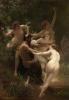
The path from this painting to the next will have yellow roses and be lit up as well; however, it will also have a sheer white sheet that I will walk on, guiding viewers to the wall adjacent to the one they were previously at, which will now be on their right. The painting Nymphs and Satyr by William Adolphe Bouguereau (approximately 100 x 71 inches) will become visible once I turn on the overhead light, and the wall behind it will be painted a deep, forest green. The painting will be centered on this wall as well, and the light on the previous painting will be turned off. Something important to note is that I’d (ideally) have control over the temperature as well, and make it a little more comfortable (warm) as we move from one painting to the next.
The final walk will be from the back wall to the wall on the left of us, and there will be a path there as well. This time, there will be no yellow flowers, but there will be large and small seashells that will create the path to the final wall. On this wall will be placed the oil painting Cave of the Storm Nymphs by Edward John Poynter (approximately 57 x 43 inches). The wall will be painted dark brown. The sound of crashing waves will play on the overhead speaker, but at a low volume. None of the paintings will be framed, and I will have the original paintings rather than replicas. Ideally, I’d make the area around the paintings pitch black so the only thing the viewer sees is the painting being presented. If I can’t do that, I’ll have the lights in other parts of the room dimmed as I said previously. As the installation comes to an end, I’ll gradually turn the lights up and have my viewers (most likely students) answer some questions about the similarities and differences they recall.
Installation Note:
My three paintings were Hylas and the Nymphs by John William Waterhouse, Nymphs and Satyr by William Adolphe Bouguereau, and Cave of the Storm Nymphs by Edward John Poynter. All three are oil paintings and follow the theme of nymphs luring a man or several men into their “trap”. I learned that nymphs are inferior females associated with lust, compulsion, fertility, growth, and nature. Throughout my installation, the number of nymphs interacting with their desired target decreases from seven, to four, to three. If a story were to be made up in order to connect these paintings, one could say that three of the nymphs from the first painting (Waterhouse) separated from the group and relocated to lure men in for their treasure.
The nymphs in Waterhouse's painting use their beauty to lure Hylas into the water. One nymph appears to hold pearls in her hand in an attempt to ease him into the water with the (possible) promise that he'd gain a similar treasure. In Bouguereau’s work, four nymphs attempt to pull a satyr into the water while three others watch. In Poynter's painting, one nymph sits on a rock inside the cave and holds an instrument- a lyre- which is either played to lure the ship in or celebrate it being lured in. Another nymph throws gold coins and the last nymph lies naked, awaiting their prey. I set the paintings up in the order that I did because I think the viewers could draw their own conclusions; maybe these paintings are connected in some way.
Certain details that I included in my display are meant to highlight specific aspects of the paintings. For instance, the yellow flowers on the ground are meant to bring the viewer’s attention to the yellow flowers in Waterhouse and Bouguereau’s work. I also used the color of the walls to highlight the men’s appearance or the scenery in the artwork. In the artwork presented first, the wall behind it will be deep blue because Hylas’ outfit was dark/navy blue in the painting. The wall behind Bouguereau’s painting is dark green because I want to draw attention to the forest and for the audience to note that each painting was different in regards to the scene: one in a cave off the ocean, one in a forest, and one in an open lake. The final painting by Poynter will rest on a dark brown wall in order to highlight the cave but also to draw more light on the amount of gold in the work. The coins were gold but the main focus is on the nymphs. The three of them seemed to glow (especially the one lying on the ground of the cave) and I felt that they looked golden.
The women are labeled nymphs, so we know that they are “less than”. I feel that some aspects of these paintings say otherwise, and some aspects agree. In the first painting presented, the women are powerful enough to use their sexuality to lure a man into the water, but are positioned beneath him which feels inferior. All seven women were trying their hardest to lure the man, which could be because one nymph alone could not accomplish the task. The four nymphs pulling the satyr into the water in the second painting presented seem to use their sexuality playfully. One pulls the satyr's ear as she calls for the other three (less playful) nymphs to join the fun. The fact that three women were able to get the satyr’s foot (or hoof) wet could be interpreted as them having more power than the seven women in the previous painting, but not enough to submerge him completely. Finally, the last painting. This one felt the most powerful to me, which is why I chose for it to be last. It felt the most powerful to me because the women were stranded- far away from anyone in a cave- and still able to lure not one man, but potentially an entire ship of men their way. One nymph lies gracefully on the floor of the cave, as if all she needs to do is look appealing to draw a man (or men) in.
Waterhouse, John William. Hylas and the Nymphs (1896)
https://commons.wikimedia.org/wiki/File:Waterhouse_Hylas_and_the_Nymphs…

Accessed February, 2023
Bouguereau, William Adolphe. Nymphs and Satyr (1873)
https://en.wikipedia.org/wiki/Nymphs_and_Satyr#/media/File:William-Adol…
_-_Nymphs_and_Satyr_(1873)_HQ.jpg)
Accessed February, 2023
Poynter, Edward John. The Cave of the Storm Nymphs (1903)
https://en.wikipedia.org/wiki/The_Cave_of_the_Storm_Nymphs#/media/File:…

Accessed February, 2023