
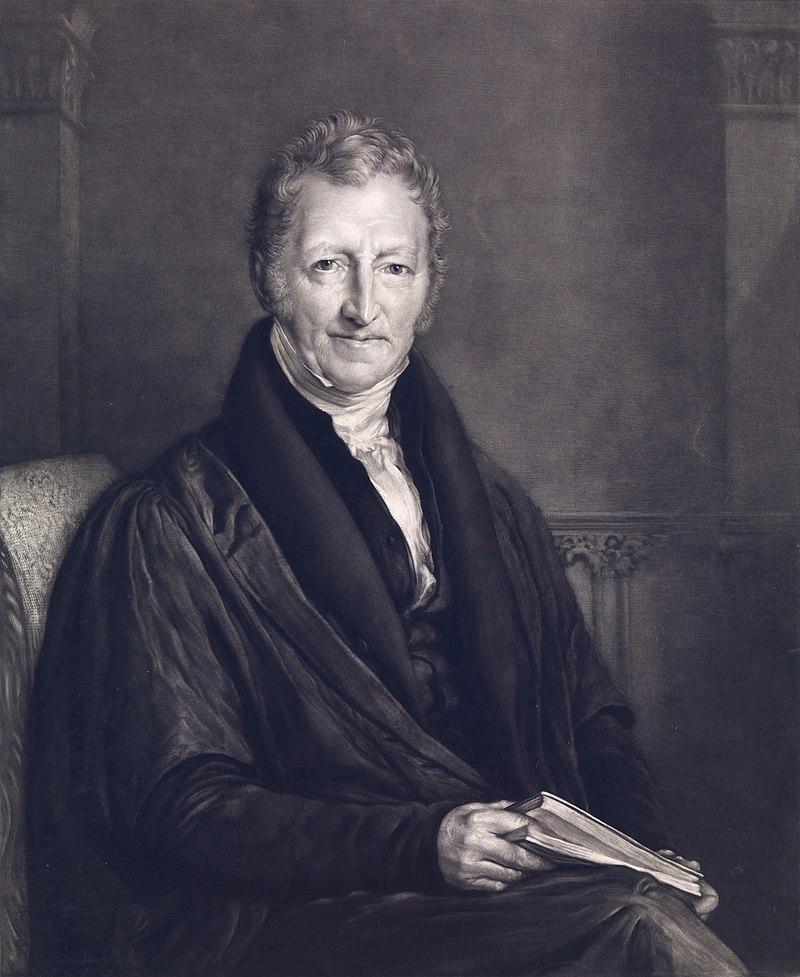
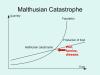
Thomas Malthus was an English economist and demographer who is most famous for his essay “An Essay on the Principle of Population as It Affects the Future Improvement of Society, with Remarks on the Speculations of Mr. Godwin, M. Condorcet, and Other Writers” in 1798. This essay details his theory that human populations will always tend to out run food production because they grow according to different mathematical principles. The only way to check that population growth is vice, misery, and moral restraint: either wide-spread death or lack of reproduction. This theory was and remains highly influential to scientists, philosophers, policy makers, and economists including James Mill, David Ridarco, among others. However, the underlying principle of this theory, that human populations need war, disease, and famine to avoid overpopulation, is wrong, and Malthus’s understanding of the world has been used in support of eugenics, social darwinism, and policies allowing the poor to remain poor.
One of the defining experiences of John Stuart Mill’s young life was the development of his philosophy through association with his peers. He describes their philosophy as “a combination of Bentham’s point of view with that of the modern political economy” with Malthus’s population principle as a “point of union among [them]” (Mill, 93-4). Malthus’s population principle fits with many of the policies that Mill later fought for when he was in Parliment.
SOURCES
https://www.britannica.com/biography/Thomas-Malthus
https://evolution.berkeley.edu/evolibrary/article/0_0_0/history_07
https://ucmp.berkeley.edu/history/malthus.html
https://link.springer.com/chapter/10.1007/978-1-349-21315-3_52
http://www.bbc.co.uk/history/historic_figures/malthus_thomas.shtml
https://getthepartystarted.wordpress.com/2017/01/31/malthusian-theory/&…;