
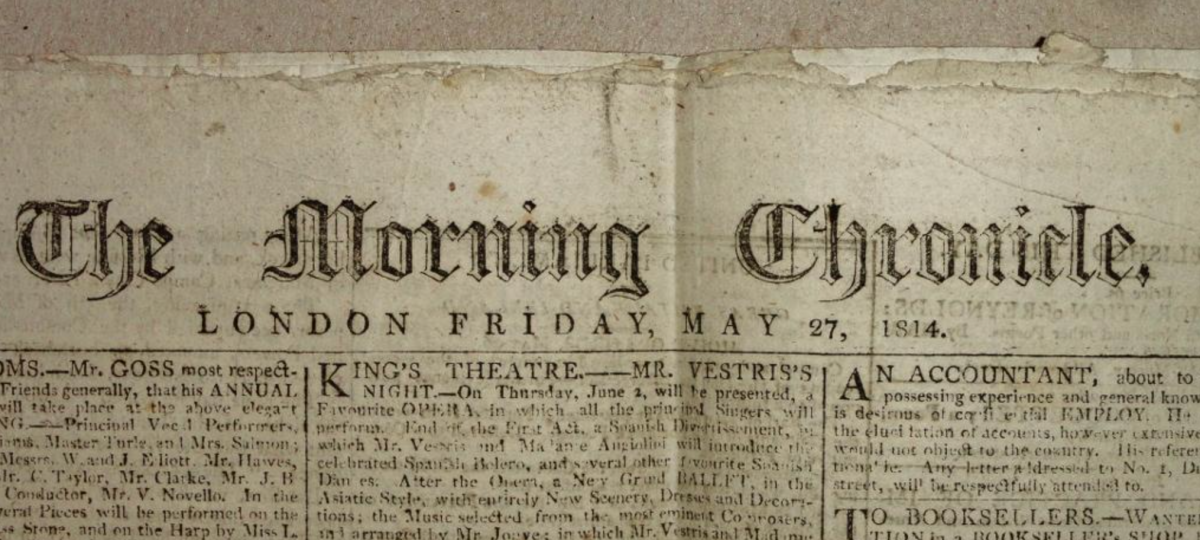
The Morning Chronicle was a newspaper in London, England. It was founded in 1769 and continued publishing until 1862, when publication was suspended. After this point, there were two further attempts to continue publication, but neither was long-lasting, and the paper’s final publication was in 1865. Originally the paper was published under the name The Morning Chronicle and London Advertiser, but from 1789 until its final publication it was simply titled The Morning Chronicle. The paper was founded by William Woodfall, who served as publisher, editor, and reporter. In 1789, the paper was bought by James Perry, who framed the paper as the Whig counterpart of the Tory London Gazette . The paper gained a reputation as radical, and several charges of libel and seditious libel were levelled against it and its contributors. After Perry, the paper was owned by John Black, then by William Innel Clement, and finally by John Easthope in 1834. The paper employed writers and essays such as William Hazlitt, Henry Mayhew, Charles Dickens, and John Stuart Mill.
Throughout his autobiography, Mill makes repeated reference to the Morning Chronicle and his works within in. Mill mentions a period in which he wrote five essays in favor of free speech on matters of religion, and says “Three of them were published in January and February 1823; the other two, containing things too outspoken for that journal, never appeared at all” (ch 4). Mill would have been familiar with the reputation of The Morning Chronicle as a radical paper which had faced charges several times, and would have expected his readers to know the same. Through this example, Mill compares his own opinions to the Chronicle, and subtly asserts that it is not as radical as is commonly believed—or that it is not as radical as him.
Sources:
Archive, The British Newspaper. “Morning Chronicle.” Morning Chronicle in British Newspaper Archive, An Unknown Publisher, 4 May 2013, www.britishnewspaperarchive.co.uk/titles/morning-chronicle.
Simkin, John. “The Morning Chronicle.” Spartacus Educational, Spartacus Educational, spartacus-educational.com/Jchronicle.htm.