
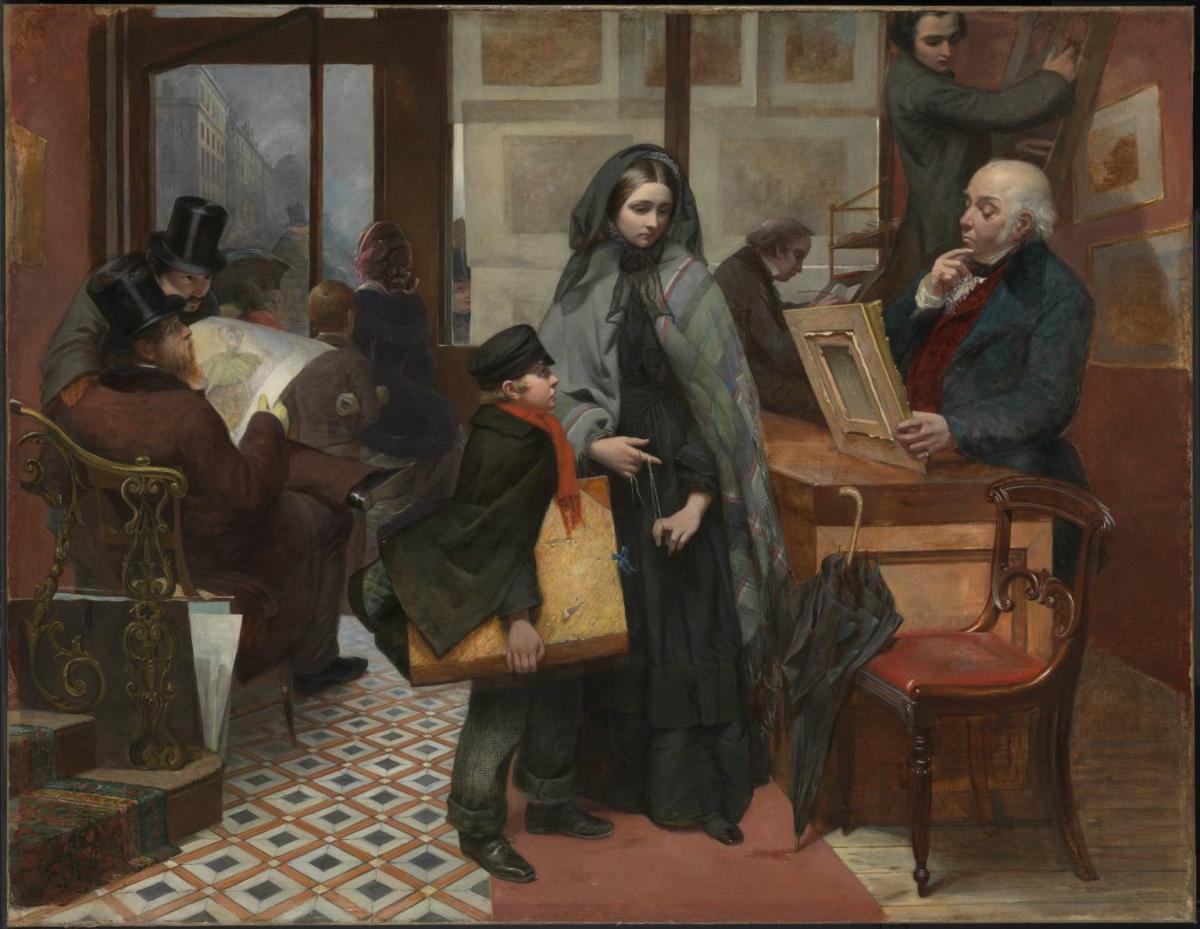
In the painting, the young woman is wearing all black, suggesting a recent loss. "She is not wearing a mourning ring though, so she and her brother are probably orphans" (Pollitt, Ben). The young boy next to her is holding a portfolio. The young woman is trying to sell her paintings. Osborn even illustrates her anxiety by how she is nervously messing with the string in her hands. If the young woman is unable to sell her paintings, she and her little brother will be forced back to the streets. We could look at this and see just another painting, but there's such a deep narrative behind it - significant to 19th century London and as depicted in Dickens' Bleak House. Like Jo and Nemo, nameless and friendless, who associate more with the oxen on the streets than those of their own figure, fending for themselves in the mud. Jo, knowing nothing but what he's learned from his own experiences. Nameless and friendless. "For some [the Industrial Revolution] was an enormously prosperous time, for the working class and for those on the margins of society, however, living conditions had never been worse and without any form of welfare a change in fortune could easily see you ending up not just nameless and friendless, but homeless and penniless" (Pollitt, Ben).
Work Cited
Pollitt, Ben. “Emily Mary Osborn, Nameless and Friendless.” Smarthistory, 9 Aug. 2015, smarthistory.org/emily-mary-osborn-nameless-and-friendless/.
This work is in the public doman (smarthistory.org/emily-mary-osborn-nameless-and-friendless/) in the United States, because it was registered with the U.S. Copyright Office before January 1, 1925.