
Character Commentary:
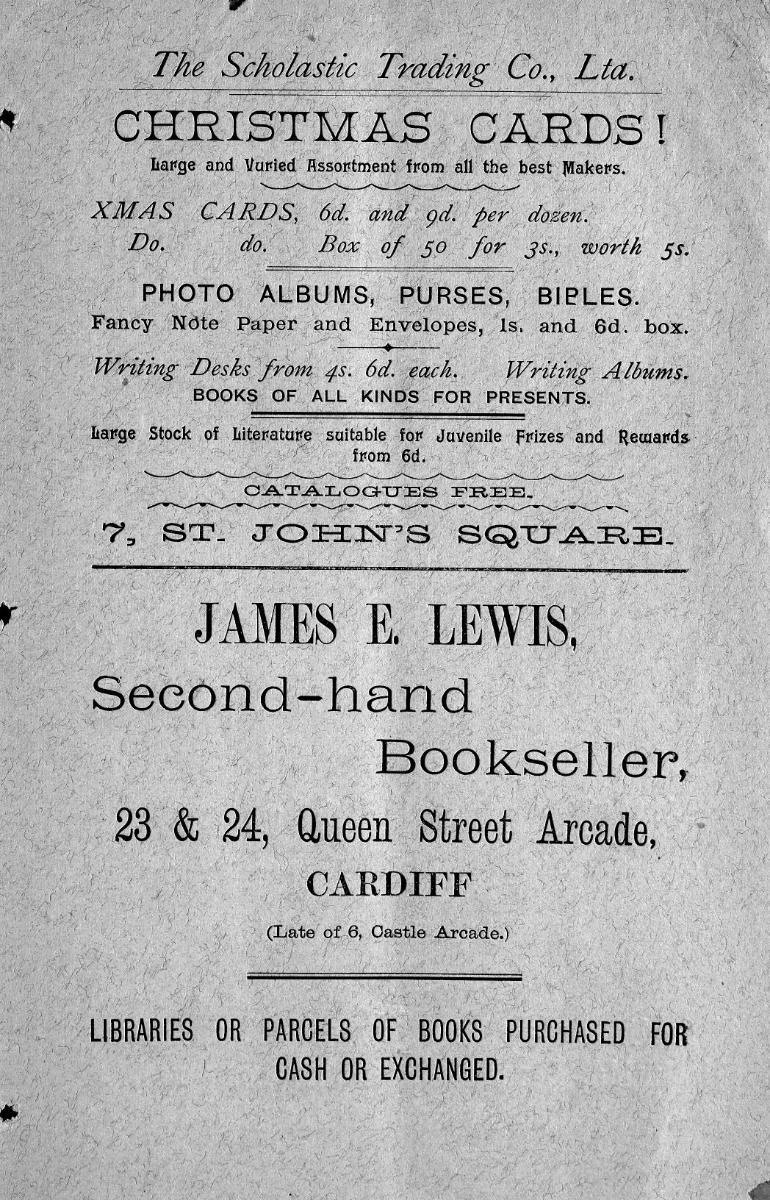
I was walking down the street today after Sunday morning mass. I stopped by the newsstand and began to browse through the papers to see if there our advertisment for 'The Ladies' Pictorial and Fine Art Company' since business has been rather slow recently. We also have been putting displays in the windows to hopefully attract customers. Anyways, an issue of the Baptist Chronicle caught my eye. I enjoy when the new issues come out each month. Upon seeing these two advertisemenst for Scholastic Trading Co. and James E. Lewis in the paper, my attention was completely captivated. I really would have loved to stop by both Scholastic Trading Co. the bookseller mentioned above, and maybe even get myself one of those free catalogues, but they are based in Cardiff and not London; what a disappointment! Hopefully the rest of the news in the paper makes it worthwhile. After looking at the notice for the bookseller, I'm feeling a bit inspired to go find some new good reads today. Although my sisters and my photography business has sustained our livelihood, my greatest dream was always to write. My love for books, literature, writing has been one of my most defining traits all my life. I would love some of the "Fancy Note Paper" listed in the advertisement, but it us a luxury I probably should not indulge in. I find it a bit funny that one of the items listed in being sold are photo albums. It seems like I am just the perfect target audience for an ad like this! There are so many photos I would want to put in that I would need far too many albums, so I will have to refrain from purchasing. Both of these promotions are so tempting, perhaps it is a good think Cardiff is a good distance away!
Editorial:
The two advertisments above were published in the Baptist Chronicle, an English newspaper that "published [both] religious articles and denominational news". (Library of Wales). Monthy issues of this paper were produced. Scholastic, the larger corporation of the two mentioned, likely benefitted on a larger scare off of this advertisting just because of the nature of the company; in the 1880's, consumer society began to form, along with a strong manifestation of supply and demand (Church). It is logical that a company that produces multiple differerent items, like Scholastic, to cater to the demands of more people. Using mass communication and advertising via even 'smaller' newspapers like the Baptist chronicle, Scholastic succeeded in promoting their businesa, helping them to mass-manufacture products. On the other hand, a second hand book seller such as James E. Lewis does not have to manufacture any product. But, this advertisment benefits him on a smaller scale because he will begin to accumulate customers, and also people trying to sell their books to him. Advertising, according to Nicolas Kaldor's theory, is implied to lower consumers' demand elasticity and desensitize them to changes in price (Church). This means businesses can sell more goods at higher prices. A small business such as the Lorimer's would definitely have benefitted from this, along with the window displays that Gertrude mentions. With the abundant competition, everchanging technology, and potential financial difficulties that the Lorimers faced, the more they could have promoted their business, it was more likely that their business could have not only survived, but thrived in such a harsh economy.
Works Cited:
Church, Roy. “Advertising Consumer Goods in Nineteenth-Century Britain: Reinterpretations.” The Economic History Review, vol. 53, no. 4, 2000, pp. 621–45. JSTOR, http://www.jstor.org/stable/2598598. Accessed 12 Oct. 2023.
Davies, Joseph Morlais, editor. “The Scholastic Trading Co., LTA, James E. Lewis.” The Baptist Chronicle [Cardiff], Vol. III No. 9 ed., February 1895. The National Library of Wales. Accessed 10 October 2023.