
Character Commentary:
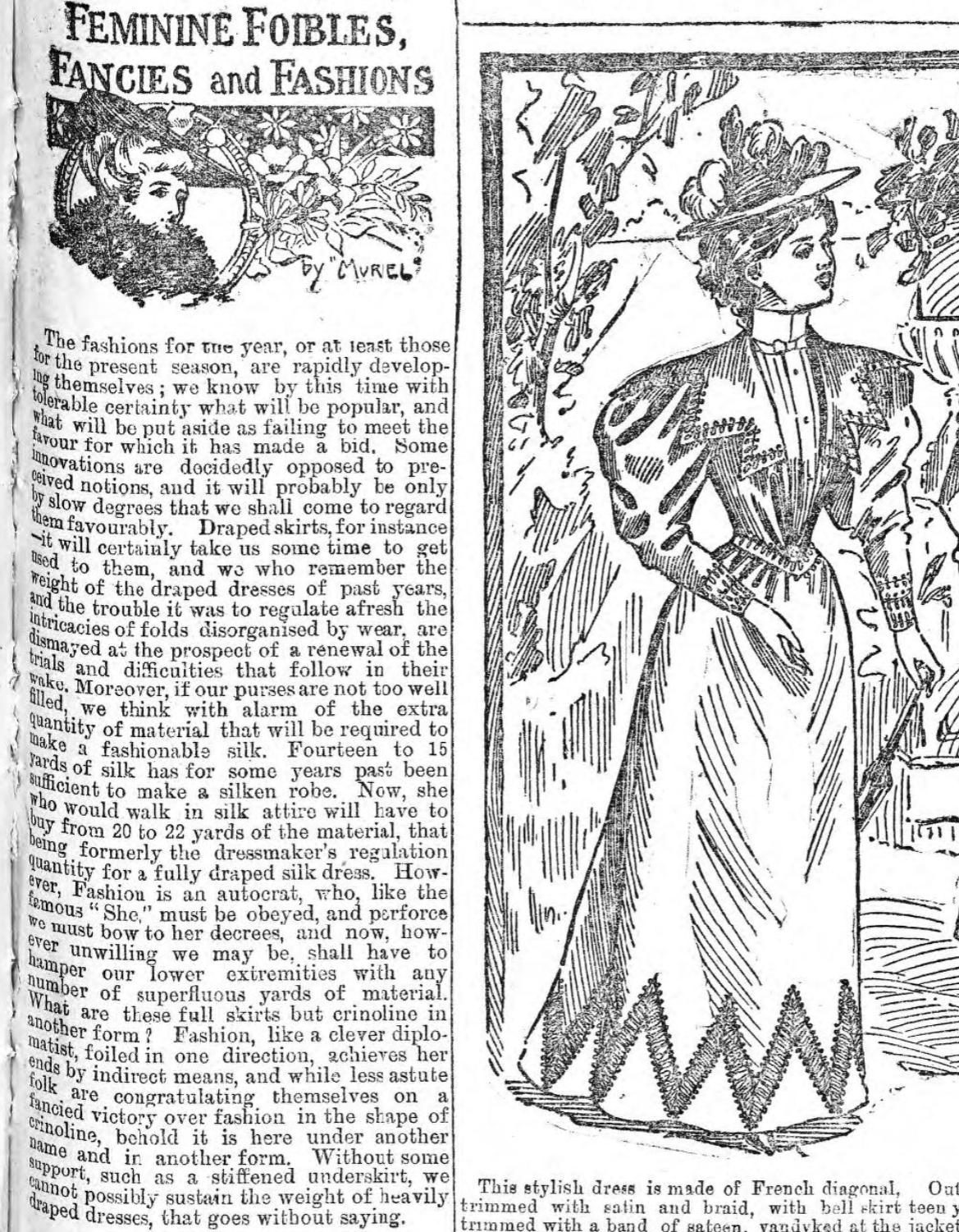
I came upon the most interesting entry today in the weekly paper which told of the new fashions of the time. Similar to all new fashion, it started in Paris and has moved its way to Britain. I have heard rumblings around town of women disliking these new styles of skirts and dresses; however, I believe that they are quite extravagant. I always say that whatever will make women look most worthy and elegant to their husbands is something I want to have in my wardrobe. My husband, of course, agrees and has been so generous to purchase everything necessary to make me the best dressed of the season. Isn’t he just delightful! I would not be able to obtain these articles of clothing if it were not for him. He knows that if I look presentable next to him, he will profit in the workplace and in society as a whole. His superiors will come to the realization that we are of the highest caliber and will then reward him with the recognition and benefits he so deserves. I would do anything to help my husband because he has worked so unexplainably hard to get our family to where we are in the present. I could not be more grateful to my husband for giving me the most up to date and elegant clothing each and every season. I am delighted that the newest season has commenced so that I can display my dresses and skirts to the town.
Editorial Commentary:
Caroline Pratt writes in her journal about the newfound trends of fashion in Europe in 1894 and goes on to explain how one presents themself is the key to success in the Victorian era. While describing the newspaper entry regarding fashion that she read, Pratt furthers her opinions by stating that “if [she looks] presentable next to [her] husband, he will profit in the workplace and in society as a whole” (Pratt). This seems to be a popular belief in this time period due to the traditional views that the woman’s main task is to care for her husband. In “The Exquisite Slave: The Role of Clothes in the Making of the Victorian Woman,” Helene E. Roberts discusses how “clothes were not mere aesthetic ornament, but emblems of society’s hierarchy” (Roberts 554). Furthermore, if a woman was dressed in the newest fashions in this century it would be advantageous to her husband in societal rankings. If a man cannot or does not care to provide his family, particularly his wife, with the current commodities then he will not be respected by society. Pratt repeatedly praises and gives thanks to her husband in her journal for buying her these highly desired clothes which depicts the relationship between men and women at this time. While men are supposed to provide for women, women are supposed to act as though their family is worthy of the position in the community of which they hope to have. Dressing fashionably is the one of the main ways that women could show off their husbands’ wealth and success.
Works Cited
“Feminine Foibles, Fancies and Fashions.” The Weekly Mail, 21 Apr. 1894, p. 7.
Roberts, Helene E. “The Exquisite Slave: The Role of Clothes in the Making of the Victorian Woman.” Journal of Women in Culture and Society, vol. 2, no. 3, 1977, p. 554.