

Character Commentary:
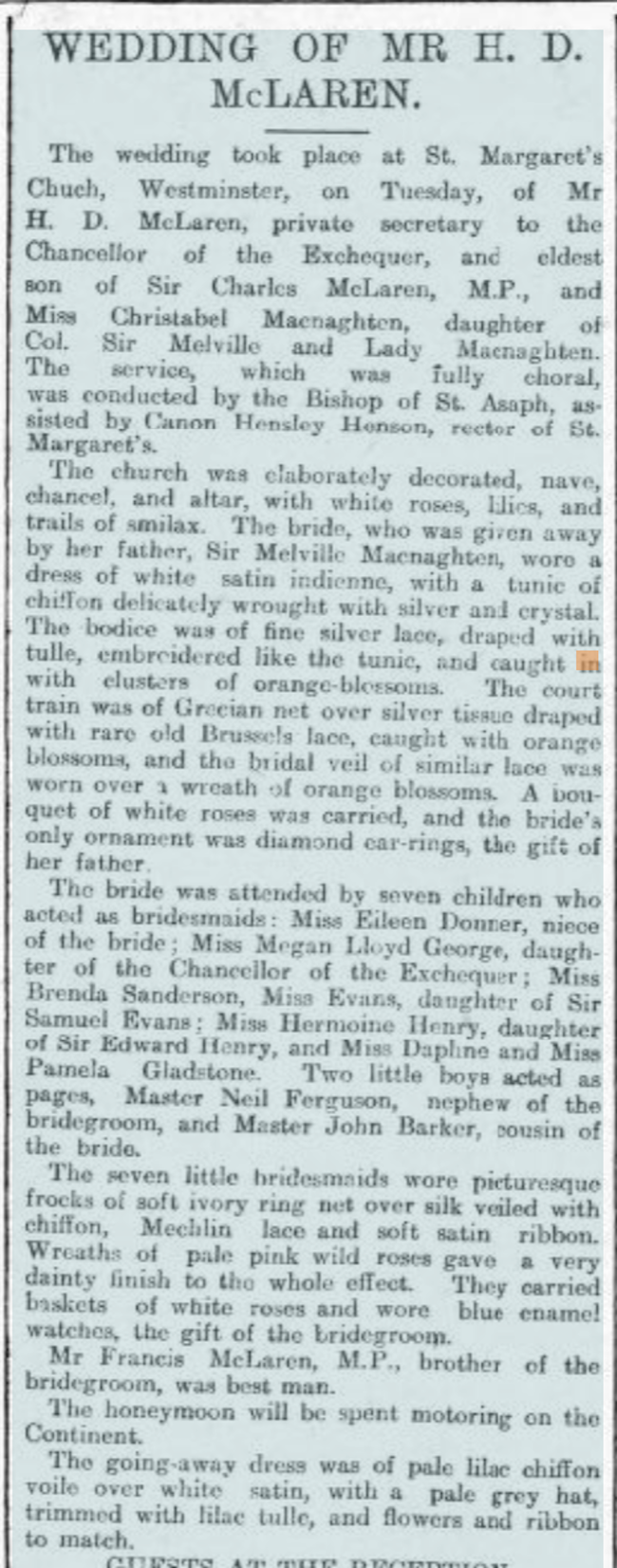
During my afternoon tea on this gloomy day of July 21, 1910, I decided to explore The Welsh Coast Pioneer newspaper. The only section I am interested in is the marital and engagement announcements. I am pleasantly surprised to stumble upon the events of Mr. H. D. McLaren and Miss Christabel Macnaghten’s wedding which took place at St. Margaret’s Church in Westminster, London. I routinely check the wedding and engagement section of multiple papers around London to ensure that society is upholding its standards. If there ceases to be any marital relationships, the world as we know it will eventually crumble in every aspect. It took me many years and tiresome discussions with my nieces, the Lorimers, to convince them of this very truth. I hope that, in good time, all women will see the truth as my nieces eventually did. Although all of my nieces are married, I continue to stay informed and even collect any readings I can find on marriage and how unmarried women should behave in order to secure a husband. It is troublesome to see how women in present times are beginning to see marriage as an “option” and desiring the same rights that men have in society. The sole duty of women is to take care of the household and make life simpler for her husband. I am genuinely outraged about the way women are acting, and I believe that if more of them were married then they would realize their reason for existence.
Editorial Commentary:
Caroline Pratt, a woman who lived in Britain in the Victorian era, expresses herself clearly through her judgments of women who do not marry and go against societal norms. Pratt discusses her findings regarding a newspaper from 1910 that describes a wedding between a man and woman in London. She highlights how women are made to “care [for] the household and make life simpler for her husband” (Pratt). These opinions were not uncommon in this time period as stated in Kathryn Hughes article, “Gender roles in the 19th century.” Hughes’s research explains that “women were considered physically weaker yet morally superior to men, which meant that they were best suited to the domestic sphere” (Hughes). In this era, women were expected to stay in the home while the men earned a living; however, that meant women had no equality and practically no rights in society. As illustrated in Sudesh Vaid’s article, “Ideologies on Women in Nineteenth Century Britain, 1850s-70s,” women were responsible for providing “physical comfort, nurturance, and the moral character of the family and home” (Vaid). These responsibilities carried on throughout the late nineteenth century, and according to Caroline Pratt, this is exactly what gender roles should entail, and no roles should be reversed. Women in the Victorian era were just beginning to oppose this idea of gender, but most women still conformed to the role they had lived their entire lives. Pratt believes that marriage is the foundation for society to succeed, and she is alarmed that some women are remaining unmarried. Gender and marriage in this period were issues in the community and many people had the same thoughts as Caroline Pratt.
Works Cited
Hughes, Kathryn. “Gender roles in the 19th century.” British Library, www.bl.uk/romantics-and-victorians/articles/gender-roles-in-the-19th-century. Accessed 1 Oct. 2023.
Vaid, Sudesh. “Ideologies on Women in Nineteenth Century Britain, 1850s-70s.” Economic and Political Weekly, vol. 20, no. 43, 26 Oct. 1985, pp. WS63-WS67.
“Wedding of Mr. H.D. McLaren.” The Welsh Coast Pioneer, 21 July 1910, p. 6.