
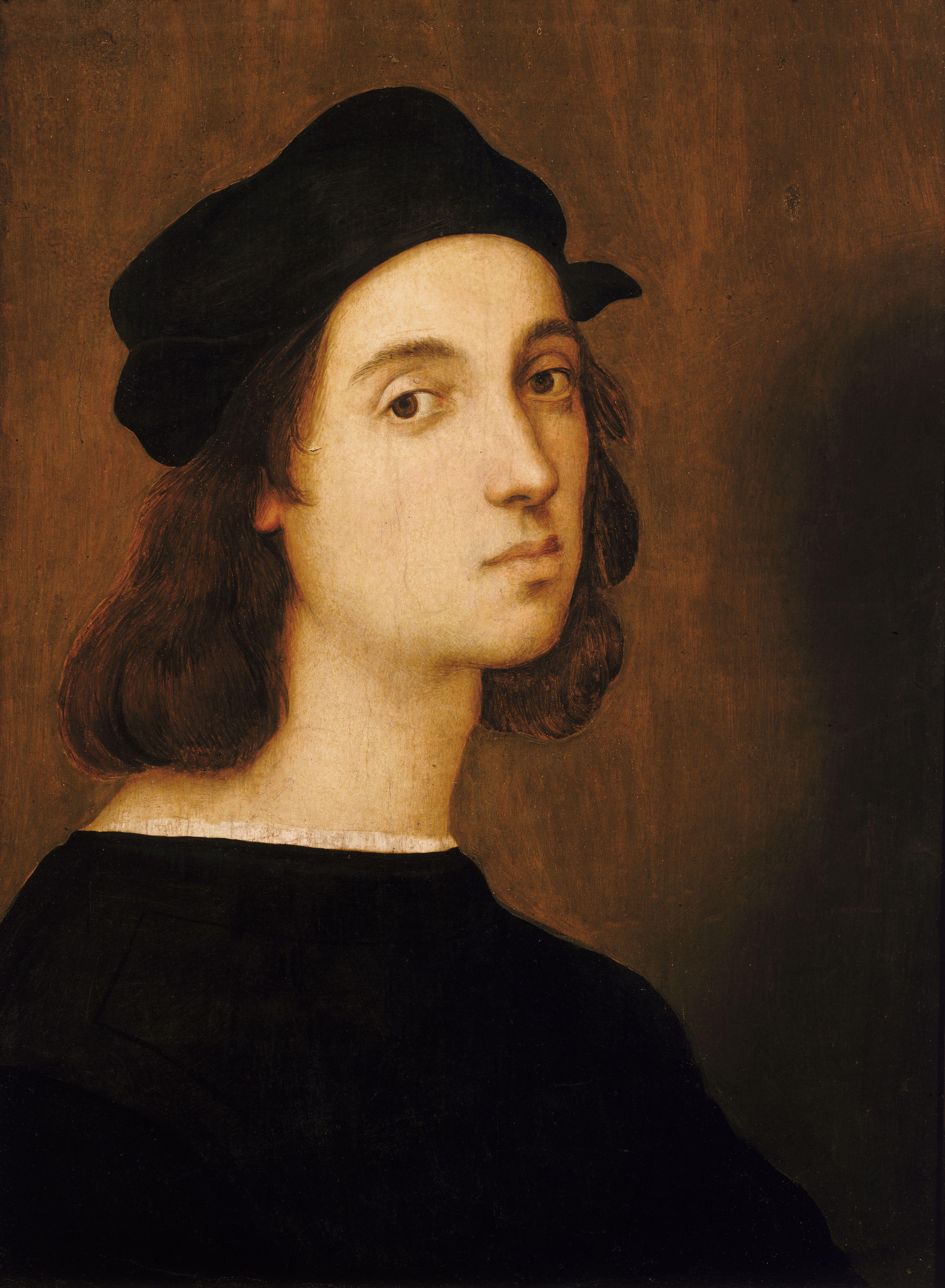
This is a portrait of the Italian artist Raphael. He was born in Urbino, Italy in 1483 and died in Urbino Italy in 1520. He is considered to be master artist from the High Renaissance, but he is also the namesake for the late 19th century group called The Pre-Raphaelite Brotherhood. They were artists , particularly painters and some writers that were particularly interested in public opinion. Raphael was considered one of the greatest artist of his time and was known for painting portraits with ideal beauty . He made art that portrayed what would have been a "perfect" woman during those times. The neoplatonic idea of humans took hold of all art forms and continued until the Pre-Raphaelite Brotherhood arose. This group was 400+ years after Raphael, but they wanted to make art return back to the way it was before Raphael came to fame hence calling themselves Pre-Raphaelites. They wanted to bring the emphasis back to what acctually was happening around them. They put a lot of emphasis on nature and challenged social norms, both the painters and the writers. Dante Gabriel Rossetti was a well known member of the group and the brother to Christina Rossetti who is the author of the Goblin Market . Although Christina Rosseti is not directly credited as part of the group and even critiqued them at times, she stood with them in their cause by her actions. Pre-Raphaelite poet-painter Dante Gabriel Rosseti illustrated Christina Rosseti's poem Goblin Market.
Timeline
Table of Events
| Date | Event | Created by |
|---|---|---|
| circa. 1848 to circa. 1852 | Pre-Raphaelitism : ArtThis is Ophelia by Pre-Raphaelite member, Sir John Everett Millias. It is a prime example of Pre-Raphaelite art. There is no real adherence to the aesthetics of the woman portrayed. She is not portrayed as perfect, but he has depicted her just before her watery death as is written in Shakespear's Hamlet. This point is particularly important as my chronlogy is pertinent to understanding Pre-Raphaelitism and Christina Rosseti's Goblin Market . Women were often portrayed as being perfect or angelic during the Victorian era. Prime examples of this depiction would be Raphael's famous Madonnas in the Vatican. Artist towards the end of the 19th century took a more realistic approach to art instead. Pre-Raphaelites focused on the simple aspects of life and sincerity. Nature is also a large part of their artistic movement. Their other cardinal focus was on moral seriousness. Additional founders of this group are William Holman Hunt and Dante Gabriel Rosseti , Pre-Raphaelite painter-poet and brother to Christina Rosseti, who is responsible for the illustrations in Christina Rosseti's Goblin Market. |
Breanna McGhee |
| circa. 1849 | Pre-Raphaelitism enters the Royal AcademyAt its time of inception the PRB was a secret society. All three of the founders of Pre-Raphaelite Brotherhood begin showing artwork at the Royal Academy with all of their pieces signed PRB. Many of them had marvelous scenes of nature versus genre scenes like were customary during the time period. This is significant because they were showcasing their artwork and gaining traction as a group. Not just anyone could have their work exhibited at a gallery. Their work was being showcased more and beginning to influence other members of society and groups. Being to influence other creators during this era. Image of the Royal Academy is from Wikipedia |
Breanna McGhee |
| circa. 1849 to circa. 1850 | Pre-Raphaelitism : The GermIn 1848 the Pre-Raphaelite Brotherhood had formed and focused on submitting and exhibiting artwork to the Royal Academy. The next year, 1849, they moved into literature. They began a magazine or small brochure called The Germ. It was a book of poetry and accompanying imagery created by PRB members. The publication was not a long time project as it faded out just as quickly as it had come to fruition. It caught the attention of Charles DIckens who hated the publication and also John Ruskin knew of it. He was why PRB took their stance on the study of nature, but he separated all ties with the group for alleged personal reason and The Germ floated into obscurity. That was okay though because it had already gotten their foot into the door. Soon all of the PRB founding three would be illustrating literary works. Most important for this point is Dante Gabriel Rossetti, poet-painter and brother to poet Christina Rossetti who penned the poem, The Goblin Market of which has PRB influenced illustrations that were done by Dante Rossetti. Image courtesy of Wikipedia /Wikimedia Commons Illustration by Holman Hunt, published 1850 in The Germ |
Breanna McGhee |
| 1853 | PRB DisbandsAfter five short years as a secret society, PRB disbands as a group. Their ideals have already caught the attention of other mid-19th century creators though and their ideals are here to stay and are recorded in history for years to come. This is significant because although their secret society no longer exist they are now all well known artist and become illustrators for other poets and painters all while creating their own PRB influenced works too. |
Breanna McGhee |
| 1862 | Goblin Market by Christina RossetiGoblin Market was officially published in 1862. This was one of many poems published as a collection and was a story of two sisters, Laura and Lizzie. The older of the two, Lizzie, regularly reminded her sister not to partake of the goblin's fruits. This is significant because you have something vile being set alongside something that is supposed to be pure. Christina Rosseti was a highly religious woman living in the VIctorian era, but she has written a tale that is not. Merriam- Webster defines a goblin as " an ugly or grotesque sprite that is usually mischievous and sometimes evil and malicious". A Victorian era woman is supposed to be chaste and moral so I feel that Rosseti is showcasing that fin de siecle or the close of an era. Christina Rosetti continues on in this tale with detailing how Laura trades her hair or a piece of herself for the forbidden fruit. It almost reads as a parallel to the prostitution that Christina Rosetti is witnessing as a volunteer at St. Mary Magdalene as she did that from 1959-1970. As Laura has the first taste of fruit she is immediately addicted. Laura spends the majority of the poem begging and yearning for the taste of the goblin fruits. She begs the goblins for me and they refuse. The only way that Laura is saved from her situation is by her sister. Lizzie goes and implores the goblins for Laura. Lizzie is courageous, morally sound and is the hero in this story. Lizzie steps in when there is no man to save Laura from herself. This poem reads with sexual undertones, highlights temptation, explores femininty, and highlights sisterhood. Cover found at: https://editions.covecollective.org/content/editions-and-renditions-christina-rossettis-goblin-market |
Breanna McGhee |
| circa. 1862 | Pre-Raphaelite Concepts in Goblin MarketPre- Raphealite artist/writers and those influenced by them often made reference to religion. With that in mind and Christina Rosseti's devoout worship one may read this poem as an interpretation of the prodigal son. Laura is the mislead son and Lizzie is the one who is always faithful. Although Rosetti claimed this story is for children, it has an alarming amount of erotic imagery. The goblin fruits are the temptation that Laura succumbs to so its like like losing her virginity. Now that she has had a taste she cannot stop, but Lizzie comes along and sacrifices to save Laura just like Jesus came along and made the ultimate sacrifice to save all of mankind. Lizzie is a savior like Jesus in this story. Christina Rosseti has transformed the fallen woman and helped her to be redeemed and released from being an eternally wayward soul. After Lizzie saves Laura they both go on to be wives and have kids and have learned from their experience with the goblin market. |
Breanna McGhee |