
The Little Lame Prince and His Traveling Cloak - a Parable for Old and Young (1900). Alamy, https://www.alamy.com/stock-photo-the-little-lame-prince-and-his-traveli....
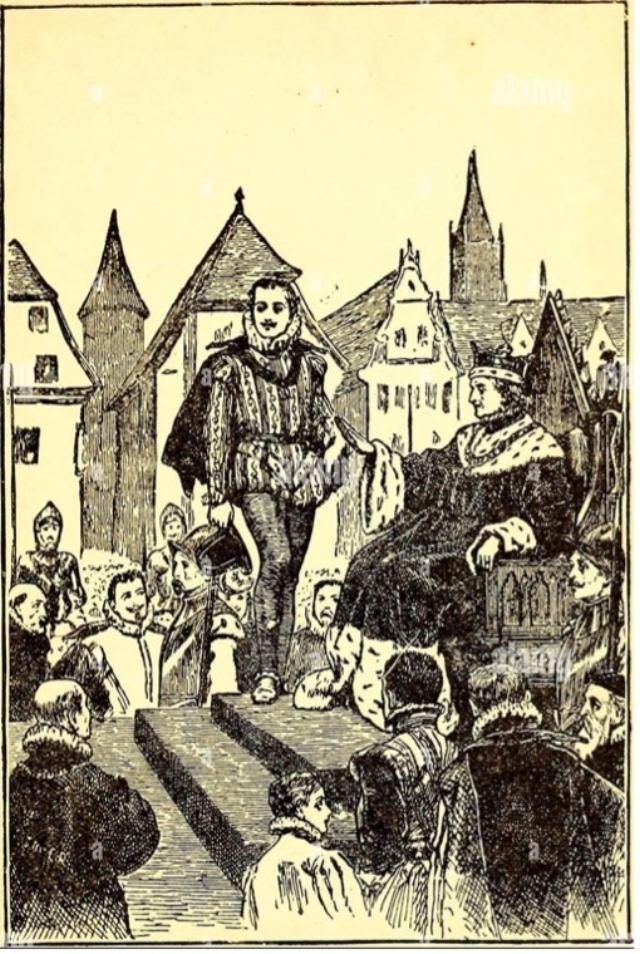
The unknown illustrator shows Prince Dolor as the fully maturated ruler of Noman’s Land that corresponds with the story’s conclusion. Diana Maria Mulock’s The Little Lame Prince, uses the juxtaposition of play and work to drive Prince Dolor’s growth from boyhood to manhood. A significant aspect of his maturation comes from his atypical experience of Victorian masculinity as a result of his physical disability. The Victorian man is a working man, with a life outside of the domestic sphere. Prince Dolor does not get this outside life in a conventional manner and his opportunity to become a working man is delayed due to the interaction between his social environment and disability. Keywords for Disability Studies states that “In many cultures, disability has been characterized as the inability to do productive labor” (Rose 187), this is especially true to the Victorian Era as an individual’s value rests on his ability to work. As Prince Dolor leaves the domestic space, he becomes more concerned with the comparison between play and work in order to understand and move towards masculinity. He reminds himself that, “He [is] not a baby now, to do nothing but play – big boys do not always play. Nor men neither – they work” (Chapter VII), and that “men work, and it must be so grand to be a man – a prince too; and I fancy princes work harder than anybody – except kings” (Chapter VII) in order to grasp the concept of manhood. While Prince Dolor does cement his masculinity by moving from playing Prince to working King, Philipose argues that as King he does not follow the traditional roles due to his disability. Drawing on the example that he never walked in processions, Philipose states that “he initiates a ‘feminine’ reign and lives according to the tenets of the religion of domesticity” (137). A religion that his extended time of isolation, toys, and play nurtured.
Works Cited
Craik, Dinah Maria Mulock. The Little Lame Prince and His Travelling Cloak. 1875.
Philipose, L. (1996). The Politics of the Hearth in Victorian Children’s Fantasy: Dinah Mulock Craik’s The Little Lame Prince. Children’s Literature Association Quarterly, 21(3), 133–139. https://doi-org.ledproxy2.uwindsor.ca/10.1353/chq.0.1268
Rose, Sarah F. “Work.” Keywords for Disability Studies, edited by Rachel Adams et al., NYU
Press, 2015, pp. 187–90. JSTOR, http://www.jstor.org/stable/j.ctt15nmhws.65.