
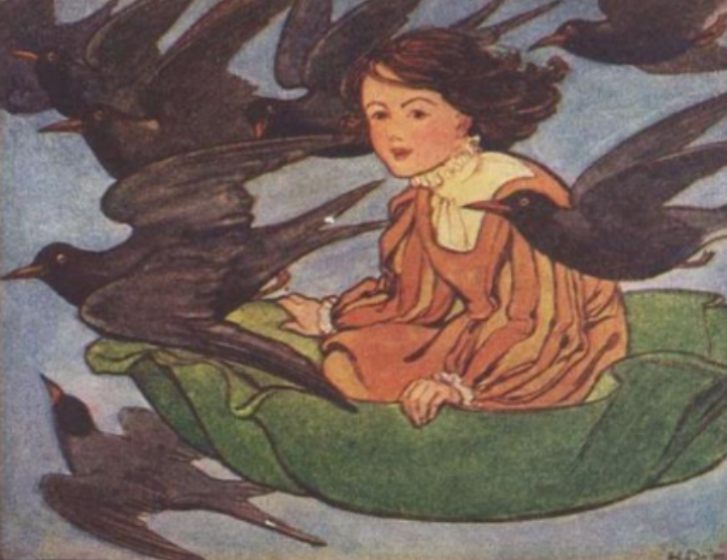

The image itself is of the prince riding on his cloak, one of his mobility devices to help him move around, and being surrounded by black birds.
In the story, birds are mentioned on several different occasions, and are often (and rather obviously) tied to flight. One quote about them from the story is when Prince Dolor says “Still it would be very nice to move about quickly—perhaps to fly, like a bird, like that string of birds I saw the other day skimming across the sky, one after the other.” (Craik Chapter IV). While there doesn’t seem to be many articles, if any, on the actual symbolism of magpies during the period, there does seem to be a kind of duality associated with the bird based on various works.
One notable appearance of the magpie is in the nursery rhyme in which the number of them in a group could either mean something good/prosperous, or the complete opposite. The numbers 1, 7, 10, and 13 in particular are the numbers in which the number of magpies does not correlate to something positive. The number 1, as an example, is described as being “One for sorrow,” (Youn 1). While magpies are thought to be untrustworthy, the idea of a singular bird representing sorrow ties to the story of Prince Dolor.
When Prince Dolor first meets Mag, he mentions “And I don't understand it—not one bit. There is nobody to tell me about it. I wish I had somebody to speak to.” (Craik Chapter VII) He feels lonely as he observes his hometown from a distance, and wishes he could know more about it. And it’s then that Mag shows up and offers to tell him about it. She would later try to part ways with him once they’ve left town, once more leaving him on his own (Craik Chapter 8).
When it comes to disability, birds in general act as a contrast to the Prince, for they are naturally able to fly and are fully mobile even on land. However, the Prince must use his cloak (something he likely wouldn’t have had, had he been able-bodied) to get around as easily and as smoothly as possible. The wings of a bird give them a natural aerial advantage and are considered a symbol of freedom, whereas the prince had been confined to a tower for much of his early life, and his movement is heavily limited without the use of prosthetics.
Image Citation:
Craik, Dinah, author. Dunlap, Hope, illustrator. “They looked at him ... as if wondering to meet in mid-air such an extraordinary sort of bird.” The Lame Little Prince and his Travelling Cloak. Edition of 1909, Rand-McNally & Company. Project Gutenberg. http://www.gutenberg.org/files/45975/45975-h/45975-h.htm
Source:
Youn, Monica. “13 Ways of Looking at a Magpie.” Sewanee Review, vol. 131, no. 1, 2023, pp. 1-6, https://doi.org/10.1353/sew.2023.0000. Accessed April 8, 2025.
Text to consider:
Barlow, Jane. “One for Sorrow (A Magpie Scarecrow).” Between Doubting and Daring, 1916, pp. 22-23. Oxford Press. Accessed on ProQuest, April 8, 2025