
At the age of twenty years old, Queen Victoria married her cousin, Prince Albert of Saxe-Coburg and Gotha, on February 10th, 1840. Despite the political pressure placed on Queen Victoria to marry in order to satisfy the era’s social need for a solid male presence in a young woman’s life (Rohrs 5), the marriage between Victoria and Albert was a blissful one. Queen Victoria, unlike most women of the time, had the luxury of choosing her spouse. Queen Victoria’s personal selection of her spouse appeared to have worked in her favor since the marriage between Queen Victoria and Prince Albert lasted 21 years, terminated only by the Prince’s death from typhoid fever in 1861, and produced nine children. After the passing of her husband, Queen Victoria went into a deep period of depression and mourning that would endure the last forty years of her life (Staniland 160).
In recounting Queen Victoria’s life, many historians note Victoria’s marriage to Prince Albert as the happiest time of her life. The love between Victoria and Albert was so strong that she took great delight in watching him shave, and afterwards, he assisted her in putting on her stockings everyday (Staniland 122). Even though Victoria was the Queen of England, she made herself frequently available to accompany her husband on many dates. The couple would often be sited going to the theater and horseback riding together, which was a novelty for individuals of their power and statuses.
Even in stressful times, the couple took great comfort and solace in one another. Many periods of stress the couple had to endure were related to Victoria’s pregnancies. The Queen gave birth to nine children in a period of ten years, and many of her pregnancies were excruciatingly painful. During uncomfortable pregnancies, Prince Albert would be of great comfort to the Queen by singing or reading to Victoria while she took time to rest on the couch (Kay 130).
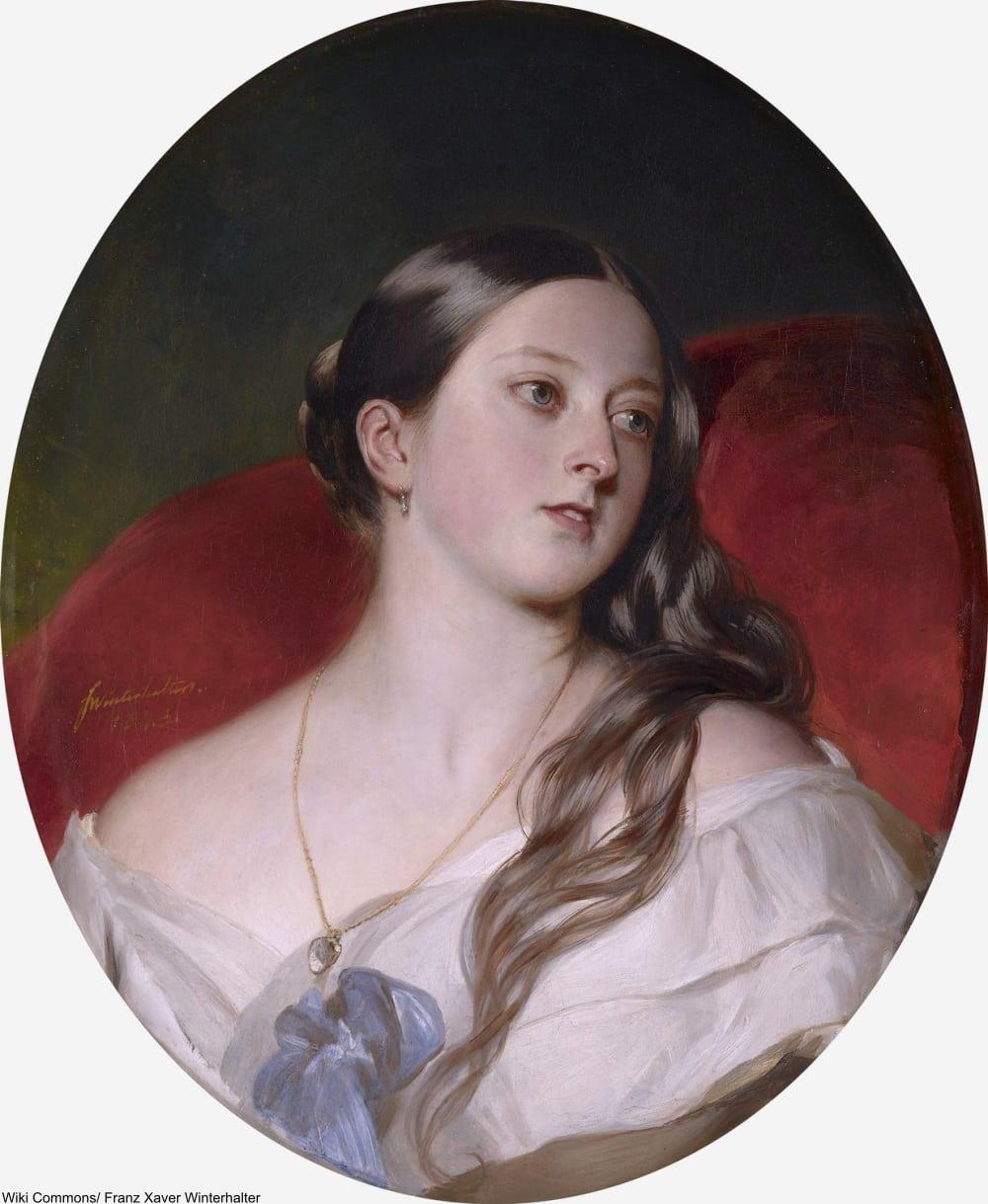
As a present to her loving husband for his 24th birthday, Queen Victoria commissioned her trusted, official court portrait artist, Franz Xaver Winterhalter, to help her create a personalized gift. She had Winterhalter create a portrait entitled, Queen Victoria, 1843 . However, public discovery of the portrait over a hundred years after its composition would cause it to be deemed “The Secret Portrait.” The portrait depicts Queen Victoria appearing sensual and embracing her feminine sexuality, which was against all accepted societal norms and expectations of any woman, especially a woman of her prestige.
The portrait showcases Queen Victoria lying her head on a red object with her hair tousled while in a white gown, with the expression of desire and innocence dominating her face. This image of Queen Victoria is intriguing because it showcases the monarch in a light that was hidden from public view and perception. Every intricate detail of the image would be upsetting to the English public because the painting as a whole is full of sexuality.
Victoria chose to wear a white, deep-plunging gown, with small earrings and a modest locket around her neck. The gown is reminiscent of a nightgown worn by women to bed after they have taken off their formal wear of the day. The Queen’s full body is not shown in the portrait, but the top of her dress showcases her bosom in a very flattering manner by its revealing and tight nature, making it an unacceptable dress to be worn in public. This selection seems to insinuate Queen Victoria is waiting to execute a sexual act or desire she has with her husband. The idea of Queen Victoria being sexually interested in her husband stands in contrast to the notion women of the era did not possess innate sexual desires. The simple and minimal jewelry also add to the idea that Victoria was portrayed near the end of the day because she does not have to appear official in any capacity and is allowed to be vulnerably transparent.
Queen Victoria’s hair also adds to the sensual theme of the portrait. Her hair is toulsed on one side from falling out of a loosely styled bun. Victorian women were not seen in public with their hair down, as wearing this style was seen as a symbol of vulgar sexuality which was often attributed to prostitutes of the time. High class women wore their hair in neat updos in order to showcase their socially accepted lifestyle. Victoria’s hair being partly down demonstrates her fearlessness to show the sexual component of her personality. She did not allow social norms to dictate her expression of love to her husband.
Winterhalter illustrates a rather complex expression on Victoria’s face. Victoria has a look of desire combined with natural innocence on her face. The artist shows the intent, slightly focused nature of Victoria’s eyes, which makes it seem as if the Queen is turned to look at someone or actively waiting on something. The slight opening of Queen Victoria’s mouth illustrates the relaxed state she has, since she makes no attempt to completely close it. Victoria’s body language and facial expression is one of a woman that is waiting on something but is completely relaxed in the process. Given the surrounding context of the Queen’s clothes, lighting, and location, one can assume that she is either looking at her husband desirably or waiting on him to perform a physically desirable act. However, Winterhalter juxtaposes this stream of sexuality with the natural innocence of Victoria’s face. He makes sure to highlight the whiteness of her complexion, which symbolizes purity. Additionally, he discreetly emphasizes the rosiness of her cheeky, which can be associated with youth, bashfulness, and innocence.
In the portrait, Winterhalter uses a dark background, which serves multiple purposes. It gives the impression that Victoria is in a private vicinity, since there is not much light from other people or objects to be found. The most likely setting of the painting is the bedroom of the Queen and Prince Albert. This adds to the overt sexuality of the painting as a whole because the viewer is able to visualize Victoria appearing this way while they are in the privacy of their own room. Winterhalter also contrasts the bright red object Victoria is resting on, presumably a pillow, with the softness of Victoria’s features. The red pillow is another nod to the sexual theme of the portrait since it was a color closely associated with sex, which made it unbecoming to be worn on clothes in public. The placement of Victoria in the center of the portrait in front of the darkness allows for the Queen’s beauty to be on full display. One can see the soft touch with which Winterhalter drew Victoria’s shouler, face, and hair. The backdrop reminds the viewer Queen Victoria is the object of ultimate desire in the portrait by using her image to take up most of the picture’s space.
Winterhalter successfully executed Victoria’s wish to create a portrait that portrayed her as the beautiful, sensual center of Prince Albert’s desire. It is a good thing that the portrait was not discovered until long after Queen Victoria’s death, given the royal court believed marriage would contain her majesty’s natural sexuality (Rohrs 3). How baffled would they have been to discover that their plot was not only unsuccessful, but heightened the source of their concern!
Works Cited
Rohrs, E. M. (2007). Queen Victoria: The Mother of Modem Celebrity (Unpublished doctoral dissertation). [CJ1] Ball State University.
Staniland, Kay. In Royal Fashion : the Clothes of Princess Charlotte of Wales & Queen Victoria, 1796-1901 . London: Museum of London, 1997. Print.