
Overview:
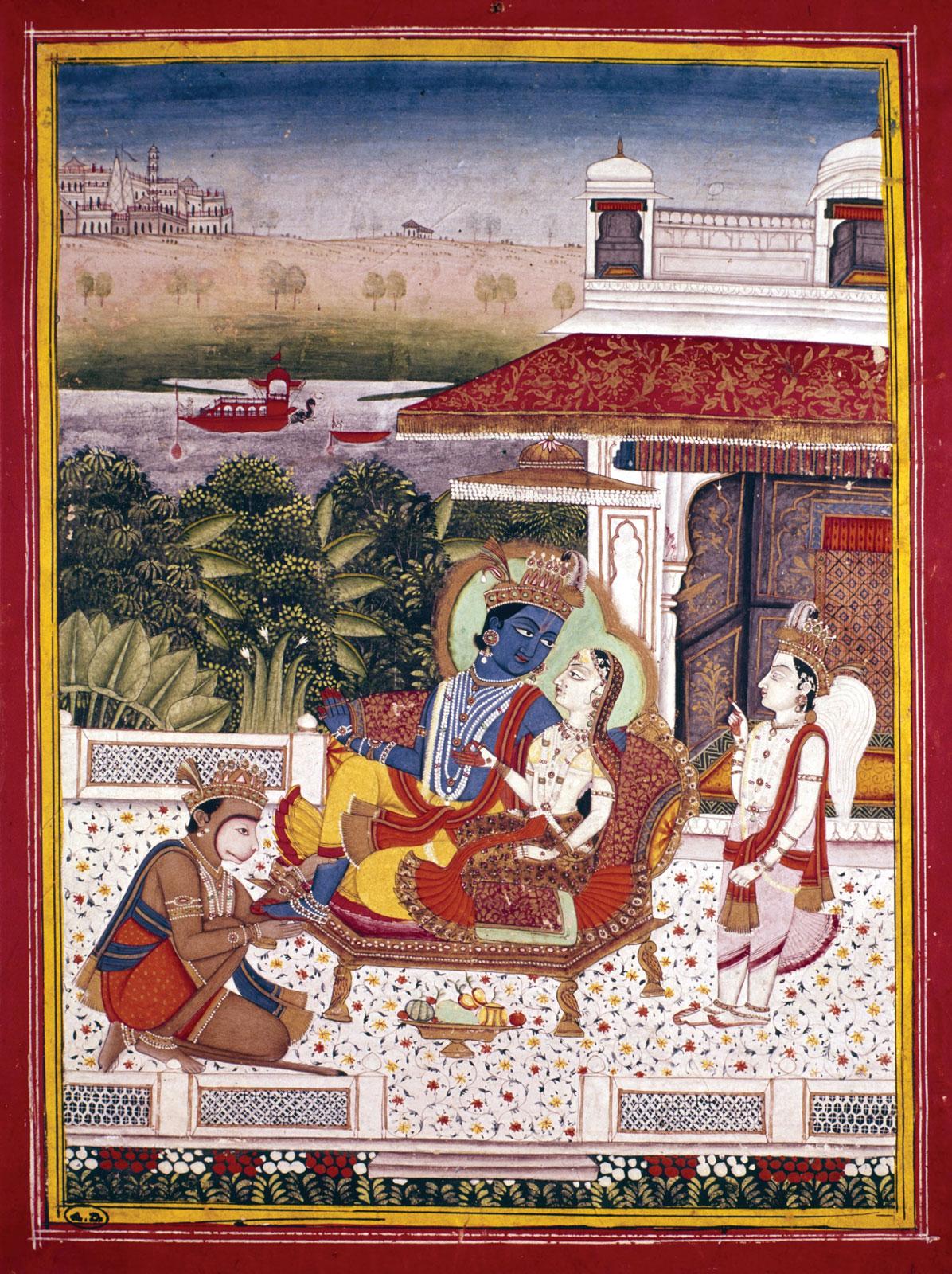
The Ramayana is an epic poem written by the Hindu sage, Valmiki, in Sanskirt around 300 BCE. The poem consists of about 24,000 couplets and is divided into seven books. It is mainly about the journey of the Hindu god, Rama. Rama is known for being the Hindu god of chivalry, virtue, and reason.
Plot Summary:
As a young man, Rama wins his wife, Sita, by stringing a bow that many other men failed to string. However, Rama along with Sita, are exiled to the forests for 14 years so that his brother may ascend the thrown. In the forests the ten-headed demon, Ravana, abducts Sita. Distraught, Rama turns to the monkey-general, Hanuman, who helps Rama locate Sita and defeat Ravana in battle. However, once freed, Rama rejects Sita since she lived with the demon. To prove her fidelity, Sita willingly throws herself into a fire, and Agni the fire god protects her, thus proving her loyalty to Rama. The poem then ends in the sixth chapter with Rama and Sita’s return to their kinddom and their successful rule over their kingdom. It should be noted that some consider the seventh chapter of Ramayana to be the real ending. This less happy chapter consists of Sita being banished while pregnant and because of their unhappiness, Sita and Rama eventually welcome death and die.
Impact:
The epic greatly increased Rama’s popularity and sects began worshipping him as the supreme god around the 14th and 15th centuries. Rama reached particular prominence with the upper castes, such as the Brahmin caste. This work and its importance would thus likely have been well known to Haimabati Sen and her family. Sen learns to read by practicing reading works such as the Ramayana and the Mahabharata. In fact, to prove that she knows how to read, it is the Ramayana that Sen chooses to read to her relatives. It is at this point that her relatives claim she will be a widow due to her knowledge, an unfortunate view that Sen struggles with throughout her life. Nevertheless, this episode reveals Sen’s perseverance, as she tears pages out of the Ramayana and continues to study in secret.
Sources:
Sen, Haimabati. Because I am a Woman. Edited by Geraldine Forbes and Tapan Raychauduri. New Delhi, 2011.