
Sophie Gengembre Anderson was a well-known Victorian artist during the second half of the nineteenth century. She was born in 1823 in Paris, France and studied under German-born artist Charles de Steuben for a year in 1843. Anderson is considered fortunate for this brief professional training in art, because at that time few women were able to receive a formal art education.1 Later, her family was forced to flee to America after the 1848 revolution in France. In 1849, she married an English artist, Walter Anderson. During her time in the United States, Anderson continued to paint and contributed five of her paintings to Henry Howe’s Historical Collections of the Great West (1852).2 In 1854, Anderson and her husband moved to London where she toured with her art exhibitions across the United Kingdom and Ireland. Later, they moved to an island off the coast of Italy where Sophie continued to paint and sell her works in France, England, Ireland and Scotland. Anderson’s career likely was so successful due to her marriage to another artist. During the Victorian Era, women were not expected to have major careers. By marrying another artist, Anderson was able to pursue her career. Interestingly, she became more well-known and successful than her husband. In 1871, the Walker Art Gallery in Liverpool bought one of her works, Elaine (1870), making her one of the first women to have their work bought with public funds. The Andersons eventually moved back to England, where she died in 1903.2
As the nineteenth century came to a close, many local towns and industrial cities funded public art galleries. These galleries served a greater purpose than collecting and presenting art. By increasing access to art, it was hoped that the working class would have healthy recreation, lead better moral lives, and see an alternative to the ugliness of industrial capitalism.3 The purchasing of art created by women complicated the typical gender roles of this time. Women were supposed to exist in the private and domestic sphere, but by showcasing Anderson’s art in a public space, her views and ideas are amplified.2 The purchase of Anderson’s works was not merely to decorate a wall with something pretty. Rather, her art was selected with its social and moral implications in mind. The themes and trends within her works inform about the times.
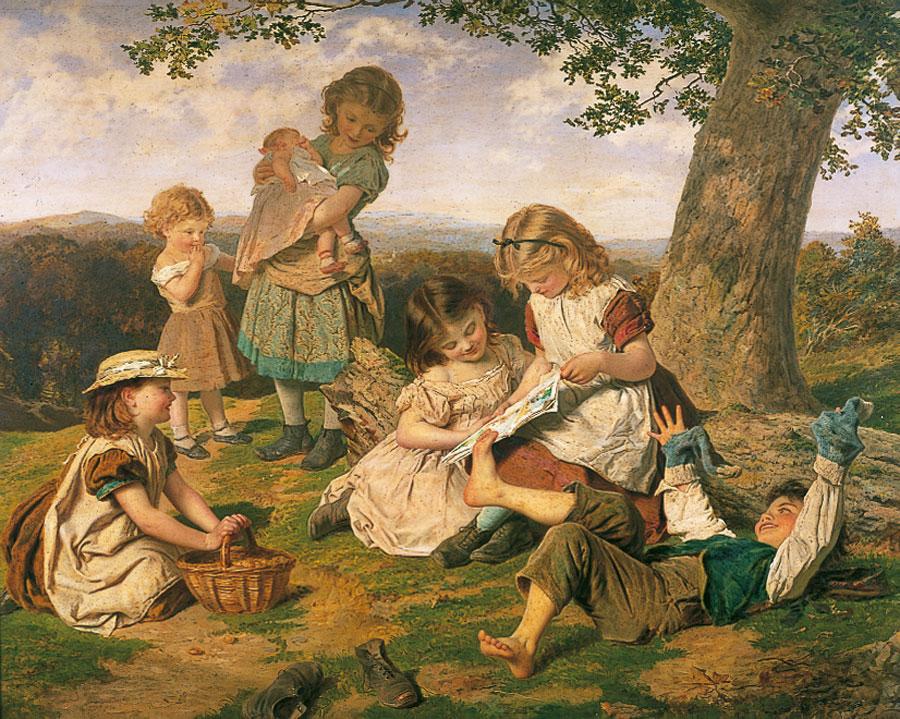
Within her artistic career, Anderson stayed within the domestic sphere by painting only children and young women. During the Victorian Era, home life was considered a respectable topic for women to paint or view as art. Anderson’s work, The Children’s Story Book, exemplifies this style with a sentimental scene of innocent children. Traditional gender roles are presented with the boy taking an active and playful role while the girls sit, calm and reserved. Additionally, Anderson’s work contrasts with the typical representations or portrayals of love by many women artists; Anderson’s paintings depict an exclusively female world. By eliminating men from her paintings, Anderson focuses on the relationships between women. There is an absence of the objectifying male gaze which is replaced with a feminine respectability.2
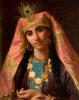
Another common Victorian theme represented in Anderson’s works includes the observance of racial differences. This emerged in the mid-seventeenth century and can be seen in her painting Scheherazade. In this work a Middle Eastern woman is depicted with elaborate fabrics and ornate jewelry. The woman focuses a knowing and direct gaze onto the spectator. This strongly contrasts with the provocative and sexualized women of non-European descent that many male artists painted as ‘exotic’.4 Unlike many male counterparts of the time, Anderson did not reduce her subject to a sexualized object and instead portrayed her as an empowered and confident heroine.
Throughout her artistic career, Anderson became well-known and respected in a male dominated field by providing a feminine insight into art. She created visions that upheld the feminine moral righteousness that many public museums wanted on display. Through the public purchase and display of her art, she broke through the social norm of women solely existing in the private sphere. The themes in her art conformed to the typical gender roles of the 19th century, but her works strayed from the typical sexualization that many male artists portrayed.
Works Cited
(1) Alison Smith, The Victorian Nude. Sexuality, morality and art (Manchester, 1996), pp.37–44.
(2) Nichols, E 2018, 'Sophie Anderson, a cosmopolitan Victorian Artist in the Midlands', Midlands Art Papers, no. 1. <https://www.birmingham.ac.uk/schools/lcahm/departments/historyofart/research/projects/map/includes/issue1/8-in-depth-sophie-anderson.aspx>
(3) Woodson-Boulton, ‘“Industry without Art is Brutality”: Aesthetic Ideology and Social Practice in Victorian Art Museums’, Journal of British Studies,46.1 (2007), p.52.
(4) The Book of the Thousand Nights and the Uses of Orientalism’, Journal of British Studies, 39.3 (2000), pp.317–39