

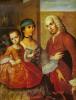
In the presented Casta Painting, there is a depiction of a Spanish colonial man and a Mestizo woman, with a child in her arms. The Spanish man seems to have some hierarchy within the ranks as he is clothed in more delicate clothes, which the Spanish would of worn compared to the natives or the slaves. The woman, herself, is dressed in extravagant clothes; however, she seemingly pays homage to her Mestizo culture by adding more vibrant colors and with her head accessories. Lastly, the child is marked with the combination of native and European characteristics, is clothed in a lavish ballgown. Due to this family's outward appearance, it can be concluded that they are from a wealthier class. The family class allows for closer speculation of the woman; being mixed, one can become curious if the marriage to a Spanish noble was arranged or even if the marriage promoted her into a higher class. The intermixing of cultures spurs numerous questions limited to the painting itself and may never be answered.
Image Citation: Cabrera, Castizo de Miguel. De Español y Mestizo. 18th century. Casta Paintings. Not Even Past. https://notevenpast.org/casta-paintings/.