
1900
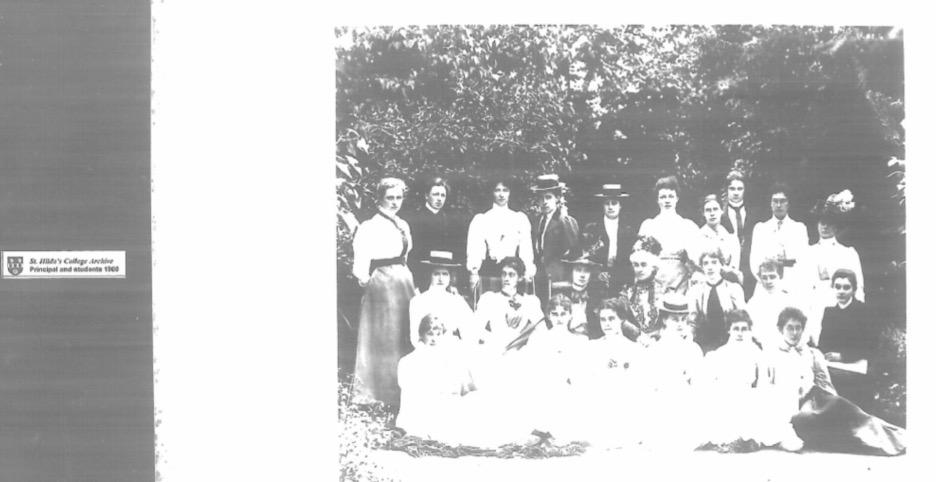
This semester has been a very exhilarating time for me and my schoolmates. We took a class photo a couple weeks ago! That does not sound like much to the ordinary person, but it was an extremely important day for all of us. I have had the pleasure to attend St. Hilda’s College this year, and my memories from this place will certainly last me a lifetime. I suppose we are history in the making or something of the sort, as it is quite uncommon for women to seek higher education. If fact, my own family has voiced their disappointment in my travels to Oxford in order to study here. College is often reserved for the men, because I suppose they are the brains, whereas we women are just the housewives. Today, that notion is changing. Me and my twenty-two classmates are some of the first women to attend college. Marie, in the top row on the far left, has plans to become a writer! She writes the most beautiful poetry. Oh, How I wish for her work to be published somewhere so that everyone throughout London can read it. I bet if it was given the chance, it would spread throughout the world! I can only hope. I am attending St. Hilda’s to study science! It is so exciting! I cannot believe that this subject has been hidden away from women in the past. I wish that every person, no matter how young or old, has the chance to study this amazing subject. It is quite incredible how so much can be explained through this world of science. Maybe one day, I’ll become so advanced in the subject that I’ll rival the men! That would most definitely be a sight to see.
St. Hilda’s College was founded out of Oxford, England beginning in 1893. This entry makes it seem as if St. Hilda’s was the founder of all women’s higher education in England, but St. Hilda’s was actually the last of the women’s colleges established in Oxford. Actually, the first college in England to award female students with degrees was the University of London. In 1869, Edith Williams, Elizabeth Garrett Anderson, and Jane Martineau were some of the first British women awarded degrees from this university (University of London). In agreeance with her entry, this woman was indeed one of the first women to attend this school. Women during the Victorian era did not normally pursue higher education due to the fact that “the separate duties of men and women were Divinely ordained” (Burstyn 113). Women were not meant to take on the same roles as men, instead Joan Burstyn explains that “by running the home and bringing up children women were fulfilling God’s intention” (Burstyn 113). Victorian women seeking higher education were not only looked down on by society, but they were also looked down on by their own religions. The women who decided to continue despite these criticisms were not met with open arms. If a woman proceeded in her education, she would “destroy the essence of [her] womanhood” in the eyes of society and the church (Bursytn 119). Seeking higher education was not easy for a Victorian woman, but as the reader can see, these societal pressures simply melted away once this woman found her passion for science. She mentioned the disappointment of her family, but she decided to travel to St. Hilda’s anyway. Women like this were the reason that higher education for women began to flourish all over the world. Without pioneers like this woman, the world might be a little bit more like nineteenth century England.
Burstyn, Joan N. “Religious Arguments against Higher Education for Women in England, 1840-1890.” Women’s Studies, vol. 1, no. 1, Dec. 1972, p. 111. EBSCOhost, doi:10.1080/00497878.1972.9978303.
"Leading Women 1868-2018." University of London, london.ac.uk/about-us/leading-women-1868-2018. Accessed 17 Apr. 2021
[[St]] Hilda's College Group Photographs, 1894-1910. [Photograph]. At: Place: [[St]] Hilda’s College Archive, University of Oxford. Available through: Adam Matthew, Marlborough. Defining Gender, http://www.gender.amdigital.co.uk/Documents/Details/St Hildas College Group Photographs 18941910 [Accessed April 13, 2021].