



AN OVERVIEW OF NOTTING HILL: OF HUMBLE – UNROMANTIC – ORIGINS
Made internationally renowned by the namesake 1999 romantic comedy, Notting Hill hasn’t always been the scene of a star-studded love. In the 18th century, before being absorbed into London, Notting Hill was known for two pursuits polar to romance: pig farming and brick making. The land upon which Notting Hill rests contains heavy and rich soil that proved useful for pig farming and clay production (Kelly). In fact, the now quaint Avondale Park, established in 1892, was built atop the Ocean, a massive pig slurry (The Royal Borough of Kensington and Chelsea).
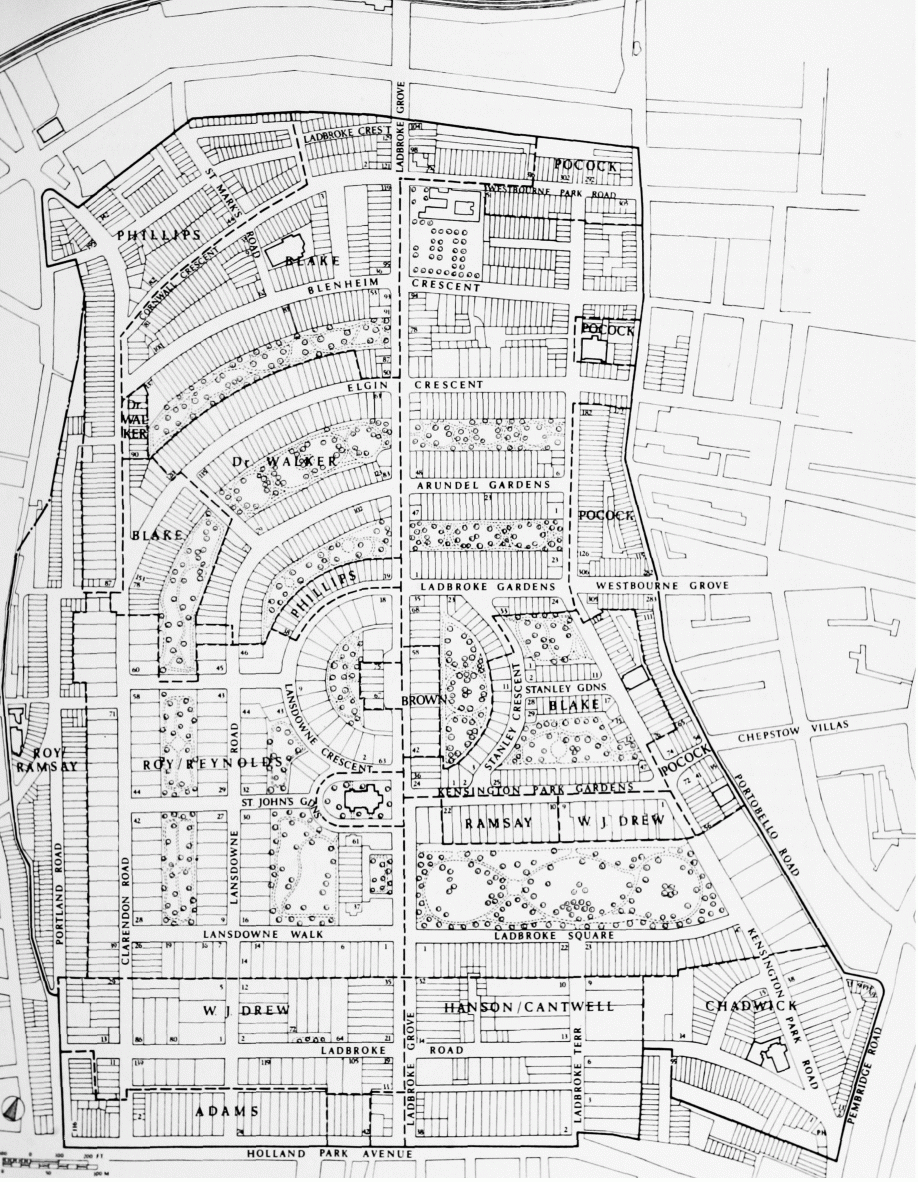
It was not until the 1820s that the area became part of London (The History Press). The Ladbroke family, predominant landowners in Kensignton, developed the former industrial region into a residential district known as Ladbroke Estate (Kelly). The homes throughout Ladbroke Estate were designed such that they stood along on the edge of a series of enclosed central gardens (Kelly). This unique design enclosed the communal gardens – referred to as paddocks – preventing those who were not residents from accessing the spaces. Today, paddocks remain a characteristic trait of Notting Hill.
At the turn of the 20th century, the area became inhabited by upper middle-class families (The History Press). With them, they brought art and culture – but their presence was fleeting. During the Second World War, the Luftwaffe leveled Notting Hill, taking with it its once stately appeal and wealthy residents (The History Press). The damage caused by the bombings instigated drastic demographic change. Many of the formerly grand townhomes were rebuilt into Homes of Multiple Occupancy (HMOs) -- lower income housing designed to house as many tenants as possible. The advent of HMOs prompted greedy landlords to exploit their new tenets by overcrowding properties and thereby causing the area to become a slum (Kelly).
After the passage of the British Nationality Act in 1948, which afforded all Commonwealth citizens with the right to fully settle in the United Kingdom, a prominent Afro-Caribbean community began to develop. As this community grew, impoverished white residents faced a narrower job market and responded with race riots. Ultimately, as activists took a stand against racism, these tensions quelled. Today, the annual Notting Hill carnival, the largest carnival in Europe, celebrates Afro-Carribean culture in the United Kingdom (The History Press).
With the expansion of the economy at the end of the 20th century, extensive gentrification efforts began in which many of the area’s HMOs were converted back to single family townhomes (The History Press). Gentrification re-attracted wealthy residents and enticed posh retailers -- reshapping Notting Hill into its present form. Today, Notting Hill is not only a center of affluence, but also culture. Its rich history, rooted in humble beginnings, manifests itself deeply. And despite gentrification, the area remains home to many persons from diverse backgrounds, earning it a repute as a cosmopolitan district.
NOTTING HILL IN THE CONTEXT OF ROMANCE OF A SHOP: EMBRACING ROMANCE
In Amy Levy’s sensational novel, Romance of a Shop, Fanny and her husband settle in Notting Hill. Based off the description of the home as a “snug and hideous little house” (Levy | XVII), it can be inferred that the couple resided in Notting Hill sometime in the early 19th century when Notting Hill was on the cusp of Ladbroke family’s development – ignorant to its romantic charm that would manifest over the next decades.
However, in the epilogue of the novel, the narrator states that “Fanny continues to flourish at Notting Hill” (Leavy | Epilogue); perhaps implying that the couple ultimately was privy to the fruits of the Ladbroke development. Nevertheless, Fanny is consistently described as residing happily at Notting Hill as she began "to feel that she had a place in the world at last” (Levy | XVII).
Fanny, much like Notting Hill, came from humble origins, but eventually embraced romance.
WORKS CITED
“Avondale Park.” Royal Borough of Kensington & Chelsea, UK Government, 18 Aug. 2022, https://www.rbkc.gov.uk/leisure-and-culture/parks/avondale-park#:~:text….
“A Brief History of Notting Hill.” The History Press, The History Press, https://www.thehistorypress.co.uk/articles/a-brief-history-of-notting-h….
“Colourful Houses in Notting Hill Area of London.” ShutterStock, https://www.shutterstock.com/image-photo/colourful-houses-notting-hill-….
Getty Images, et al. “Housing Conditions.” Getty Images, https://www.gettyimages.in/detail/news-photo/the-interior-of-a-slum-in-….
Kelly. “The History of Notting Hill.” My Notting Hill, 27 May 2017, https://www.mynottinghill.co.uk/the-history-of-notting-hill/.
“Ladbroke Estate Plans.” British History Online, british-history.ac.uk/survey-london/vol37/pp194-200.
Sportiello, Antoine. “Notting Hill 1890.” Pinterest, https://br.pinterest.com/pin/713116922225622850/.
Adi, Hakim. “On Post-War Black British History.” Black Perspectives, https://www.aaihs.org/on-post-war-black-british-history/.
Levy, Amy. The Romance of a Shop.