
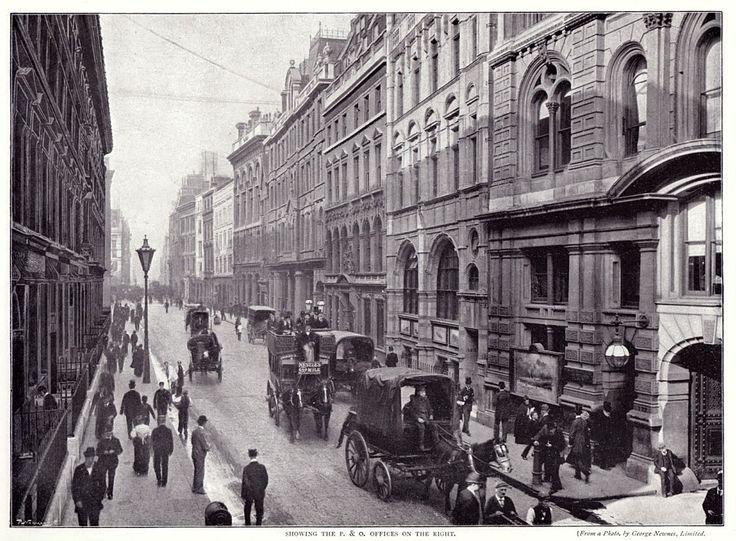
Baker Street is a mile-and-a-half-long street in London, England, built in the 18th century. It started as a stretch of housing mostly for the wealthy. But as London changed, so did Baker Street. London grew both in size and economically, and Baker Street began to transition apartments and homes into offices and working environments. Around the 1880s when The Romance of a Shop by Amy Levy was published, Baker Street was bursting with commerce. In 1863, the Metropolitan Line was built with Baker Street as one of its stops. The Met was an underground railway that connected 40 miles of England (Kinsey). This marks the time when Baker Street became a true hotspot for opportunity. We see hints of this in The Romance of a Shop.
When left fatherless, the sisters decide to start a business to make a living. They are eventually steered in the direction of Baker Street. While deciding, it is mentioned that “There are a great many photographers in Baker Street already.” Which tells us that it is a highly trafficked area for business. The street being chosen as their new home is not by chance. It symbolizes the girls’ new beginning with their careers as well as Baker Street's new beginning with its up-and-coming commercial life. It is important to note that Baker Street was still known to be predominantly wealthy in the 1880s, as it had just begun to transition from a residential area for the rich to a largely commercial area. We can infer that the wealthy would frequently visit Baker Street. In the novel, we can see this by analyzing the people the Lorimer girls meet through their business on the street—for example, Lord Watergate. The girls meet Lord Watergate when he asks them to photograph his wife who has passed. We know by his title that he is wealthy, and also by the fact that he is notably well-connected in society and lives in Sussex place, which was home to many wealthy or even royal families. About midway through the book Gertrude says "I daresay he is going to lunch in Sussex Place. Lord Watergate's Sunday luncheon parties are quite celebrated," which confirms the elevated social status of Sussex Place (Levy).
Baker Street remains full of life and commerce today. Its station transports over twenty-six million people every year. However, most of its businesses are locally owned. It is also a museum hotspot and was home to the first Madame Tussauds in 1835. Madame Tussauds is a famous wax museum and popular tourist attraction (Evans). This stop on our literary tour plays into our theme which is “First Impression of London.” Many people will have Baker Street as their first look at London. Baker Street provided the girls, for example, their first look at a working London. Conveniently placed on our tour after the Palace of Westminister, Baxter Street is often not the main attraction. Tourists will flock to the Palace and will later venture to Baker Street to make a living and thrive off of its opportunity.
Evans, Evan. “The Strange History of Madame Tussauds.” Evan Evans Tours, 2 Nov. 2023, evanevanstours.com/blog/the-strange-history-of-madame-tussauds/.
Gordon, Nick. “Image Result for Baker Street Exterior Victorian: A4 Poster.” Pinterest, 31 Oct. 2017, br.pinterest.com/pin/447474912967836988/?amp_client_id=CLIENT_ID%28_%29&mweb_unauth_id=%7B%7Bdefault.session%7D%7D&simplified=true.
Kinsey, Andy. “Baker Street Underground Station - The Worlds First Underground and the Sherlock Holmes Connection.” iNostalgia, 23 Aug. 2023, inostalgia.co.uk/transport-history/baker-street-underground/.
Levy, Amy. “The Romance of a Shop.” Cupples and Herd, 1889.
“Madame Tussauds.” Wikipedia, Wikimedia Foundation, 22 Feb. 2024, en.wikipedia.org/wiki/Madame_Tussauds.