
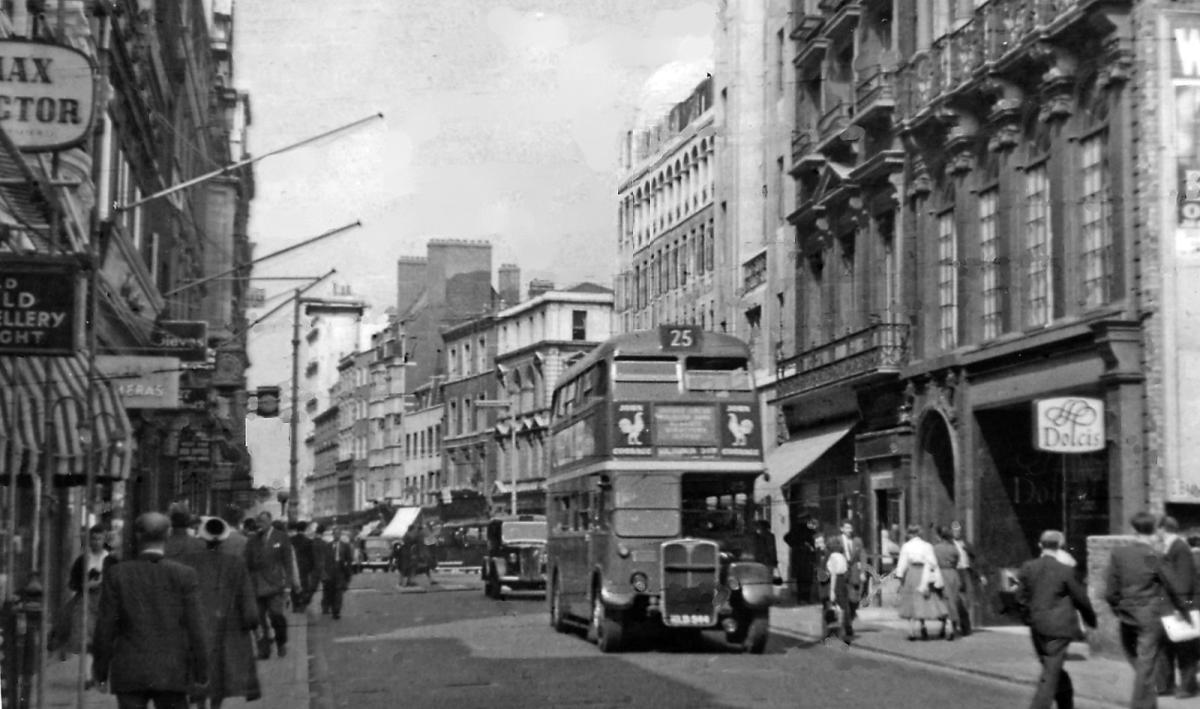

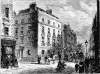
Bond Street is an iconic location in the heart of London that established its presence in the city during the early 1700s. According to “Visit London, “Since its foundation in 1700, Bond Street has been a playground for society’s wealthiest, most stylish and influential people'' (Visit London, 2024). People from all around gather on Bond Street to splurge on items they value and shop through famous designer brands that are not accessible just anywhere. Although it has undergone many restorations, renovations, and changes as time has passed, the main purpose of Bond Street has remained consistent as a safe haven through its impressions of beauty, sophistication, and lavish lifestyle; a means to draw people together and live large despite the challenges of the world around it. As seen in Mrs. Dalloway in Bond Street, it is a part of town that remains well kept with high end fashion, bustling crowds, and the newest luxuries of life.
The original designer, Sir Thomas Bond wedged Bond Street between Piccadilly and Oxford Street, two major streets in the heart of London, also famous for their history in the development of the city. An article by the City of Westminster explains the development of Bond Street and explains that, “There has been a considerable amount of piecemeal rebuilding since the eighteenth century creating a richly textured townscape which has helped the street retain its international reputation” (City of Westminster, 1992). However, the desirable location developed by Thomas Bond established its early popularity for socialites from close and far. Virginia Woolf emphasized the draw of Bond Street through the perspective of the main character as seen depicted in the introduction of the excerpt. The poem reads, "‘I love walking in London’ said Mrs Dalloway. ‘Really it's better than walking in the country!’” (Woolf, 1923) The love of Bond Street is depicted although the literature is still seen and enjoyed today by tourists and citizens of the area alike simply due to the ease of walkability, architecture, and awe-inspiring sights of grandeur.
Due to Bond Street’s establishment more than 300 years ago, it has withstood the test of war and time. Mrs. Dalloway in Bond Street alludes to the events of World War 1, known as The Great War at the time. The relevance of war in 1923, the time the poem was published, was still very fresh and the economic effects were prominent in London. However, Bond Street was still full of business and life despite the recent events and travesties of World War 1. London can take pride in the sentiment of their lives and routines in the midst of troubling times. The culture and prestige of Bond Street radiates through the busy city of London and tourists and natives alike can find themselves drawn to the historical taste of the area.
Although Bond Street was designed in the 1700s, and Mrs. Dalloway in Bond Street takes place in the early 1900s after the war, the area remains popular in 2024 and a major metropolitan area. A blog by London Office Space claims “According to the Cushman & Wakefield Main Streets Across the World report for 2011, Bond Street commercial real estate prices were the sixth highest in the world…” (London Office Space, 2013). This demonstrates the prominent wealth and pride for the street throughout history. The beauty of Bond Street is established through its architecture and the sheer fact that it has remained a center for gathering and enjoying life despite the challenges of life and society. People can continue to gather and admire the beauty and prestige of Bond Street the way Mrs. Dalloway sought to perceive it after the war as seen in Mrs. Dalloway in Bond Street.
References
“Bond Street - Clothes Designer - Visitlondon.Com.” Visit London, www.visitlondon.com/things-to-do/place/7883674-bond-street. Accessed 18 Feb. 2024.
Brooksbank, Ben. “English: Northward up Old Bond Street from Piccadilly.” https://en.wikipedia.org/wiki/File:London_Old_Bond_Street_geograph-3066999-by-Ben-Brooksbank.jpg. Published 26 Aug. 1955.

City of Westminster. “Bond Street A Guide to Shopfronts and Advertisements” Department of Planning and City Development, Development Planning Services. https://www.westminster.gov.uk › media › document › b…. February 1992.
Diaz, M del Rosario Castro. “Secret London.” The Secret London Guide to Bond Street, https://secretldn.com/bond-street-guide/. 19 Feb. 2020.
“London Office Space.” Explore Bond Street: History, Architecture, Business and Tourism, https://www.londonofficespace.com/buzz/bond-street-guide/. Published 7 Jan. 2013.
Walford, Edward. “'Piccadilly: Northern tributaries.” Old and New London: Volume 4 (London, 1878), pp. 291-314. British History [accessed 28 February 2024]. https://www.british-history.ac.uk/old-new-london/vol4/pp291-314