
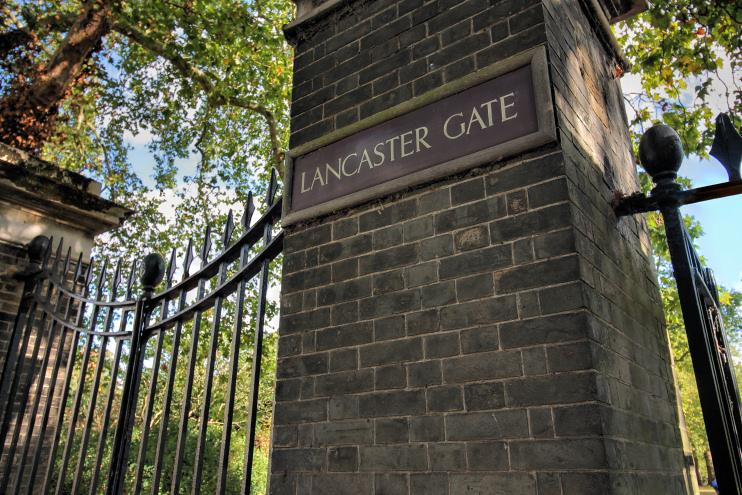


In The Romance of a Shop, Aunt Caroline’s residence is at the Lancaster Gate development. Amy Levy characterizes Aunt Caroline as a traditionalist upper-class woman deeply concerned about how society perceives her and those connected to her. Exploring Lancaster Gate’s rich historical backdrop and integrating it with the book provides a deeper understanding of Aunt Caroline’s background and the influences shaping her personality.
Lancaster Gate is two terraces of 15 six-story townhouses in the Bayswater district of Central London constructed in the early 1860s. Until 1965, the name “Lancaster Gate” was limited to the Christ Church in the square; meanwhile, the terraces were known as Upper Hyde Park (Wikipedia). Lancaster Gate gets its name from the entrance to Kensington Gardens—the once private Garden of the Royal family—across the street. The name “Lancaster” itself honors Queen Victoria, the Duke of Lancaster (Hidden London). Designed by the renowned architect Sancton Wood, this expansive property, boasting a French-Renaissance-style architecture, sought to attract the influx of affluent families desiring to live in the neighboring Mayfair district. Consequently, the grandiose allure extended to numerous noble families choosing to settle there (Smyth).
The first mention of Lancaster Gate comes when the Lorrimer Sisters split up after their father’s death, and “the unfortunate Fan” is sent there. Referring to Fanny here as “unfortunate” was an interesting choice of phrasing because she was the sister most in favor of living a traditionalist domestic life, thus making it easier for someone like her to fit in there. However, the narrator’s critical tone of Lancaster Gate indicates it is a daunting environment for those unable to measure up to its standards. At that point, none of the Lorrimer sisters could fulfill those standards in terms of financial means and marital status. Readers gain insight into the power of fitting in as Fanny is only favored by Aunt Caroline after her fiancé “won golden opinions at Lancaster Gate,” suggesting that widespread social approval is necessary for being well-received.
Aunt Caroline’s disdain for the girls’ low standing is evident, as she often spoke down on their “loss of caste and damage to prospects." This shame was amplified by the high social statuses of those around her, making her desire for social validation all the more pressing. Nevertheless, by the epilogue, she continued to “remain supreme” within her circles at Lancaster Gate and spoke “with the greatest respect of her niece, Lady Watergate.” She recognized that the higher degree of proximity she had to nobility, the better society would perceive her. Thus, following the shame she felt of her nieces defying social norms, flaunting Gertrude’s marriage to a man of nobility was the perfect remedy to enhance her image.
Since the 19th century, Lancaster Gate has been a prime area to live in, as it is within walking distance from numerous high-class retail (e.g., luxury dress and jewelry makers) and entertainment attractions (e.g., theatre halls and art galleries) that have expanded over the decades. As the prominence of the English aristocracy declined, the area was divided into flats in the 1920s and is now characterized by its slew of embassies, offices, and luxury hotels (Smyth;Wikipedia). Due to the shift away from large residential units, it is a magnet for young, well-off, educated, single residents (Hidden London). Thus, Lancaster Gate’s continued significance as an enclave for the affluent is a testament to its history.
Works Cited
Hidden London. “Lancaster Gate.” Hidden London, https://hidden-london.com/gazetteer/lancaster-gate/. Accessed February 2024.
“Lancaster Gate.” Wikipedia, https://en.wikipedia.org/wiki/Lancaster_Gate. Accessed February 2024.
Smyth, John. “Getting to Know Lancaster Gate.” Park Grand, 2020, https://www.parkgrandlancastergate.co.uk/blog/getting-know-lancaster-ga…. Accessed February 2024.