
This second stop focuses on Gertrude, and her lifelong pursuits within the literary arts. This second-eldest sister’s true passion is writing, although she often finds herself either unable to sell her work, or discarding it, such as when the novel describes how, when discussing her work Charlotte Corday; a tragedy in five acts, “its fate seemed uncertain; but it found its way ultimately to the basket.” (Levy ch. II). Nonetheless, Gertrude makes “frequent and fruitless visits to the region of Paternoster Row” (Levy ch. II) in hopes of selling her work.
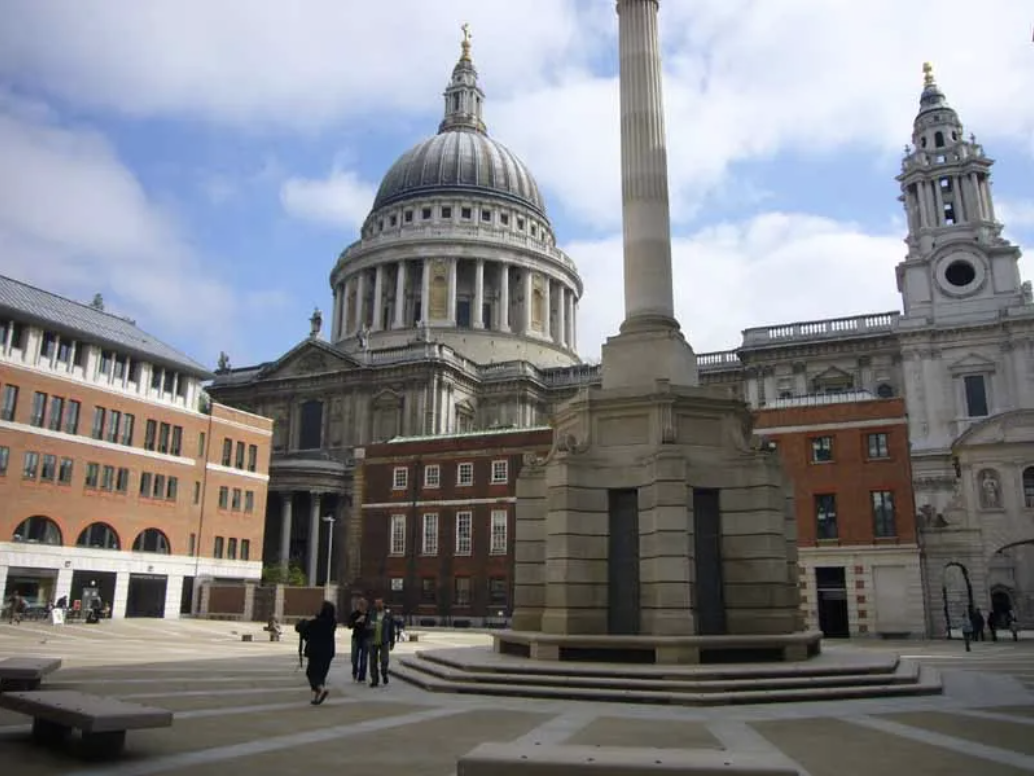
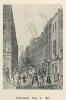
This leads to the second destination: Paternoster Row, which holds a great amount of significance for Getrude and her artistic passions. Paternoster Row was originally established within the area of St. Paul’s Churchyard, where clergy of St. Pauls would walk, rosary beads in hand, and recite the Lord’s Prayer, or “Paternoster” ("Paternoster Square"). St. Paul’s Churchyard, even from the fourteenth century, was a prime destination for bookselling. Several publishers utilized the area, and often made certain areas or streets of St. Paul’s Churchyard their signature location. However, after a fire in 1666 that destroyed several places within the location, more publishers chose to set up shop along Paternoster Row, which was along the eastern boundary (Ainsworth and LeBere). Due to this, Paternoster Row served as a central bookselling scene, especially during Gertrude’s time.
Like many hopeful authors, Gertrude often remained hopeful that success would come from her interactions with Paternoster Row, since writing continued to serve as a form of comfort and consolation for her (Levy ch. X). However, her fate with publishing remained the same as many: “the same unsatisfactory results as of yore…which in these days is heard through the breadth and length of the land.” (Levy ch. X). As with many driven London writers, Gertrude’s publishing fate seemed to mimic the “starving artist” caricature a bit too closely. It’s not until her poem is published alongside Frank’s artwork in The Woodcut that she is able to experience the satisfaction of a published work (Levy ch. X).
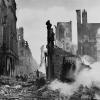
This hustling and bustling area remained popular with authors and publishers alike for numerous years, up until the frightfulness of World War II. Though not a stranger to enemy bomb attacks, London entered the Blitz, and night raids by Germain aircrafts were to follow (“WW2: The Blitz Hits”). Arguably the most infamous night raid during this time occurred directly over London on December 29, 1940. The city was in ruins, and although nineteen churches were destroyed, St. Paul’s ironically survived the attack. The same could not be said, however, for Paternoster Row. London’s publishing hotspot was in ruins, and an estimated five million books were lost with it (“WW2: The Blitz Hits”), effectively ending the important relationships it held with hopeful authors like Gertrude.
Fortunately, in 2003, the Paternoster name would be reestablished with the construction of Paternoster Square, located next to St. Paul’s Cathedral ("Paternoster Square"). Similar to its former likeness (as seen from Gertrude’s descriptions) Paternoster Square is a popular and bustling destination. Instead of books, it now houses a multitude of restaurants and shops, and serves as an important location for many Londoners.
Works Cited
Ainsworth, Sarah-Jayne and Kate LeBere. “St. Paul’s Churchyard.” The Map of Early Modern London, https://mapoflondon.uvic.ca/STPA3.htm.
Beaton, Cecil. “Paternoster Row After Bombing.” Vogue Photos, Condé Nast Store, 9 March 2017, https://condenaststore.com/featured/paternoster-row-after-bombing-cecil-beaton.html.
Levy, Amy. The Romance of a Shop. Boston, The Algonquin Press, 1889.
“Paternoster Row in 1837.” Paternoster Row in 1837, Royal Collection Trust, 2017, https://www.rct.uk/collection/702334/paternoster-row-in-1837
“Paternoster Square.” City of London, www.cityoflondon.gov.uk/things-to-do/architecture/modern-architecture/paternoster-square.
Welch, Adrian and Isabelle Lomholt. “Paternoster Square Buildings.” Paternoster Square, E-Architect, 27 June 2014, https://www.e-architect.com/london/paternoster-square.
“WW2: The Blitz Hits.” Sky HISTORY, www.history.co.uk/history-of-london/ww2-the-blitz-hits.