
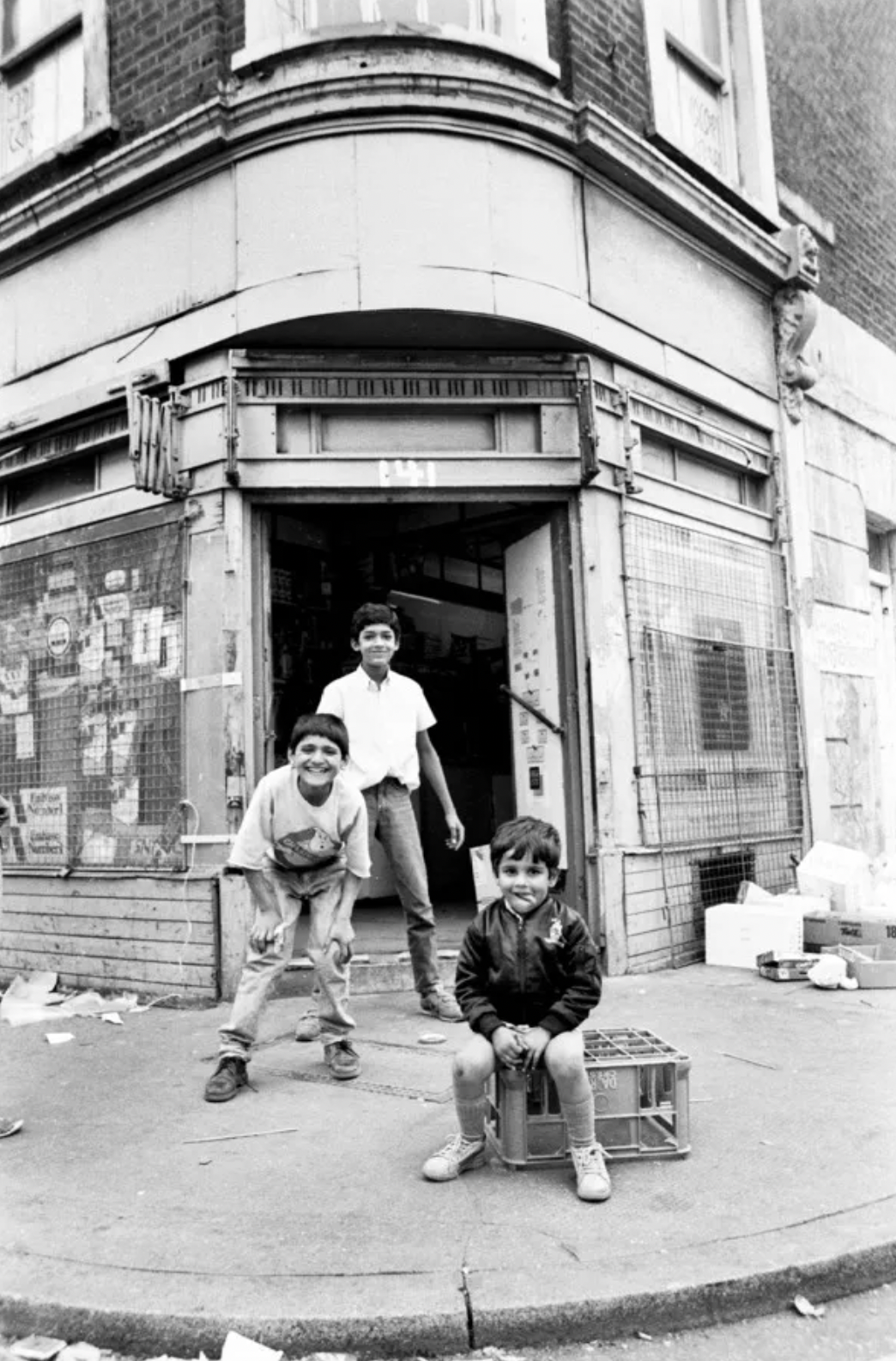
Brick Lane is a well-known street in Tower Hamlets, a densely populated neighborhood in the East End of London. Inhabited by people from all over the world, Tower Hamlets is the cultural melting pot of England. While the area received huge waves of French Huguenots, Irish farmers, and Russian Jews in earlier centuries, it is mostly occupied today by Bengalis, and is commonly referred to as “Benglatown.” The neighborhood saw a steep rise in its Bengali population in the mid-to-late twentieth century, following World War II. After traveling by boat, Bengalis typically chose to reside on Brick Lane because of its proximity to the Thames ("Tower Hamlets").
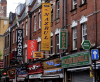
Though “Benglatown” is very much a part of London, Bengali immigrants have strongly influenced the area, making it a cultural enclave. As the main character in Monica Ali’s Brick Lane notes, even street signs along Brick Lane feature Bengali writing underneath their original English text: “The sign screwed to the brickwork was in stiff English capitals and the curlicues beneath were Bengali” (Ali).
Upon arriving in Tower Heights, the Bengalis also made their cultural mark on Brick Lane by establishing shops and restaurants along the street. Several of Brick Lane’s traditional Bengali restaurants are still popular today, and most travel guides argue that Brick Lane is the best place to find authentic curry in all of London ("The Colorful History of Brick Lane in East London"). Bengali citizens also purchased what was formerly a chapel and synagogue and turned it into a mosque, which still stands today. Brick Lane is also famous for its street art, and several of its murals have Bengali influences. One of the most well-known murals found along Brick Lane is of Mohammad Ali and celebrates Bengladesh’s fiftieth year of independence ("Explore Bangladeshi Culture and Cuisine Along London's Brick Lane").
Following the September 11 terrorist attacks, many parts of England saw a rise in Islamophobia and racism towards Asian immigrants, resulting in violence in enclaves like Tower Hamlets. Brick Lane portrays this violence through a fictional anti-Muslim gang called the Lion Hearts. Another fictional group called the Bengal Tigers is founded to fight for equal rights and fair treatment of Muslims in England. Contrary to their efforts, violence even breaks out amongst the Bengal Tigers in the final chapters of Ali’s novel. Amidst the frequent outbreaks of violence, Brick Lane becomes almost unrecognizable to the novel’s main character, Nanzeen. She looks around only to discover “missiles rain[ing] across the road” and hears a familiar voice shout, “‘Brothers, why are you fighting against yourself, Mussulman against Mussulman?’” (Ali).
Ali’s portrayal of the violence on Brick Lane in the early twenty-first century is unfortunately accurate. While racist attitudes have subsided slightly, Brick Lane still faces high poverty and crime rates. Efforts by the British government to gentrify the poor neighborhood have been strongly resisted by its inhabitants ("The Battle for Brick Lane"). Bengali Britons have a deep desire to protect the rich, vibrant culture of Brick Lane.
Works Cited
Abbas, Tahir. After 9/11: British South Asian Muslims, Islamophobia, Multiculturalism, and the State.
Ali, Monica. Brick Lane. Penguin, 2023.
GoPhoto. “Brick Lane.” Go Photo London, 6 Oct. 2014, gophotolondon.com/travel-photography/photo-spots-london/brick-lane/.
Maxwell, Phil. Brick Lane 14. 2011, Spitalfields Life.
McGrath, Meadhbh. “Explore Bangladeshi Culture in London’s Brick Lane.” Lonely Planet, 25 Apr. 2023, www.lonelyplanet.com/articles/brick-lane-london-walking-tour.
“Tower Hamlets.” Encyclopædia Britannica, Encyclopædia Britannica, inc., 22 Jan. 2024, www.britannica.com/place/Tower-Hamlets.
Uddin, Tasnima, and Syma Tariq. “The Battle for Brick Lane: Struggle and Solidarity in East London.” THE FUNAMBULIST MAGAZINE, 4 Jan. 2024, thefunambulist.net/magazine/undocumented-international/the-battle-for-brick-lane-struggle-and-solidarity-in-east-london.
Vaidyanathan, Raju. Brick Lane Sunday Market. 1985, The Guardian.
Yoong, Shing. “The Colourful History of Brick Lane in East London.” The Culture Map, 1 Dec. 2023, www.theculturemap.com/brick-lane-east-london-history/.