
Character Commentary
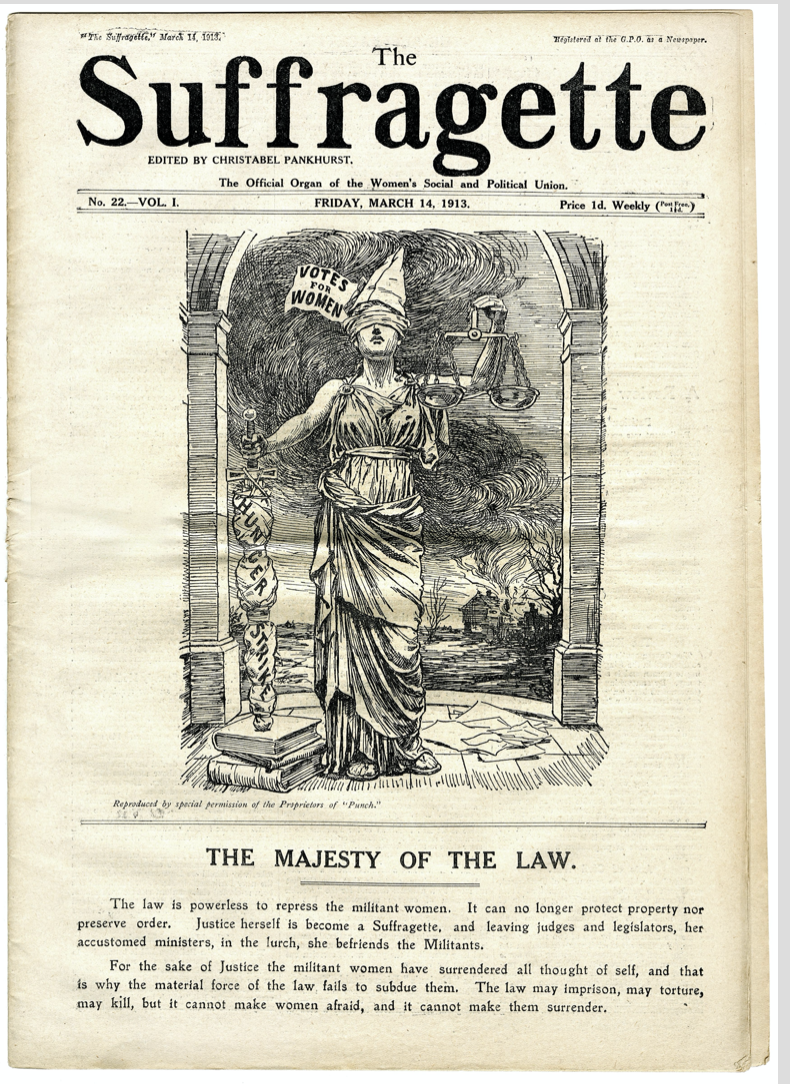
I was walking the streets of London when I saw a copy of The Suffragette, crumpled up on the sidewalk. I knew it was meant to be that I saw this edition, because lately I have felt defeated as women have fought, yet we can’t seem to make society understand our views. As I read it, I began to realize that The Suffragette is more than just a woman’s newspaper. Instead, it is a representation of all of the fighting that women who advocate for our basic rights give way for the next generation of women. Now as a member of the women’s suffrage movement, The Suffragette gives women hope as we have already come so far from the harsh Victorian Era. We want our right to vote and we won’t stop until we have our economical, political, and sexual freedoms. What impacted me the most from this newspaper were the words “The law may imprison, may torture, may kill, but it cannot make women afraid, and it canot make them surrounder”. The power this phrase holds is impactful to the many people that read this because it shows that we are in this fight together and will not give up easily. I also believe it’s so impactful because a few years ago, no women would think about saying something so influential to society, and it goes to show that there will be light at the end of the tunnel. I feel inspired by the scale shown, as it represents equality between sexes.I feel empowered as I believe that the blindfold represents her lack of fear. What stood out to me was the woman’s confidence, as she is symbolic of the thousands of women who have embraced being independent regardless of society’s perception. I admire her wrapped up sword because it shows that they will not hurt anyone, as the blade is covered and can’t be used to cut. I will continue to collect editions of The Suffragette, so that when I am grey and old, my grandchildren can look back on these newspapers and see how much progress women have made. Women cannot be silenced anymore and this idea is shown in The Suffragette.
Editorial Commentary
The Suffragette and their role in press played an important role in attracting members and supporters to advance the Women’s Suffrage Movement as more people began to spread their message.There were many attempts on behalf of the British government to shut the publishing of The Suffragette down; for example, on multiple occasions, many publishers of The Suffragette were arrested as well as there was an incident involving the government’s attempt to suppress the voices of British women. (Vote for Women / The Suffragette / Britannia) The Suffragette was the primary platform in which British women could publicize their social and political messages. The government, that was fighting hard to subdue the feminist movement, did not like the idea of women having a this newspaper that was so publicly available. The oppression of The Suffragette may have had a connection to the New Woman, as she was ridiculed and criticized for influencing others, both women and men, to move past a male dominated society. The Victorian Era’s society felt threatened by the New Woman because they knew that social norms were being overthrown. and that the new woman represents the future of progression of the women's movement, and we see this advancement through The Suffragette. The New Woman believes in protecting young girls from the brutal stereotype that dominates society, and further objectifies her as an object for sex. (Grand) The aim of The Suffragette and the New Woman is to help women live in a more moral atmosphere without being suffocated by the old woman societal norms.The New Women shown in The Suffragette and Louise Creighton both represent the feminine idea of self sacrifice in order to stand up for equality among sexes and to promote new opportunities for women. (Bates) Both of these women also embrace the new woman ideal, as they ignore society’s limits to further advance the suffrage movement.
Citations
Bates, David, et al., editors. The Creighton Century, 1907–2007. DGO - Digital original, 2 ed., University of London Press, 2009. JSTOR, www.jstor.org/stable/j.ctv13qfvgj. Accessed 24 Nov. 2020.
Grand, Sarah. The New Woman And The Old. 1898.
The Suffragette [London], no. 22, 14 March 1913, https://www.nationalarchives.gov.uk/education/resources/suffragettes-on-file/the-suffragette-newspaper/
“Vote for Women / The Suffragette / Britannia (1907-1918).” Towards Emancipation, hist259.web.unc.edu/vote-for-women-the-suffragette-britannia-1907-1918/.