
The variety of taxidermied creatures mostly sourced from places far from England's shores on display at the Great Exhibition of 1851 in London represented the Victorian fascination with natural history, exploration, and travel. Just before the exhibition, "gentlemen naturalists," such as Charles Darwin and Alfred Russel Wallace, began breaking ground on their soon-to-be published revolutionary works on evolution and animal behavior, respectively. Darwin's On the Origin of Species was published in 1859. Similarly, A.O. Hume, sent to India on behalf of the British Empire, came to be fascinated with the bird life whilst working there and soon published several works on his findings. At the same time, explorer Mary Kingsley embarked on several trips to Africa to document and collect birds, insects, and other small specimens. She discovered several previously unrecorded species of fish, including, notably, the Ctenopoma Kingsleyae.
As a result of such innovations in the field, the natural world and its animal inhabitants were sources of a great deal of excitement for Victorian individuals. Needless to say, a considerable portion of the Great Exhibition was devoted to the display of wild creatures, both taxidermied and living.
Owing to the Victorians' excitement for exploration and scientific innovation, many households contained exotic creatures––both live and taxidermied. An increasingly global England meant that the Victorians could keep colorful birds and kangaroos as pets. However, the cost of maintaining such animals proved unsustainable for most Victorian households (the wealthiest folks, of course, could manage). Taxidermy, then, proved the next best option. As taxidermy specimens, these animals could be dressed, decorated, and posed. These creatures adorned the home––and some were even fashioned into utilitarian objects (such as chairs, light fixtures, and clothing).
"The Victorians and Animals, I: Studying Animals.” Edited by Jacqueline Banerjee, The Victorian Web, https://victorianweb.org/history/animals/pets.html.
"The Victorians and Animals, III: Studying Animals.” Edited by Jacqueline Banerjee, The Victorian Web, victorianweb.org/history/animals/studying.html.
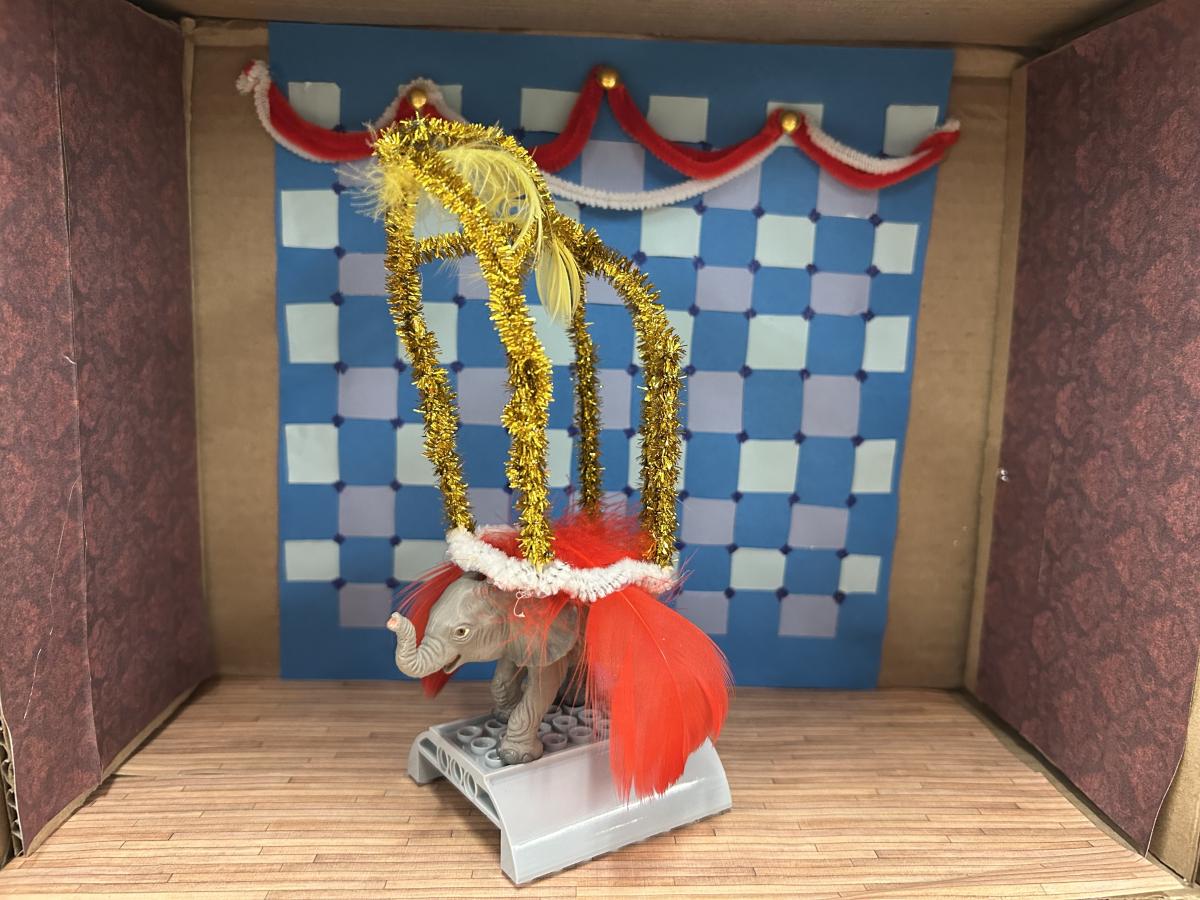
Booth Creation: Queen Victoria's Howdah, by Mary Timmons, 2025. In this photo, I have captured my rendering of the "India Court" display at the Great Exhibition of 1851. Using tinsel and pipe-cleaners, I constructed a model of Queen Victoria's howdah, gifted to her by Nawab Nazim of Bengal, and situated it on a model elephant meant to represent the large taxidermy elephant in the "India Court" display. For a more detailed summary of the "India Court" display, please refer to the next entry. I situated my model of the howdah atop a plastic elephant, which represents the taxidermy elephant that carried the howdah at the Great Exhibition. For the backdrop, I consulted Joseph Nash's print (pictured in the next entry), and I wove colored construction paper strips together to imitate Nash's rendering of a tapestry that likely hung behind the elephant in the original display. Finally, I acquired a deep red Victorian print to function as wallpaper for my diorama, and I utilized an illustration of wooden panels for the flooring of my display.
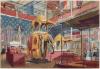
"The Great Exhibition: India No. 4." Watercolor and Gouache painting by Joseph Nash. Royal Collection Trust. In "The Great Exhibition: India No. 4," artist Joseph Nash represents the extravagant "India Court" display at the Great Exhibition of 1851. This painting is one of a collection of 49 depicting various artifacts and displays at the Great Exhibition, which were commissioned by Queen Victoria and Prince Albert. Chromolithograph reproductions of these paintings were later published in Dickinson's Comprehensive Pictures of the Great Exhibition of 1851 by Dickinson of Bond Street in 1854. As represented in the painting, in this portion of the exhibition, a taxidermy elephant supports a howdah (a canopied seat for riders), which was on loan from Queen Victoria's private collection. She had been gifted the howdah by Mansur Ali Khan, the Nawab Nazim of Bengal c. 1850. The howdah itself was an ornate construction of fine materials: the body of the structure was primarily of carved ivory, and the side panels, which draped over the taxidermy elephant on display, were red silk velvet with floral embroidery and tasseled fringe.
Joseph Nash (1809-78) - The Great Exhibition: India No.4, www.rct.uk/collection/919942/the-great-exhibition-india-no-4. Accessed 25 Feb. 2025.
"The Victorians and Animals, III: Studying Animals.” Edited by Jacqueline Banerjee, The Victorian Web, victorianweb.org/history/animals/studying.html.
"Side Panel of an Elephant Howdah." Royal Collection Trust. https://www.rct.uk/collection/42349/side-panel-ofnbspan-elephant-howdah.
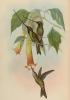
"Docimastes Ensiferus" (Sword-bills) from A Monograph of the Trochilidae or Family of Humming-birds, Vol. 4: 130. This illustration comes from John Gould's The Birds of Great Britain (1862), a comprehensive anthology of Gould's ornithological research. The print itself depicts a group of hummingbirds posed on a flowering branch. John Gould was particularly interested in hummingbirds, and he displayed an impressive collection of taxidermied hummingbirds (among nearly 300 other species of his collected specimens) at the Great Exhibition in the gardens of the Zoological Society. Gould's display stood out to Victorians because of its dynamic, naturalistic quality: Gould took care to pose the birds such that they seemed alive. The exhibit was dazzling to beholders. Queen Victoria wrote in her journal, "It is the most beautiful & complete collection ever seen, & it is impossible to imagine anything so lovely as these little Humming Birds, their variety, & the extraordinary brilliancy of their colours" (Queen Victoria in The Royal Collection Trust).
John Gould (1804-81) – A Monograph of the Trochilidae, or Family of Humming-birds; Volume 5, https://www.rct.uk/collection/1055258/a-monograph-of-the-trochilidae-or-.... Accessed 6 Mar. 2025.
"John Gould (1804–1881), Ornithologist: A Brief Life." Edited by G. T. Bettany, The Victorian Web, https://www.victorianweb.org/science/gould/bio.html. Accessed 6 Mar. 2025.
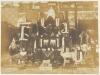
Photograph by Nicholay and Son, Oxford Street, London, presented at the Great Exhibition of London in 1851, Royal Collection Trust. Captured by photographer Claude-Marie Ferrier, this image was published in the second volume of Exhibition of the Works of Industry of All Nations, 1851: Reports by the Juries on the Subjects in the Thirty Classes into which the Exhibition was Divided, an anthology of the juries' assessments of the booths on display at the Great Exhibition. The publication of this volume was Prince Albert's request, and over 100 copies were distributed to key participants in the Exhibition after its conclusion. The photograph itself is a salted paper print. Represented in the image are various furs, a wolf, a gazelle, a lion, and a spotted cat––among other creatures and display objects.
"The Great Exhibition, 1851: Display of Fur and Taxidermy." Royal Collection Trust. https://www.rct.uk/collection/2800052/the-great-exhibition-1851-display-...