
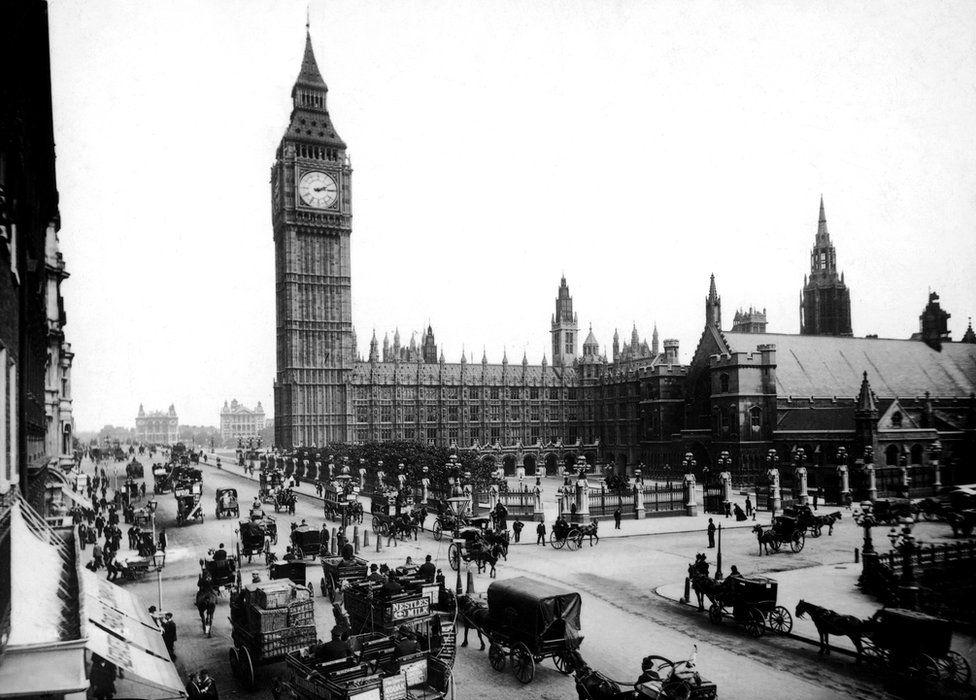


The Elizabeth tower, commonly known as Big Ben is perhaps the most recognizable of London’s numerous historic landmarks. Standing at 315 feet tall, the clock tower looms large over the Palace of Westminster and the River Thames, two locations that are central to political and economic makeup of life in London. While one might not realize it today, the clock tower was incredibly innovative for its time. When it was constructed in 1859, “the clock at Elizabeth Tower, which is located at the north end of the Houses of Parliament, represented a fundamental breakthrough in clock design. (Excell, 2016). looking specifically at how Virginia Woolf references Big Ben in “Mrs. Dalloway in Bond Street”, one sees the ways in which the clock tower has been perceived literarily and culturally in London, specifically during times of immense change.
Woolf begins “Mrs. Dalloway in Bond Street”, with several references to the clock tower. In fact, the clock tower is the first location mentioned in the narrative and is the backdrop of the main character’s first action, “Big Ben was striking as [Mrs. Dalloway] stepped out into the street.” (Woolf) Therefore, when the reader continues to take in the world of Mrs. Dalloway, the clock tower remains in their mind. This is accomplished by other references to the clock in the text, such as “Big Ben struck the tenth; struck the eleventh stroke.”, but also through constant references to clocks throughout the text as well. The importance of clocks in “Mrs. Dalloway in Bond Street” can been seen in quotes such as, “They waited; a clock ticked; Bond Street hummed, dulled, distant; the woman went away holding gloves.” (Woolf)
While Big Ben and the use of other clocks are not central aspects of the narrative, they serve a crucial role in the background of a story placed in London following World War One. Like it has throughout the library of British literature since it’s opening, Big Ben serves as a symbol of time itself through the narrative of “Mrs. Dalloway in Bond Street”. By beginning the narrative with a reference to the striking of Big Ben, and by continuously referring to the striking or ticking of clocks, Woolf keeps the movement of time in the background of her reader’s mind. Considering that “Mrs. Dalloway” is set in a post-war London, it can be easily seen that Woolf is alluding to the cyclical nature of time as well as the cyclical nature of violence.
The use of Big Ben is particularly important though, as it also ties the movement of time with British tradition and aristocracy. For the reader who is familiar with British politics and architecture, Big Ben would be very closely tied with the Palace of Westminster. Therefore, not only does the clock tower represent time itself but also British tradition and politics. So, whenever the clock strikes, the reader not only feels that time is both cyclical and ever moving, but that the nature of British politics is too. Thus, following the war, the reader ought to be left wondering what that cyclical nature means for the good of the country.
Works Cited
Chronicle. Parliment Square. London, 1920.
ESB Professional. Big Ben in Sunny Day. London
Excell, Jon. “Why Is Big Ben Falling Silent?” BBC Future, BBC, 5 July 2016, https://www.bbc.com/future/article/20160704-the-big-ben-renovation-and-how-the-clock-works.
London Stereoscopic Company. The House of Parliment and Big Ben Circa 1897. Getty Images. London, 1897.
Woolf, Virginia. "Mrs Dalloway in Bond Street" The New York Public Library Digital Collections. 1923-07. https://digitalcollections.nypl.org/items/9166c561-29c9-9af8-e040-e00a1…