
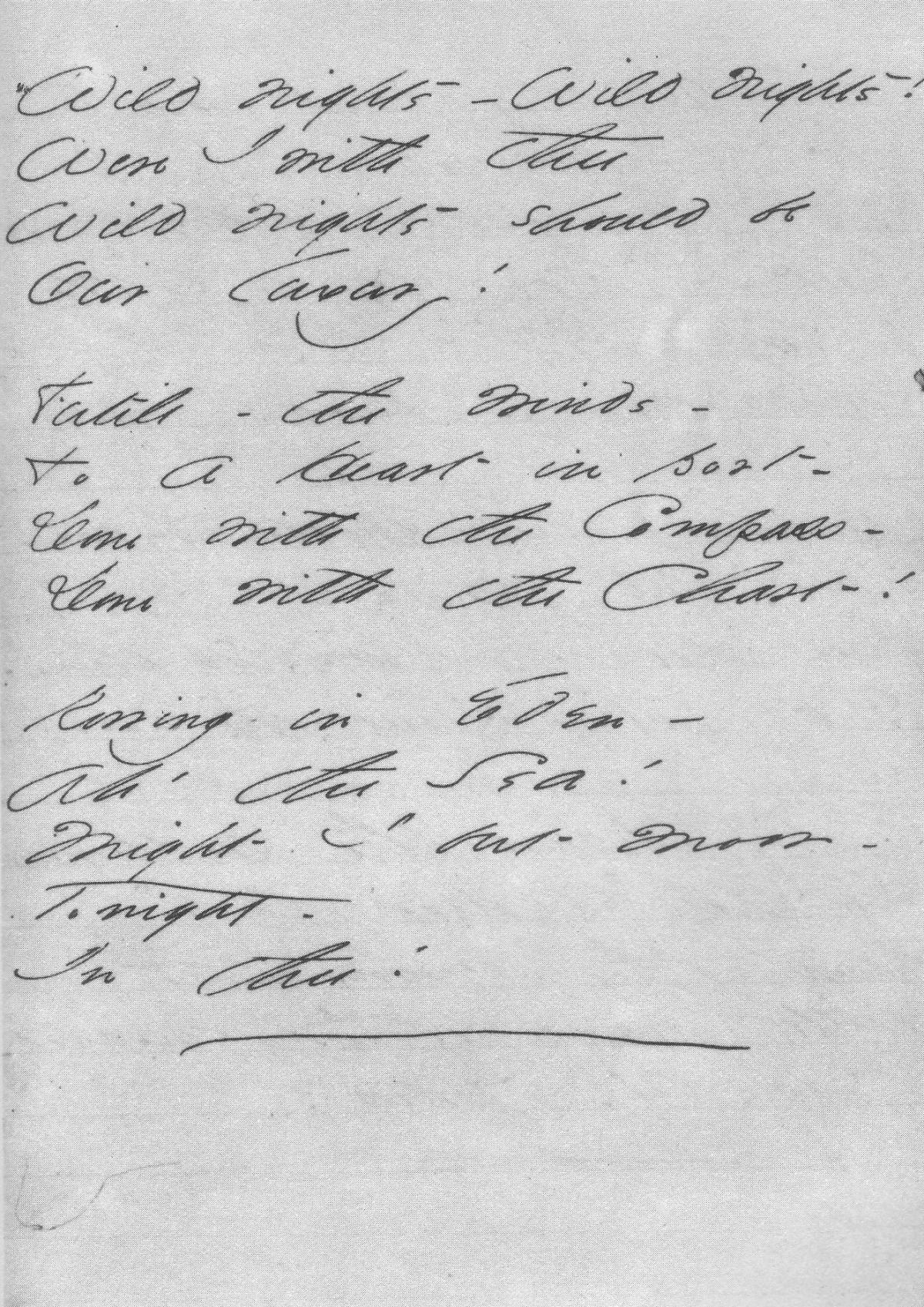
Ah, wild nights. This poem reminds me so much of my younger, unrestrained self. It was back when I indulged in every whim I’d had, and those wild nights were my luxury. Perhaps my sister never really understood the charm of indulgence the way that I did, or at least to the same extent. Looking back on the event now, I have the hindsight to recognize that my decision was dangerous, selfish, and utterly irresponsible. I sacrificed the sweetness of everyday domesticity with Lizzie for the chance of something sweeter. It caused our relationship so much pain, and for that, I will be forever sorry. Yet, there is this part of desire within me that lingers, and I have to ask myself, would I do it all again? The last stanza of the poem strikes me, especially the line “Rowing in Eden.” Eden and Hell, purity and sin. How can such opposites feel the same? That fruit was pleasure, pain, Eden, and Hell all together in one bite. Such an overwhelming experience that it’s hard to make sense of my feelings about it even now. Even so, my relationship with my sister and my family is more important to me than those goblin men will ever be. I’ve vowed to stay strong, and that I must. It’s hard to know if I will ever be free from the memory of the wretched goblin men and their fruit, but, I will pray, repent, and hope until the day I die. God will offer me forgiveness in the same way that Lizzie has.
Editorial Commentary: Emily Dickinson's poem “Wild Nights — Wild Nights” covers an extremely controversial topic for the 1860s: women exploring their sexuality. Not only does the poem delve into female sexuality, but it also subverts expectations of a pure and innocent woman by portraying Dickinson’s desire as something passionate and explicit. In this way, Dickinson and Laura are very alike; they both value their own pleasure above society's expectations of a pure, innocent woman. Laura would relate to the idea of wild nights overcome with passion, because she was the sister who was the most curious about the goblin men and their fruit. Dickinson’s publisher worried that “Wild Nights — Wild Nights” would shock the general public and turn many away from her poetry (Nelson). Laura and Lizzie experience the same stigmas around expressing female sexuality; as shown by the fate of a woman named Jeanie, who serves as a cautionary tale for girls wanting to indulge themselves in the Goblin Market. The idea that expressing lust will result in isolation from the public is a strong link between the two. Another similarity between “Wild Nights — Wild Nights” and “Goblin Market” is the additional layer of religious analogy. Some see Dickinson’s poem as a reference to spiritual love with God rather than physical pleasure, which is supported by the fact that Dickinson was a devout Christian (Nelson). In the same way, Laura’s journey Goblin Market is often perceived as an analogy for Christianity. Laura’s journey then represents a brief separation from God, with a restoration of faith at the end. Therefore, both Laura and Dickinson retain their passion for God and their parallel characterizations are still in line, even in this alternate analysis.
Citations:
Dickinson, Emily. “Wild Nights — Wild Nights.” Biblioklept, 24 Feb 2014, biblioklept.org/2011/02/24/emily-dickinsons-handwritten-manuscript-for-wild-nights-wild-nights/.
Nelson, Kristin. "Wild Nights — Wild Nights! Summary & Analysis" LitCharts, 7 Jan 2020, litcharts.com/poetry/emily-dickinson/wild-nights-wild-nights/.