

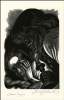
Obviously, when it comes to Victorian literature portraying women with mental illness as monstrous or terrifying, the character of Bertha Mason in Jane Eyre is the gold standard. Clearly quite unbalanced, she tries to burn Mr. Rochester in his bed, brutally attacks her brother, and terrorizes Jane the night before she is supposed to marry Mr. Rochester. Jane’s fear of Bertha is evident in her description of Bertha’s appearance during this last encounter: “‘Fearful and ghastly to me—oh, sir, I never saw a face like it! It was a discoloured face—it was a savage face. I wish I could forget the roll of the red eyes and the fearful blackened inflation of the lineaments! … Shall I tell you of what it reminded me?’ ‘You may.’ ‘Of the foul German spectre—the vampire,’” (Brontë 327). In this passage, Jane, and therefore Brontë, points out how terrifying Bertha is—fearful and ghastly, and barely, if at all, human. This last idea is incredibly important: Bertha is depicted here as fundamentally monstrous and “other,” and Jane is the one portraying her in this way. Jane tells us she has never seen a face like Bertha’s; Jane describes each of Bertha’s features in horrified detail; Jane quite explicitly compares Bertha to a vampire, obviously a monster. In other words, Jane, despite her own identity as a woman and her own possible emotional issues, not only fails to see the humanity in Bertha but further encourages her demonization. So why does Brontë set up the story this way, with her assertive, eloquent female narrator showing only fear of and contempt for a mentally ill woman? It seems likely that her own internalized misogyny may be in play here—Brontë was immersed deeply enough in Victorian culture that her text echoes, perhaps unintentionally, the prominent male fear of women with mental illness.