
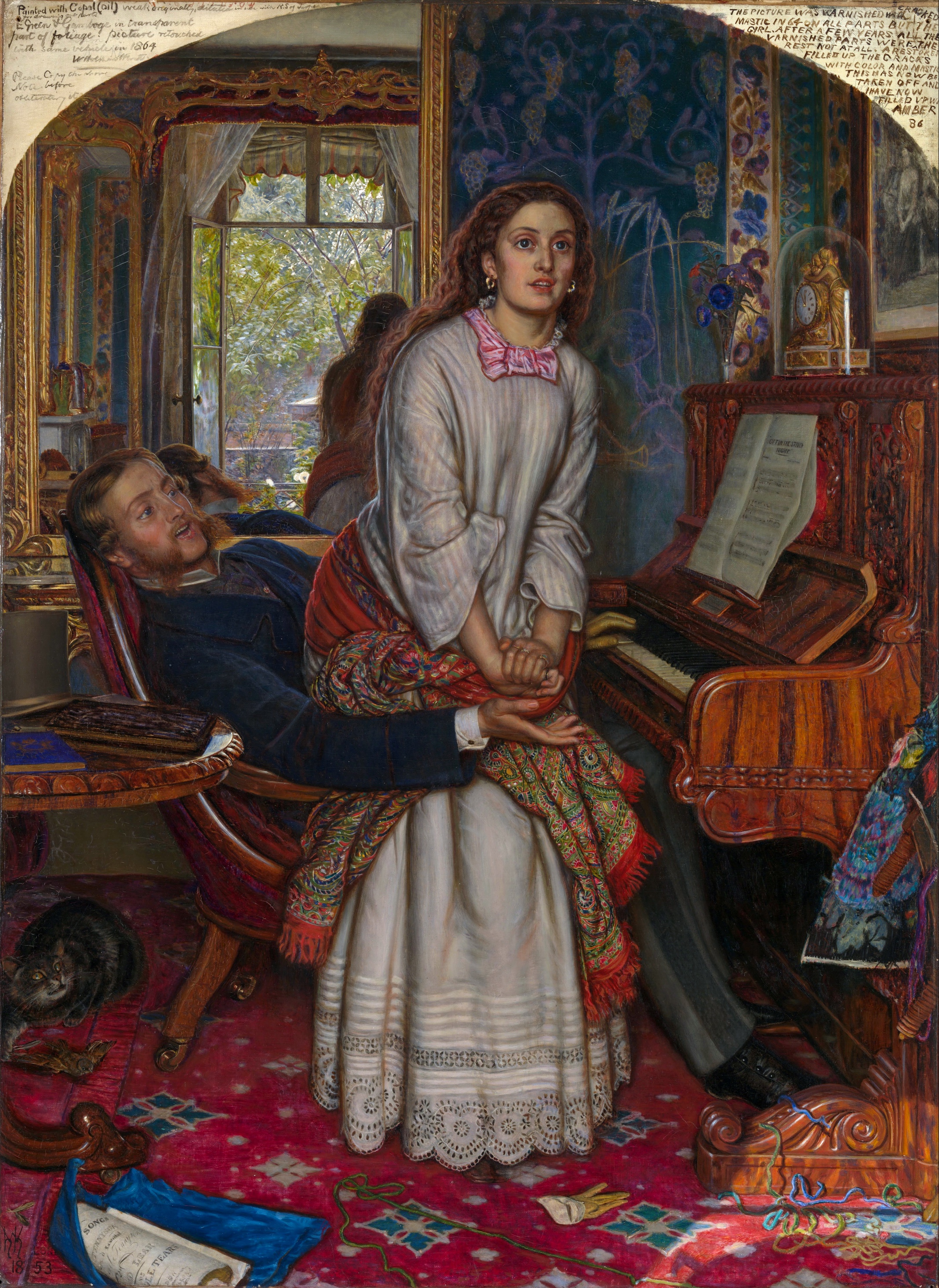
In the mid-1850s, when the Pre-Raphaelites took up stories relating to modern life and middle-class lifestyles, William Holman Hunt’s painting The Awakening Conscience (1853) and Dante Gabriel Rosetti’s poem “Jenny” (1848-69) portrayed prostitutes and the houses that they lived in as lesser than Victorian respectability, but capable of being more. When looking at the individual in comparison to the place that they inhabit, both of these pieces show either the fallen woman herself having an innate desire to be something or others seeing potential for more than what these women currently are.
The Awakening Conscience emphasizes emotional freedom and the desire to seek something more. The woman glances out the window and the greenery shown in the mirror. While a prostitute, she suddenly turns wide-eyed towards nature with a look that longs to be a part of it all, a grander awakening as she comes to accept that she could be doing more with herself, and has a short distraction from the man trying to keep her attention. In relation to houses and homes versus the land, and how the houses correlate with their owners, her home could be seen more as a designated prostitution house rather than a home of a standard young woman. With the realization she has in the painting, she could be well on her way to changing how she and her home are perceived and becoming a better person for herself as her eyes have opened, literally and metaphorically.
In “Jenny,” we see a similar scene with Jenny entrapped in her current life situation, by the narrator and other men who use her for prostitution. When it comes to the ideas of views of prostitutes within the 1800s, it shows a story similar to how prostitutes are treated today, with them being treated as lesser individuals than those who opt to use their services. In turn, her individual self as a prostitute is reflected within the land that surrounds her, as her home is notably different from his: “This room of yours, my Jenny, looks / A change from mine so full of books” (Rossetti 22-23). She’s no academic scholar as he is, she isn’t virtuous and though she is beautiful she is seen as much lesser. In turn, the land that she occupies is also seen as lesser due to her job and how she is treated within her job.
The Pre-Raphaelites had strong devotion to understanding middle-class individuals and highlighting exploitation within their works. While the days of Croome Court had individuals whose large house and gardens led to great recognition from others, the PRB era had highlights of the opposite type of relation to the land. These two works instead highlight lower individuals and the land they occupy in order to show that while they are currently lower in class status and virtue, they still had capability to become much more than what they were. If they could free themselves, they could become greater individuals and in turn allow for greater appreciation for their own land as more than just a brothel.