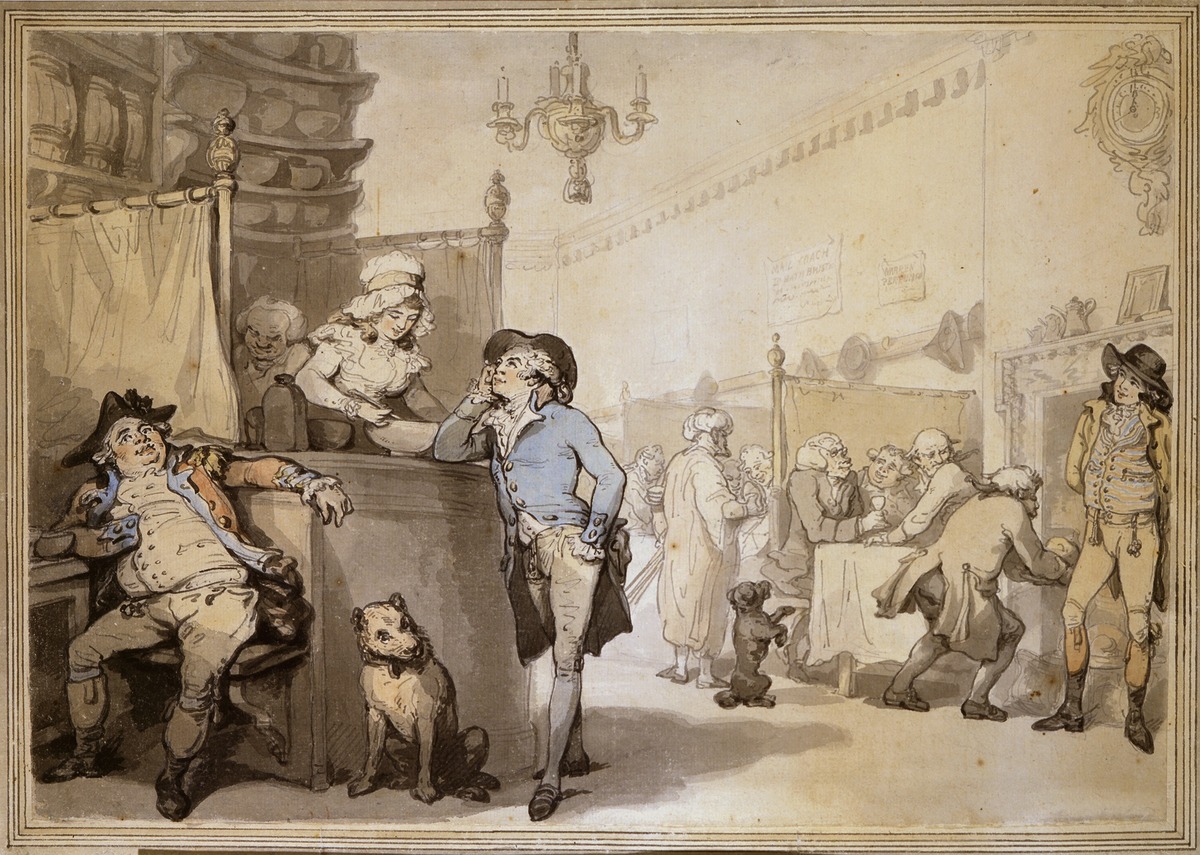
Thomas Rowlandson (1757-1827), The Coffee House (pencil, pen, and watercolor on paper, 1790; Aberdeen Art Gallery); Art UK.
Starting in the Restoration and increasing throughout the eighteenth century, the patronage of literature and the arts shifted from the royal court to the city of London, from court-appointed dependents to a public marketplace of ideas. The earliest hub of this activity was the coffee house. Serving coffee, chocolate drink, wine, brandy, and punch, the coffee house preceded the modern office, not just as a convivial space for conversation and news, but as a busy center for invention and creation, deal-making, and finance among middle-class merchants as well as gentry (Brewer 35).
Specific professions gravitated to favored houses -- artists at Old Slaughter's, literati at Will's. Often the houses were located in associated sectors of the city: dancers and opera singers gathered at the Orange, near Covent Garden Theater; booksellers met at the Chapter in Paternoster Row, where printers had set up shop since the early Renaissance. Even today, Lloyd's of London, the insurance marketplace, survives from its inception in a coffee house, Lloyd's, in the 1690s, located in Lombard Street, the center of what became the financial district.
Coffee-house culture spawned a literary form of its own, the daily periodical. In 1711, Joseph Addison (1672-1719) and Richard Steele (1671-1729) founded The Spectator, "ambitious to have it said" that, whereas Socrates "brought Philosophy down from Heaven, to inhabit among men," they would bring "Philosophy out of Closets and Libraries, Schools and Colleges, to dwell in Clubs and Assemblies, at Tea-Tables and in Coffee Houses" (Addison 117). At a time when newspapers were expected to be politically partisan, the Whig Addison and the Tory Steele came together to craft a new, nonpartisan genre, the belletristic essay, which explored a wide range of topics through a lens of disinterested, civil observation. Commentary was attributed to fictional characters, "Mr. Spectator" and his fellow members of the Spectator Club who convened their meetings in a coffee house. This fictional device is credited as a progenitor of another new genre -- the English novel, which first emerged later in the eighteenth century in a similarly serialized, epistolary form (Benedict 6-7).
The royal court recognized coffee house culture as competing with its dominance. During the Restoration, Charles II attempted to close the coffee houses, suspecting them of harboring "seditious" conversations among the people of mixed ranks who were freely admitted; however, the king's opposition was stymied by his own cronies who habituated the scene (Brewer 36-38).
The shift in cultural patronage from court to city was most powerfully represented by the Kit-Cat Club, named after mutton pies, called Kit-Cats, baked by their host Christopher Cat. The club effectively operated as impresarios, sponsoring production of plays and operas, and supporting writers. One member, the publisher-bookseller Jacob Tonson (1655-1736), influenced the consolidation of a national British literature. As a supporter of the Copyright Act of 1709-10, he not only stabilized careers of modern writers such as the poets John Dryden (1631-1700) and Alexander Pope (1688-1744) but also cemented a literary heritage by acquiring the copyrights to Shakespeare and Milton (Brewer 40-43).
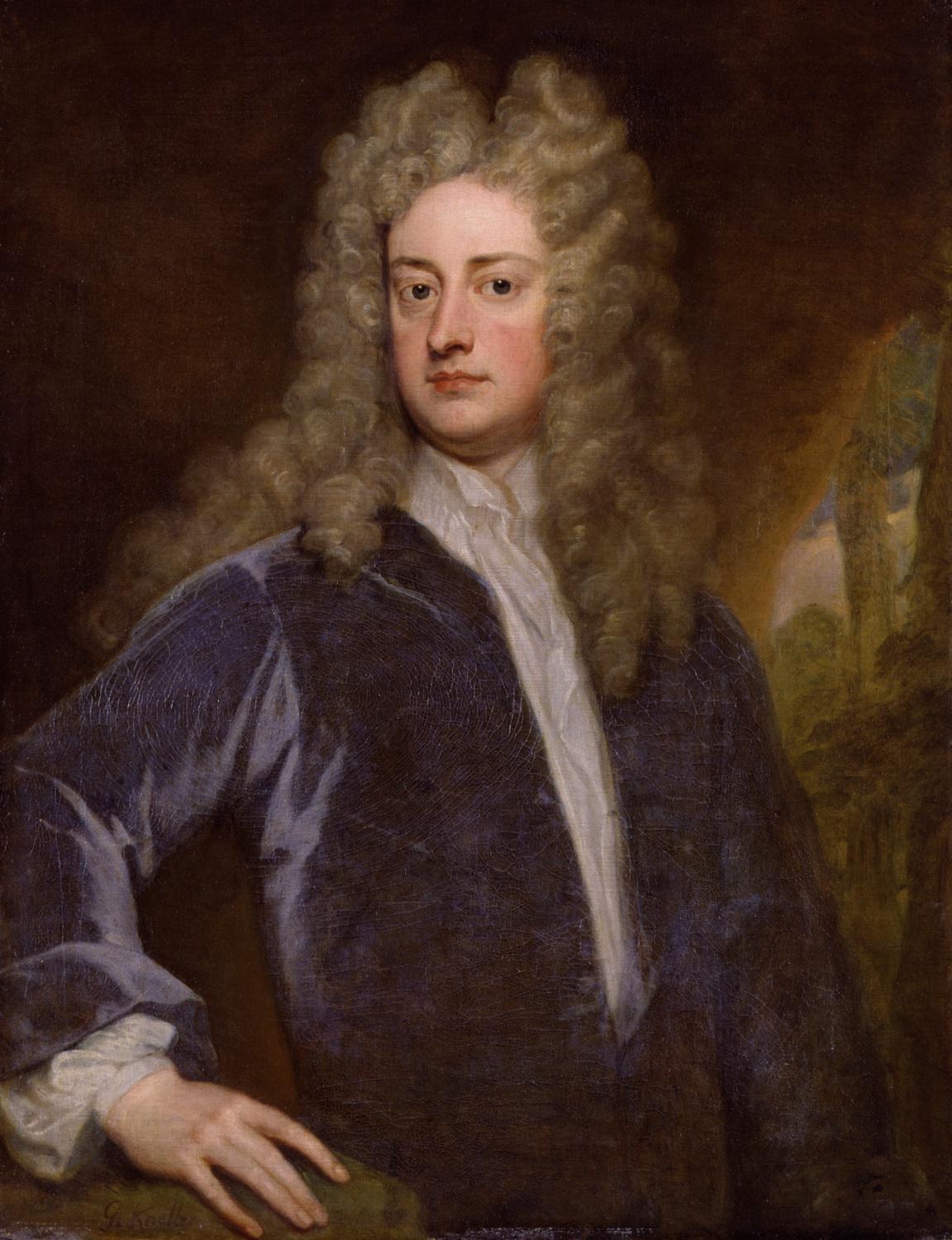
As a symbol of the shift in power and patronage from the court to city club, a distinctive style of portraiture was developed for the Kit-Cats by the painter Godfrey Kneller (1646-1723). Unlike the 12-feet tall grand style portraits devised by Van Dyck for Charles I at Hampton Court Palace, Kit-Cat portraits were held to 3 by 2 feet to be accommodated within the modest rooms of Tonson's house. Yet, while Kneller maintained a dignified pose for the members, he brought the figure forward in space, closing in on a three-quarter body length that emphasized the expressiveness of face and hands. Dignified yet intimate, Kneller's portrait of Addison (below) suggests a figure engaged in polite conversation with the spectator, like one of his essays for The Spectator (Brewer 41-42; Vaughan 72).
Works Cited
Addison, Joseph. Spectator no. 10. In Selections from The Tatler and The Spectator, edited by Robert J. Allen, 2d ed. Holt, Rinehart and Winston, 1970, pp. 116-19.
Benedict, Barbara M. "Joseph Addison." The Oxford Encyclopedia of British Literature, edited by David Scott Kastan, Oxford UP, 2006, vol. 1, 6-10.
Brewer, John. The Pleasures of the Imagination: English Culture in the Eighteenth Century, Farrar Straus Giroux, 1997.
Vaughan, William. British Painting: The Golden Age from Hogarth to Turner. Thames and Hudson, 1999.