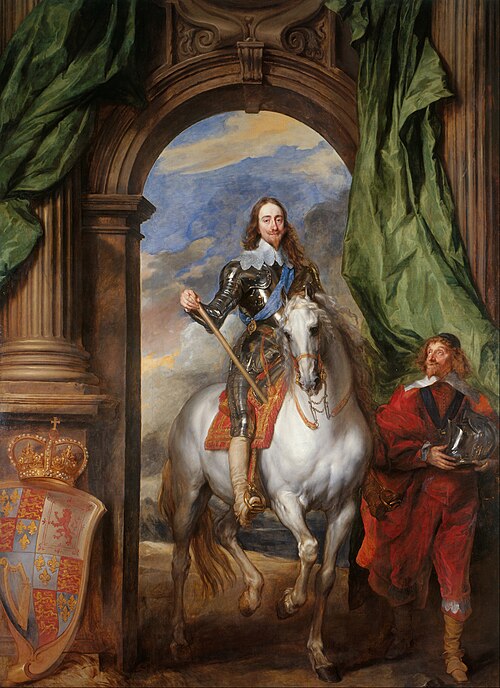
Anthony Van Dyck, Charles I (1600-1649) with M. de St Antoine (oil on canvas, 12.1 ft x 8.8 ft, 1633; Royal Collection, Windsor Castle); Wikimedia.
The Stuart king Charles I (1600-1649) represented a pinnacle of cultural patronage centered on the royal court. Charles assembled one of the largest and finest art collections in Britain and Europe, derived from Continental artists on the assumption that the English court displayed its prestige largely by importing the arts rather than by patronizing native talent.
In literature, Charles favored the flattery of the English Cavalier poets, while the poet and polemicist John Milton (1608-74) led the growing republican and Protestant opposition to Charles's assumption of the "divine right" of absolute monarchy and to his connections with Continental Roman Catholicism. Milton's influential works include the Protestant epic, Paradise Lost (1667, 1674), and his essay arguing for freedom of expression and independence of the press, Areopagitica (1644).
Resistance by the English Parliament to Charles's absolutist rule erupted into the English Civil War, resulting in Charles's capture, trial, and beheading. Subsequent Parliamentary rule fell part, however, succumbing to the Restoration of the Stuart king Charles II until 1688, when the Glorious Revolution finally deposed the Stuart reign of Charles's brother, James II. In the eighteenth century, the modern British constitutional monarchy developed under the Protestant royal House of Hanover imported from Germany -- the Georges I, II, and III. The reign by George III (1738-1820) and, from 1811, by his son George IV acting as Regent coincides with the period with which our class begins -- the Revolutionary period dominated by revolutions in America and France.
Anthony Van Dyck (1599-1641) was a Flemish artist, appointed by Charles I as painter to the English court in 1632. Along with another celebrated Flemish artist of the period, Peter Paul Rubens (1577-1640), Van Dyck typified the Continental artists favored by the Stuart court.
Van Dyck is especially known for the Grand Style portrait, in this example also an equestrian portrait. The huge canvas depicts Charles in military armor, astride a noble steed and riding through a triumphal arch. The architecture alludes to the triumphal arches of the ancient Roman Empire, which were erected for powerful generals and emperors returning from a great military victory. The symbolism enforces Charles's absolute power; and since he is accompanied only by his riding master, M. de St Antoine, instead of surrounded by cheering crowds, the symbolism also enforces his "Personal Rule" — referring to his decade of ruling without Parliament, an absolutism he believed justified by Divine Right.
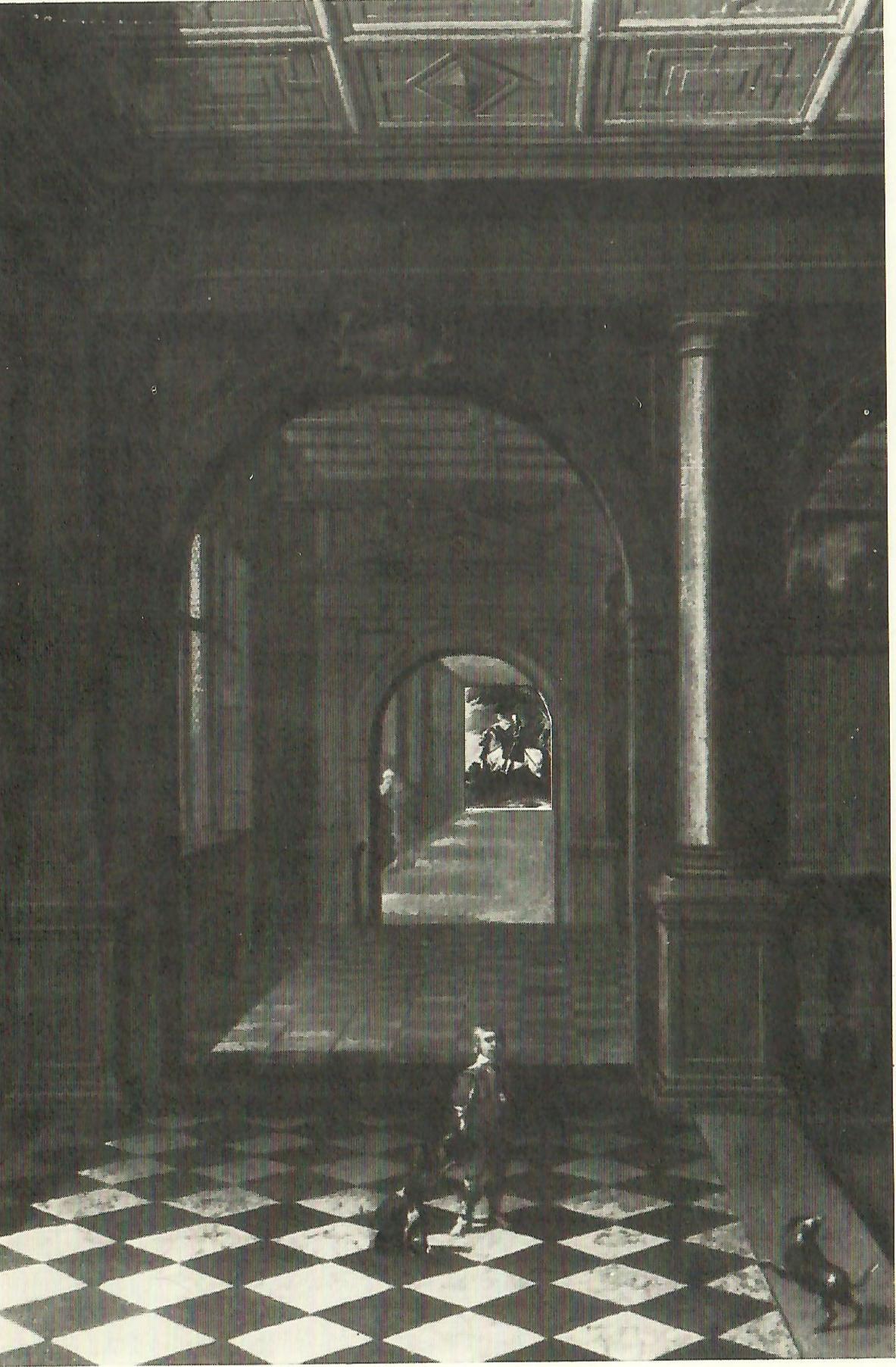
The portrait was originally hung at the end of the Long Gallery in Hampton Court Palace (below), creating an illusion of the king entering the palace in a blaze of power (Strong 14, 20-25).
Work Cited
Strong, Roy. Charles I on Horseback. Viking, 1972.