
By Chay Rosario
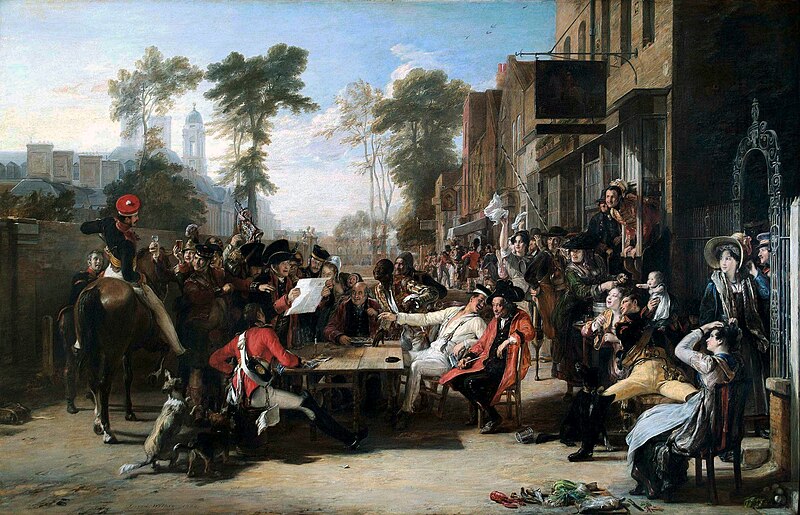
With the turn to genre and narrative painting in the early Victorian era, heroic figures were democratized compared to the mythic heroic figures in history painting of the eighteenth century and before. After Benjamin West’s Death of General Wolfe (1770-71), the theme of patriotism was maintained, but Sir David Wilkie made heroes of ordinary soldiers in Chelsea Pensioners Receiving the London Gazette Extraordinary of Thursday, June 22, 1815, Announcing the Battle of Waterloo (exhibited 1822). The new way to depict the heroic figure in this painting was as soldiers on a pension in a pleasant suburb, celebrating the final victory of the Napoleonic wars.
Wilkie's composition differs from that in West’s painting. Wilkie’s painting centers on the figures in the middle ground, who are arranged in a sort of arch. This allows for multiple figures to be seen and highlighted. No one figure is the main hero being depicted; in fact, all the soldiers are seen as heroic figures thanks to this composition choice. This grouping is anchored by a separate group on the far right. While the soldiers are celebrating in the center of the piece, this group to the right are seated and looking on at the soldiers. This serves to highlight the soldiers and shows non-soldiers looking on at what would now be considered heroes. This composition serves to elevate the status of the soldiers in the center of the piece.
This elevation of ordinary people to heroic figures also occurred in poetry. In William Wordsworth’s “The Thorn,” the protagonist is elevated to a heroic figure through a sort of superstitious tale. In the poem, the narrator describes a thorn (bush) that sits atop a hill. The narrator goes on to describe the story of a woman named Martha Ray who goes to sit by this thorn. It is said that Martha Ray had fallen in love with a man and had planned to marry him. However, he married someone else, leaving her heartbroken and a bit mad. It was soon discovered that she was with child. However, no one knew what happened to the child. Martha's daily visits to the thorn caused people to think that she may have killed the child and buried it on the hill. The description of the woman and the whispers surrounding her story serve to elevate the character to a sort of legendary status.
While the term heroic figure has a connotation of famous and mythic persons, in this poem the term seems to take on a new meaning. The figure does not necessarily have to be one with a positive light cast upon it. Wordsworth adds a sense of mystery and intrigue to the character. The narrator repeatedly states that he does not know the answers as to why or how events occurred. The speculation of others in town are also mentioned. All of this adds to the elevation of the character to a legendary status.