
By Clarisse Declaro
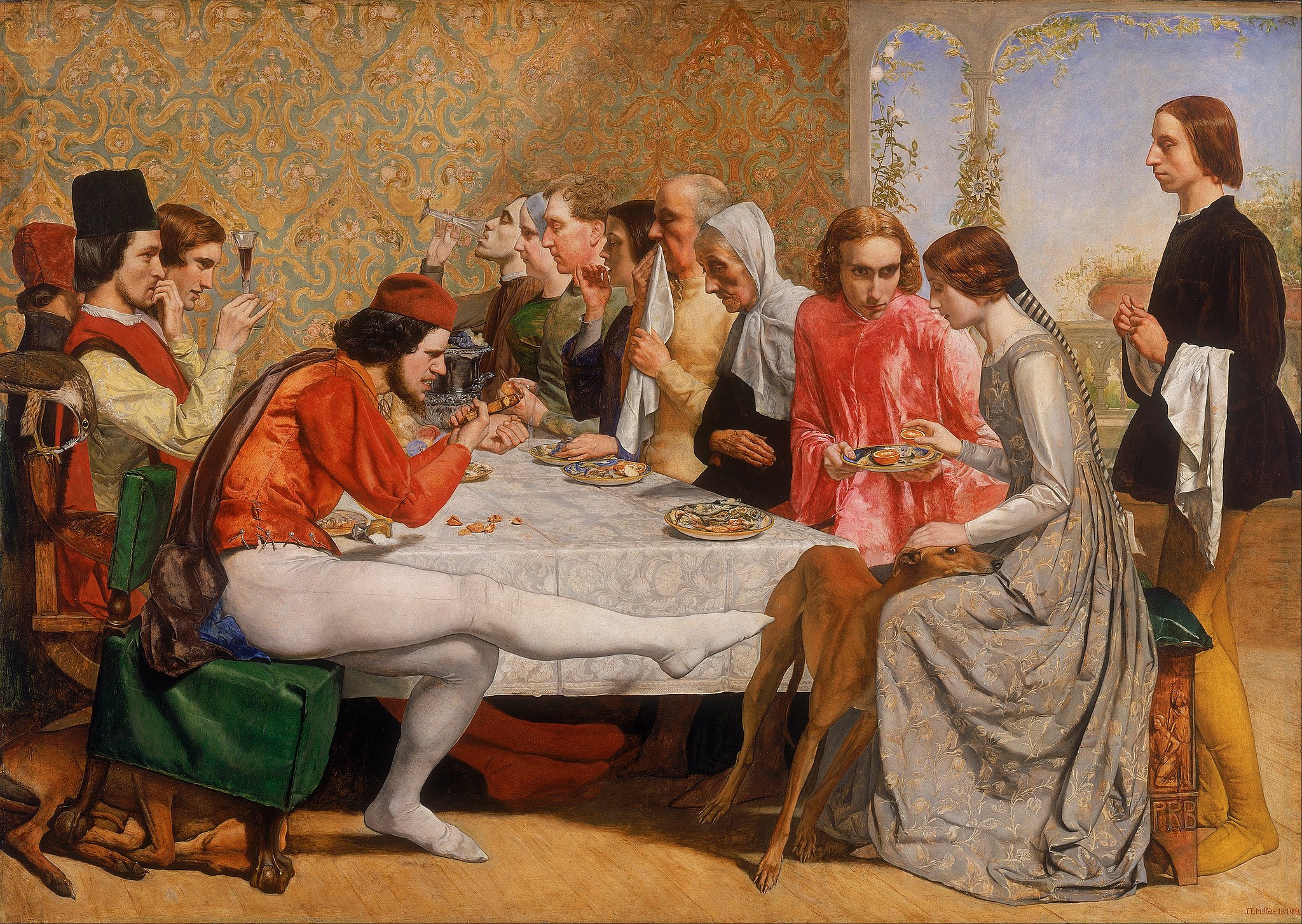
In 1848, a group of young artists—John Everett Millais, Dante Gabriel Rossetti, and William Holman Hunt—formed the Pre-Raphaelite Brotherhood (PRB) to challenge the established conventions and norms of academic art in Britain. They rejected the rigid ideals of the Royal Academy, which promoted imitating the grandeur of Raphael and High Renaissance art. Instead, they focused on sincerity, details, and vibrant naturalism of the earlier art, preferring the “bright colours, flat surfaces and what they thought of as the simple honesty of the fifteenth-century Italian…” (Barringer 9). One of their early major works is John Everett Millais’s painting "Isabella." The painting draws the viewer in with its intricate details such as the characters’ facial expressions, body language, and vibrant colors to depict the tension and drama of the story. Isabella (the central female figure) shows an expression of being calm yet sorrowful, showing her love for Lorenzo and her awareness of the tension around her while Lorenzo (her lover, seated near Isabella) with an expression gentle and reserved, showing his affection for Isabella and his unease in the brothers’ presence. On the other hand, the brothers exhibit arrogance and hostility. One brother leans aggressively on the table, pointing a finger in a menacing way, showing control and dominance. The painting also highlights the patterns of the floor, the folds in the clothes of Isabella, and even the small objects on the table to make the scene appear realistic. Millais’s "Isabella" captures the PRB’s mission by portraying the central conflict between love and cruelty through emotions and meticulous detail. Isabella and Lorenzo’s vulnerability contrasts with the brothers’ greed and hostility, creating tension enhanced by the setting in the painting and the use of bold colors. Inspired by Keats’s "Isabella," the painting critiques power and greed while reflecting the PRB’s commitment to their beliefs that art should tell meaningful stories, show deep emotions, and stay true to nature.