
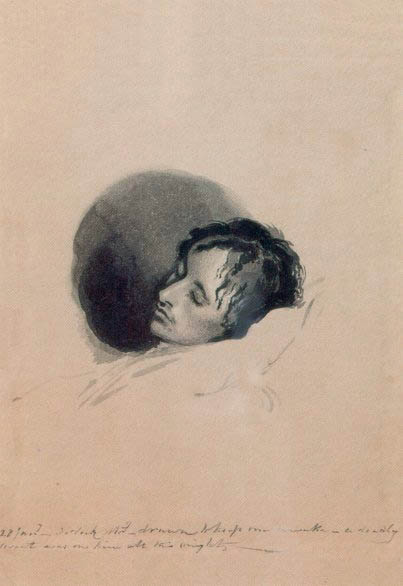
John Keats, one of the great literary "what ifs," represents the Romantic sense of individualistic death.
His poem “When I Have Fears That I May Cease to Be” clearly illustrates his grappling with death. The poem's first-person pronouns and its mourning of his wasted potential reflect this Romantic sentiment. He is mourning the end to his physical life, but more importantly, he mourns the cessation of his imagination. His apparent illness in 1819 and 1820 made it clear that his time was rapidly approaching. In a period where individual freedom and expression were of paramount concern, death meant the loss of a great mind and imagination. As was the case with Keats, who died in 1821 at only 25. Although he frantically and fervently wrote in his final years, his forever-fragmented Hyperion stands as an everlasting reminder of what dies with a person.
Hough, Graham Goulder. “John Keats | Biography, Poems, Odes, Philosophy, Death, & Facts.” Encyclopedia Britannica, 20 July 1998, www.britannica.com/biography/John-Keats.
Ogden, Philippa. “Romanticizing Death: Art in the Age of Tuberculosis.” TheCollector, 9 May 2020, www.thecollector.com/tuberculosis-art/.