
By Maggie Tregre
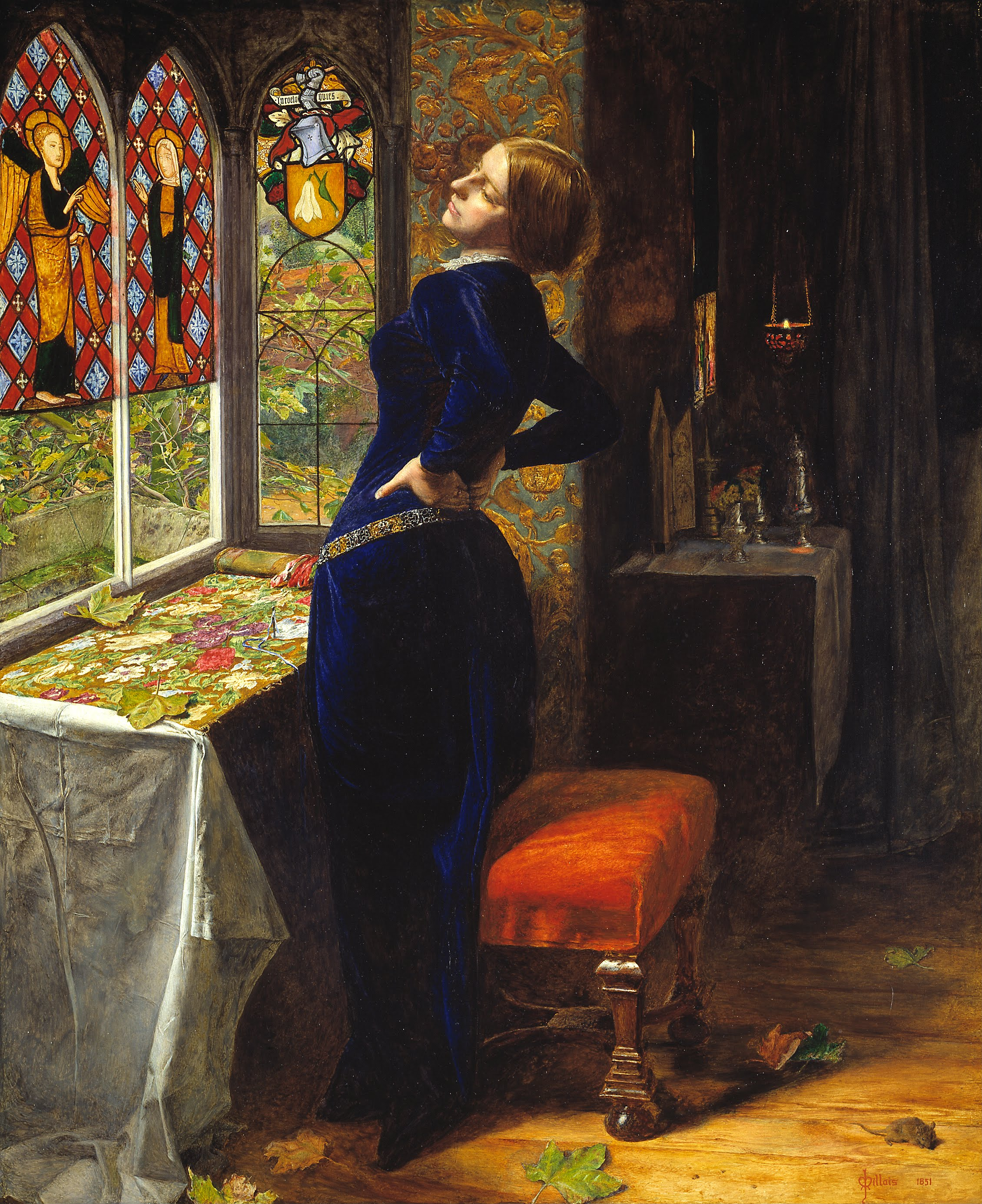
John Everett Millais’ Mariana (1851) depicts the central figure of Alfred Tennyson’s 1830 poem of the same title. Mariana waits and laments for her love as she begins to realize that he will not be coming back for her, leaving her isolated and alone. In the painting, Mariana is seen standing and looking off to the side through a window. Her gaze is cast outward as she looks for her lost love. What is most interesting about her figure is her posture. Mariana does not follow the graceful and feminine Raphaelite “S-curve,” such as the maiden in Charles Eastlake’s The Champion (1824). Instead, she is in an almost inverted position, with her arms bent backwards to grab at herself. Innocent viewers might understand this posture given the context of the poem. It seems like she is stretching her arms and back after she has spent time sitting and waiting and working at her embroidery, but in the nineteenth century, this image would have been extremely provocative due to this pose. Her posture seems to throw her own sexuality back onto herself, which was simply unacceptable at the time the painting was released.
In 1847-48, Dante Gabriel Rosetti wrote the first version of “Jenny,” which he revised several times prior to publication in 1870. This poem was equally if not even more shocking than Mariana was. Jenny is immediately characterized as “Fond of a kiss and fond of a guinea” in the poem’s second line. This line hints at the nature of Jenny’s life as a prostitute, since she is fond of sexual attention and greedy for money. She is also half-naked: “Your silk ungirdled and unlac’d / And warm sweets open to the waist.” Rosetti’s shocking poem would not fit with the Academy’s ideas about art or poetry. In the time of the Pre-Raphaelites, Jenny represents the new kind of woman who has no respectable position. She is a prostitute, who cannot fit into high society. Middle-class women were not supposed to think about sex.
Mariana and “Jenny” are just two examples of the elusiveness of women in art in the eighteenth and nineteenth centuries. Women were denied access to the academies, but their figures were often the subjects of paintings. Male nudes were often studied and copied in an attempt to achieve classical styles, but female figures were not supposed to be aware of their own sexuality. Even Alexander Pope understood that there was a grey area when it came to women. His Moral Essays depict a man’s portrait in the Grand Style, but Pope's narrator claims (satirically) that women did not have enough character to be painted in the Grand Style. He presents the “idealized” woman as his friend, Martha Blount, but Martha still represents a woman of high status and good moral standing. She would never be associated with a woman like Mariana or Jenny. Pope also argued that each person, both men and women, were individuals, so the Grand Style was not adequate to capture the beauty of each unique individual. This idea extends through the Pre-Raphaelites, since each of these women are unique individuals, but their individuality does not fit within the acceptable roles for women in society.