
By Kimber Peters
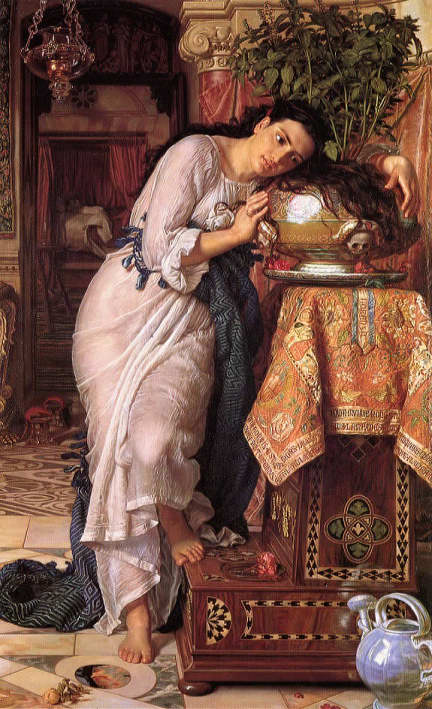
Burke defines the sublime as being “productive of [fear,] the strongest emotion which the mind is capable of feeling” (39). Throughout A Philosophical Enquiry, his descriptions of the sublime focus heavily on aspects of the world he believed were best at creating sublime experiences for audiences. Of these aspects, Burke says that tapping into one’s emotions, fears, and imagination is the best way to develop sublime artwork. While Burke focused mainly on extraordinary subjects, later artists such as the Pre-Raphaelites transformed the expression of the sublime by shifting its focus to the real, tangible world. This shift created a new interpretation of the sublime, referred to as the material sublime. Smith describes the material sublime as being a “juxtaposition of romance and realism, or sensibility and detachment” (302) which serves as a reminder that “[imagination] should arise from the sublime in the world rather than from the mundane or weird, and they should arise from external matter, not from subjective feeling” (303). John Keats’ poem Isabella and Holman Hunt’s painting Isabella and the Pot of Basil demonstrate this balance between realism and sensibility by showcasing narratives that are significantly grounded in realistic, worldly matter. At a glance, Hunt’s painting Isabella and the Pot of Basil does not appear to be productive of intense feelings Burke believes all sublime art should be capable of eliciting from audiences. To understand how Hunt’s painting Isabella and the Pot of Basil expresses the sublime, consider it in relation to the poem Isabella. The painting depicts Isabella watering her pot of basil, which houses Lorenzo’s severed head, with her tears. Despite the disturbing and saddening fates of both Isabella and her lover, Hunt’s painting depicts the scene in the particularized Pre-Raphaelite manner without dramatic displays of passion. Isabella’s face is rather emotionless; however, viewers can only assume that she is embracing the pot with tender affection, given the way she gently caresses it with her fingers as she gazes longingly into the distance. The skull on the pot signals Lorenzo's death; however, Hunt does not exaggerate the tragedy that is already apparent within the scene. This painting presents viewers with a balance of romance and realism which is foundational to the material sublime.
Keats also prioritizes this balance of romance and realism in his poem Isabella. According to Smith, juxtaposition is one of the techniques that Keats uses to strike this balance (305). In order to control readers’ reactions to the discovery of Lorenzo’s body, Keats pairs the horror with beautiful language and descriptions which mitigate the terror of the scene. An example of this beautiful language can be found in part XLVI of the poem where, upon discovering Lorenzo’s gravesite, Isabella gazes at his “pale limbs at the bottom of [the] crystal well” (Keats 175). While it is disturbing to imagine Lorenzo’s pale limbs, the image of the crystal well is pleasing and possibly even soothing. Additionally, part XLVII has an abundance of poetic language which paints a beautifully tragic picture of Isabella mourning (Keats 175). Thanks to this technique, the scene does not overwhelm readers or trigger extreme, intense emotional responses. The beauty dilutes the horror, allowing readers the space to process the sublime experience before responding to the poem sensibly. Keats’ focus on the tangible aspects of the world is also noticeable in transformation of Isabella as her “love sickness turns to real sickness” (Smith 305). As Isabella’s love for Lorenzo consumes her, she begins obsessively watering her beloved basil pot with her tears. The narrative pivots focus from Isabella’s internal emotions to her visible, tangible misery which is also depicted in Hunt’s painting; this change mirrors the shift in the sublime aesthetic as artists began balancing romance and realism. Instead of the spectacular, Keats and Hunt create sublime experiences in a realistic, detailed world which all people are familiar with. The material sublime, which is a major shift from Burke’s ideas of the sublime, better represents the priorities the of Pre-Raphaelites, who believed that all art had to reflect the actual world and the experiences of common people.
Works Cited
Burke, Edmund. A Philosophical Enquiry Into the Sublime and Beautiful. Routledge, 2008.
Smith, Louise Z. “The Material Sublime: Keats and ‘Isabella.’” Studies in Romanticism, vol. 13, no. 4, 1974, pp. 299–311.