
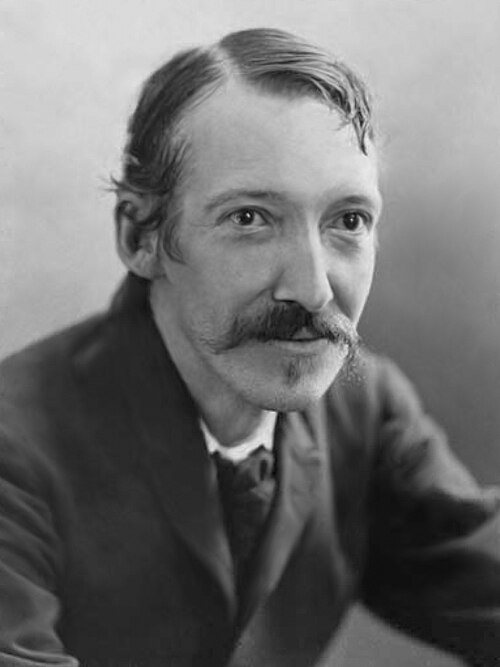
This article was produced by the National Endowment for the Humanities and written by Danny Heitman. The purpose of this article is to provide a further in-depth understanding of the life that Robert Louis Stevenson lived and how his life and health influenced his writing. I feel like the intended audience of this piece is to be students and teachers because of how informational it is.
This article talked about Robert Louis Stevenson's health and how he was very often sick. It contrasted his sickly health with his exciting and adventurous stories. One thing I found very interesting was even though he had very little energy, his imagination and stories he wrote were full of action, travelm and danger. The article uses his book, Treasure Island, as a comparison. I think even the story that we read in class, Jekyll and Hyde, is a good example of how his work contrasts his actual life, but also aids it in a way. I think he used his work as an escape from his real-life struggles. By understanding his health issues, it brings into question whether or not Stevenson used Jekyll and Hyde as a way for him to express how much he wanted to separate his health from himself, just like he tried to separate his evil from his good in his novel. By understanding and knowing about the struggles that Stevenson went through in his life makes Jekyll and Hyde more meaningful and emotional because it allows the reader to be able to connect with the personal struggles and health struggles he might have been going through when he wrote his work.
I believe that this article is very well written and interesting. I love the insight it gives into Stevenson's life and work. I think I would overall rate it an 8/10.
“Treasure Island Author Robert Louis Stevenson Was a Sickly Man with a Robust Imagination.” The National Endowment for the Humanities, July 2015, www.neh.gov/humanities/2015/julyaugust/feature/treasure-island-author-r….
Stevenson in 1893 by Henry Walter Barnett is licensed under Public Domain.
