
By Chay Rosario
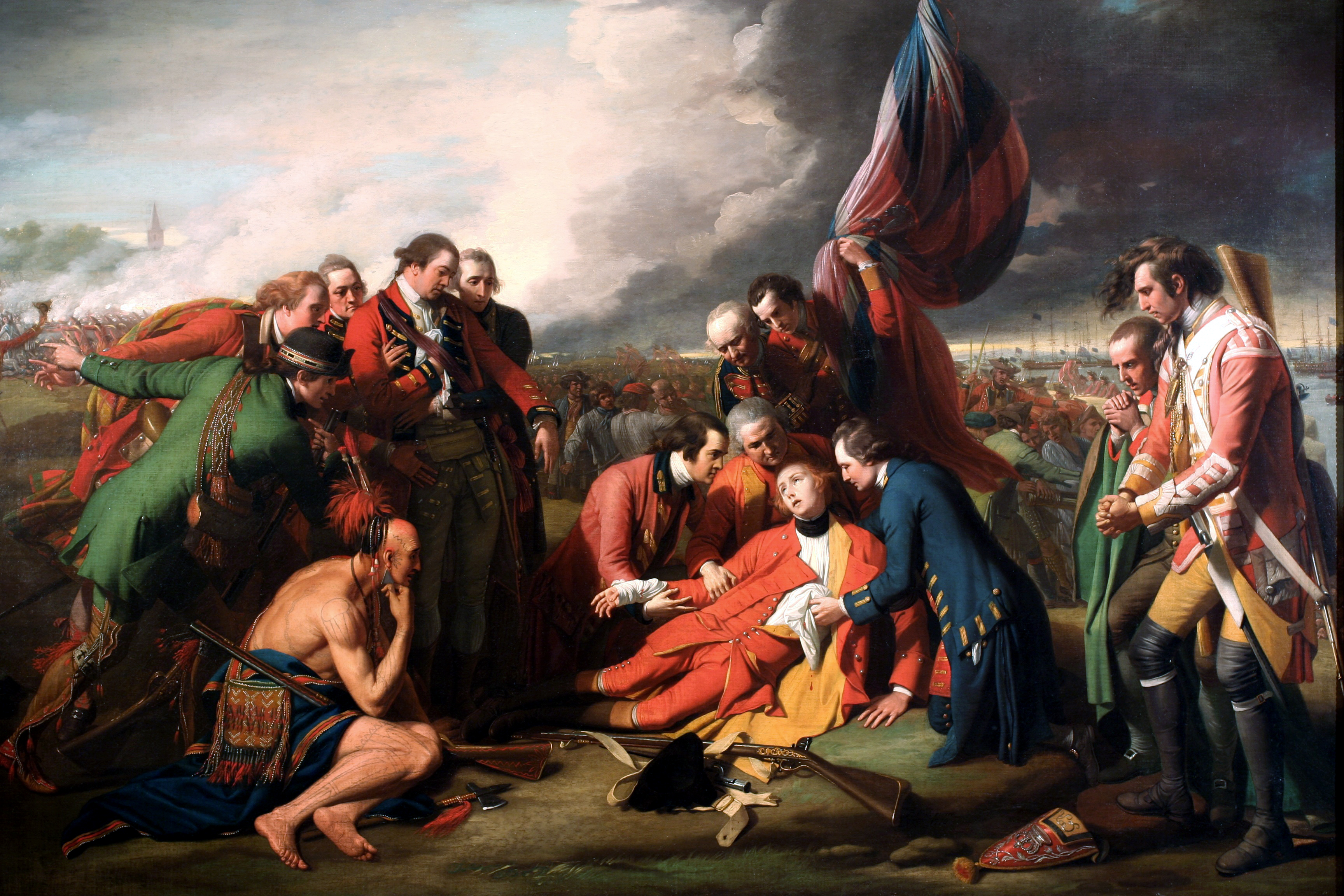
In the eighteenth century, British artists began to find more innovative ways to present narrative and characterization in pictures. This led to the introduction of a new type of narrative art—the modern style of history painting. This style was introduced by Benjamin West with his painting The Death of General Wolfe (exhibited 1771). This new mode of history painting represented contemporary events in contemporary costume, as opposed to more classical events of older history paintings. In this painting, there is a focus on the heroic figure—General Wolfe. The heroic figure is, traditionally, a figure that is depicted in a large-scale narrative form of art that seems to share a sort of moral message.
In Sir Joshua Reynolds’ Discourse III (1770), he mentions the beauty found in the human form. He mentions the heroic figures Hercules, Apollo, and the Gladiator. As he goes on to explain the beauty of the human form, he mentions how the artist must look to the Ancients to learn, but ultimately it is up to the artist to capture what is truly beautiful in the form. He believes that is it necessary for the painter to vary the compositions with “figures of various forms and proportions” while never losing sight of “the general idea of perfection in each kind.”
The depiction of Wolfe in this painting was one that caused some controversy at the time. West’s choice to depict the subjects in modern dress was not originally accepted. While painting the piece, it was recommended to him by Reynolds that he should dress the figures in “the classic costume of antiquity” in order to protect the “inherent greatness” of the subject. However, West disagreed. He believed that because the event depicted occurred in a region that was unknown to the Greeks and Romans and in a time when those nations and ways of dress no longer existed, it would in fact be a disservice to the piece to depict the subjects in the classical way. The subject of the painting was an event of historical significance and, as such, should be depicted in a way that accurately represents the event. When the painting was completed, West invited Reynolds back to view the painting. In turn, the original objections were retracted. They believed that West treated the subject as it ought to be treated. It was also said that the painting would “occasion a revolution in the art” of historical pictures (Mitchell 20-21).
Another aspect of the painting that was central to the piece, was the actual depiction of Wolfe. He is depicted in the pose known as the pietà. This was a Christian art theme that depicts Mary cradling the dead body of Christ after the crucifixion. Wolfe is depicted in a similar stance. He is draped in the arms of his men, similarly as Christ is draped in the arms of Mary. By depicting the heroic figure in this manner, West draws a parallel between Wolfe and Christ. It lifts Wolfe up in status as a heroic figure and elevates the scene. Drawing this parallel allowed for West to depict Wolfe in a patriotic way. At the time, patriotism was extremely intense. There was a lot of tension between Protestant Great Britain and Catholic France. West’s choice to depict a battle that resulted in a victory over the French was one that not only launched the new style of history painting, but also helped to establish the “British School.” Also, by depicting Wolfe in the pose of the pietà, it helped to draw the parallel that the Protestant religion was the superior one to Catholicism. Placing Wolfe in the position of Christ, equated the victory that is depicted with a religious victory.
Work Cited
Mitchell, Charles. “Benjamin West’s ‘Death of General Wolfe’ and the Popular History Piece.” Journal of the Warburg and Courtauld Institutes, vol. 7, no. 1, 1944, pp. 20–33. https://www.jstor.org/stable/750377.