
In “Book First: Introduction—Childhood and School-Time” from The Prelude, which Wordsworth first drafted in 1799 and revised steadily over the years until published after his death in 1850, he describes his childhood and how nature played a role in creating his imagination. In multiple stories, he details his journey through the woods and hills of the Lake District and how everything around him came to life. In one of his tales, he recalls when he found a boat tied to a willow tree. He says he was led to this tree by “her,” the spirit of nature. He went on to untie the boat and ride in it. As he travels down the lake, he describes how the voice of the mountain pushes his boat, and the horizon behind him forms a creature. This creature, mysterious and intimidating, drives him back to shore. This experience left him pondering on the forest for days after. This story magnifies his use of the sublime. He felt true terror in that moment but was in awe of the beautiful landscape surrounding him too. The way he describes this scene highlights the strong use of emotion. He describes being scared, curious and exhilarated. Another one of his memories includes him stealing prey from someone else’s trap. While in the forest, he hears something coming toward him, which he explains as being nature's voice.
In his poetry, Wordsworth describes the everyday life and adventures of a young child. There is no elevated way of life shown here. The language used, although colorful, is easy to understand and makes for an enjoyable time for the reader. Wordsworth gives life to nature and has it speak back to him. From these tales, Wordsworth creates the concept of time being a spot. These memories exist in his mind but take place in actual locations.
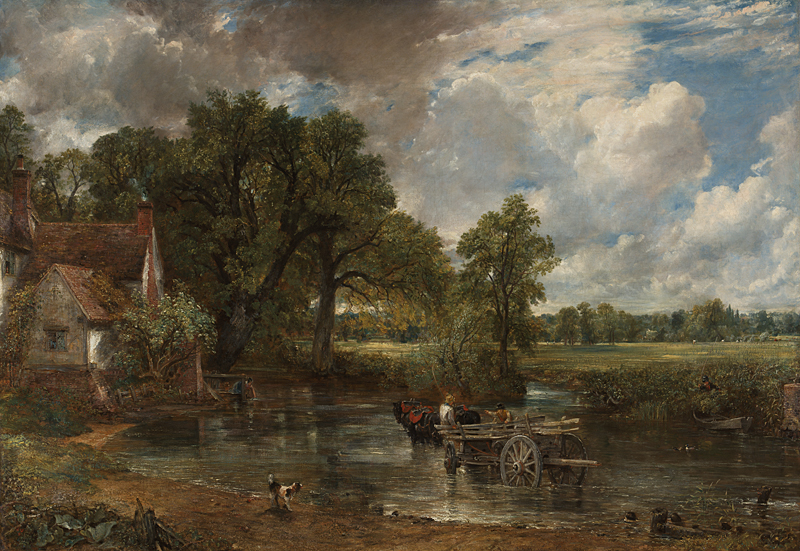
John Constable’s Hay Wain (1821 is a piece of artwork that follows Wordsworth's train of thought. The painting itself is filled with incredible detail of a countryside that seems to be far away from industrialization. On the left side of the portrait, a homey cottage sits surrounded by trees. In the middle of the painting, a small river flows behind the house, which is shaded by the same trees that are next to the cottage. Two men sit in a wagon placed in the water, and this carriage is being led by several horses. The water is still, and the men don’t seem to be in a rush to get their work started. To their right is a clear, vast field, and the clouds above are heavy and gray. In the foreground of the portrait, a small dog is looking toward the men in the wagon but isn’t attempting to jump into the water.
This painting matches the poem as it mirrors the point of view that Wordsworth deems important. The painting shows everyday life, as the men seem to attend to their everyday lives. The beauty of nature is exemplified further down the stream, where the trees form a canopy for the oncoming crew. The large field of land that seems to have no end represents the sublime. This painting also depicts the standing still of time. The wagon and the horses are facing one way, but the wheels are taking a turn to the right. The man sitting on the wagon's left faces the field while the man next to him points in another direction. The dog also represents the freezing of time, as his body is slightly turned and he looks toward the wagon. Ultimately, both of the poems and the piece of literature show how nature can be translated into a language, a way of thinking, and the building of imagination.