
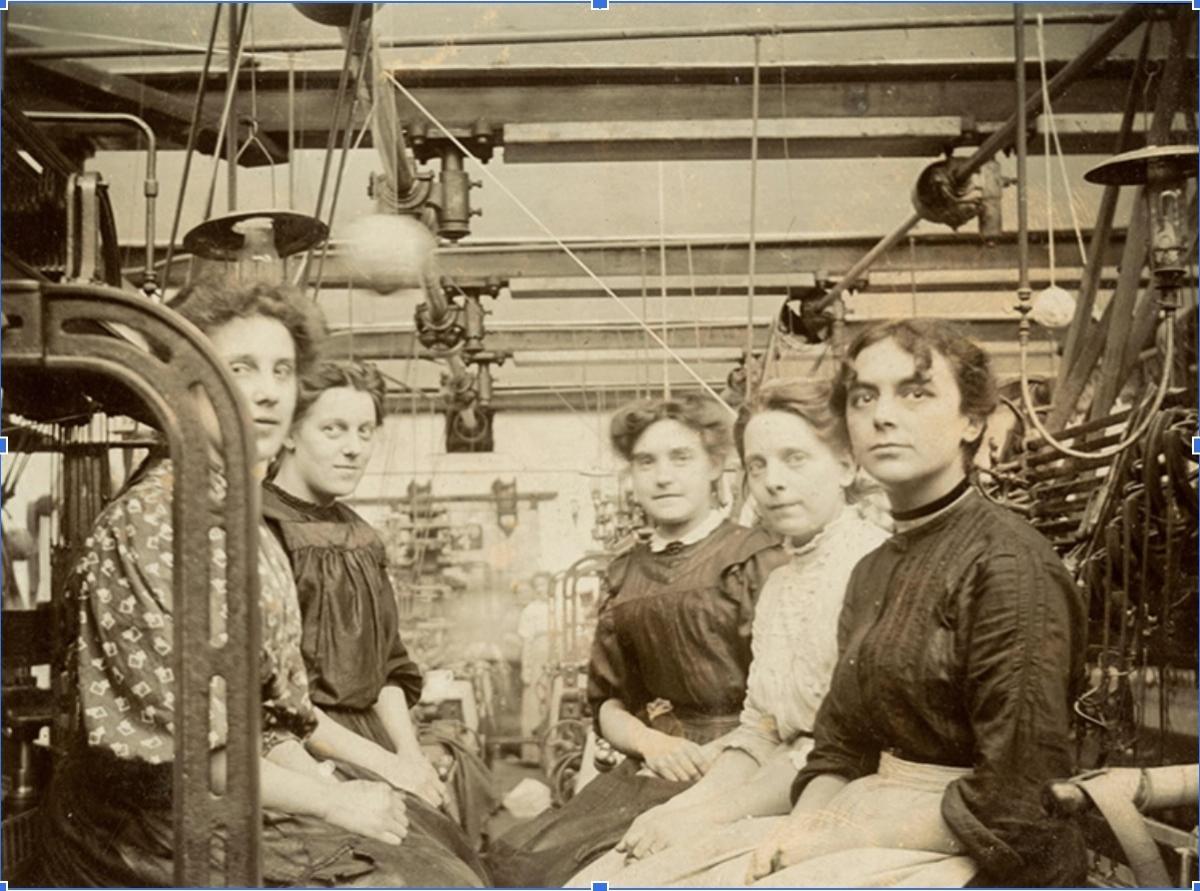
The company at which my friend (Front right) is employed hired a photographer to take photos of the Mill and its workers. She only began working there because her husband died and left no money for her in his will. Instead, he left it all to another woman whom he’d been seeing for several years before he died. She works long hours in the Mill, usually 7am-7pm with only one 25 minute break at 12pm for lunch. She works every day of the week except Sunday and Christmas. She claims that sick days usually mean lagging behind on bills, so she tries to work as many days as possible to make due and save up a sum of money to buy a smaller home. She used what she had left of her week's salary to buy a few copies of the photo, and she sent me this copy. In the letter I am replying to her with, I will send her a photo of my sisters and I working in the shop we own. Hopefully this will make her feel less alone in her long hour days, except for the fact that we find our work rewarding, and we do not receive wages. I am planning on sending her the snippet that I saved from the Newspaper not too long ago. Hopefully, she will find hope in the Labor Union’s efforts to bring better working conditions to the women of England. If she ever chooses to leave the Mill and return to our town where she was born, then I will offer her a job in our shop without hesitation. I plan on inquiring about the opportunity in the letter I send with the article snippet.
Gertrude received this picture from her friend (Abbey) that works in a textile mill in Rochdale Lancashire, England. She explains to Gertrude that she has been working long hours in the Mill, and that she longs for another way to earn a living, but she simply can’t afford to leave the Mill for any amount of time until she buys her own small home. Abbey is a prime example of the type of work women did in the Victorian era. Most women who worked, worked in factories like this one. They would work long, gruelling hours somewhere close to “14, 15, and 16 hours”(Ittman, 51). Most would continue their jobs in the mill “until they were married and leave work”(Ittman, 51)). Once they were married they would leave, if they could afford it, but for some, this was their only source of income. Women who were not born into money or they could not marry into it had to work to earn their living. Lots of women “supported their families on the low wages of spinning and weaving”(Ittman, 51). This is a trait of the “New Woman”. Gertrude or Abbey chose to work for a living, they still exemplify the financially independent traits of the “New Woman”. The New Women had a hard time joining the workforce because many citizens still believed women did not belong in the workforce. Rather, they should marry into money. Nevertheless the new age of feminine independence persisted, but not without the struggle of inequality. Women could not do jobs deemed to be reserved for men, so they mostly worked in spin mills. These jobs were strenuous already, but many people believed that most women would marry off and leave the job eventually, so they had a hard time obtaining and getting any form of a raise in their jobs.
Wilkes | Published in History Today Volume 67 Issue 6 June 2017, Sue. “A (Working) Woman’s Place.” History Today, 6 June 2017, www.historytoday.com/working-woman%E2%80%99s-place.
Ittman, Karl. Work, Gender, and Family in Victorian England. Palgrave Macmillan UK, 1995.