
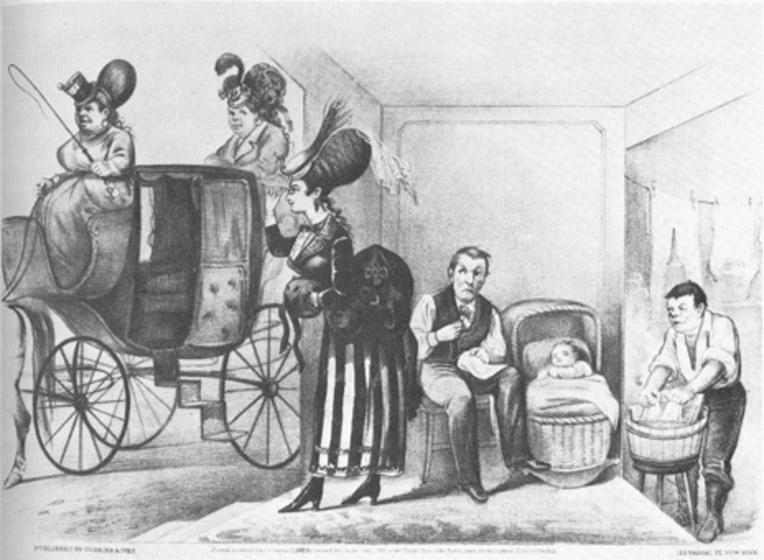
I look at these women and I see hope. I see hope for the future of my daughters and the lives that they can live. They will not have to be restrained by the burden of gender roles. I pray that my children can have whatever job that they desire and that they can attend any school that they wish. My daughters should not have to only worry about sewing, washing, and looking after the children, like these men in the drawing and like most women of my time. The period of repressed women is over and the movement toward gender equality has already begun. The women’s suffrage movement has been underway for many years now, but I wonder when we will actually be able to vote. How much longer do we have to wait?
I see these women have the freedom and will to do as they please, but I also see the anger in their husbands’ faces. Do men not realize that we have had this anger for all of our lives too? We are angry for not being able to do what men are allowed to do. For my entire life I have watched men flaunt their freedoms in my face, while I am taking care of the house. I have never been more ready for change and I know that I am not the only woman that feels this way. As another housewife brought this drawing to me knowing that I would feel the same way about our feminist movement.
Editoral Commentary:
This print depicts a major shift in gender roles. There are two men carrying out tasks that women of the Victorian Era (1837-1901) would normally be expected to accomplish. One man is sewing and the other is washing clothes, and both are looking after a child. The men are looking at the women with very hateful gazes. There is a very well-dressed and sophisticated looking woman stepping into a horse-drawn carriage that is being run by two other women. The print shows a stark contrast between the normal gender roles of the time and what gender roles could become in the future. It also highlights the feelings that women have about the stereotypes of women during the Victorian Era. Because the genders are swapped in this drawing, the men express the hatred and envy that the women of the time, especially the New Women, would have of men’s freedom.
The New Woman is who sparked the change in England. She inspired others to support a feminist movement to change the gender roles of women, as well as initiate the women’s suffrage movement. These two movements occurred in relatively the same time period, as the women’s suffrage movement began during the 1870s through women suffragists. Propaganda and campaign ads were commonly used to spread the message of the new view of femininity. Prints, like this called “The Age of Iron” by Currier & Ives, also were a popular way of emphasizing these ideas since they displayed strong messages of freedom that women could have if they would support the movements.
Citation:
Currier & Ives. The age of iron. Man as he expects to be. New York: Published by Currier & Ives, 152 Nassau St. Photograph. Retrieved from the Library of Congress, <www.loc.gov/item/90708467/>.