
Christina Rossetti includes an allusion of Christianity within her poem, "Goblin Market". This is evident based on the premise of the poem. Laura falls to temptation and then Lizzie redeems her by making a sacrifice. Laura can be paralled to Eve, in the Garden of Eden, in the book of Genesis. In Genesis 3:1-6, the serpent manipulates Eve into eating some of the fruit from the tree which God said not to eat from, but Eve "saw that the fruit of the tree was good for food and pleasing to the eye, and also desirable for gaining wisdom, [so] she took some and ate it." Eve fell tempted to what the serpent was speaking to her and ultimately fell to temptation, damning herself. She was worse off after giving in to temptation. In comparison, Laura was tempted by the goblin men to eat their fruit. When the goblin men are trying to sway her, "The whisk-tailed merchant bade her taste / In tones as smooth as honey, / The cat-faced purr'd, / The rat-paced spoke a word / Of welcome, and the snail-paced even was heard;" (Rossetti l. 107-111). They tried to create a false sense of security and happiness in hopes to sway Laura to try some fruit. The result of the goblin's fruit turned Laura's hair thin and grey, "She dwindled, as the fair full moon doth turn / To swift decay and burn / Her fire away" (Rossetti l. 278-280). She became sick physically and unwell mentally, as she was hoping to hear the goblin's cry again.
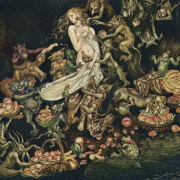
In Christianity, with the fall necessitates a sacrifice. In the Old Testament, the sacrifice is in the form of animals. However, in the New Testament, there is the sacrifice of Jesus Christ. In Hebrews 10:10, it reads, "And by that will, we have been made holy through the sacrifice of the body of Jesus Christ once for all." Jesus preformed the ultimate sacrifice so that we could be saved from the damnation Eve put upon humanity, Before Jesus' sacrifice, it was the animal sacrifices that sufficed. In "Goblin Market", there is Lizzie's sacrifce that ultimately saved Laura. After Laura gets sick, Lizzie goes out to find the goblins to get fruit. When they won't give it to her, they "trod and hustled her, / Elbowed and jostled her, / Clawed with their nails, / Barking, mewing, hissing, mocking, / Tore her gown and soiled her stocking, / Twitched her hair out by the roots, / Stamped upon her tender feet, / Held her hands and squeezed their fruits / Against her mouth to make her eat" (Rossetti l. 399 - 407). The physical harm that Lizzie endures to save Laura is extreme and leaves her battered and bruised. However, without this sacrifice, Laura would die and without Jesus' sacrifice, we wouldn't recieve external life.
This parallel between Eve and Laura, and Jesus and Lizzie is undeniable. The temptation by an outside force, the falling to a fruit, and the sacrifice for redemption is all consistent in both the story of the Bible and "Goblin Market". There is also a connection to the volunteer work Rossetti was doing at the time she wrote this poem. She was volunteering at the St. Mary Magdalene Penitentiary for "fallen women." Fallen women were considered prostitutes, or those that had transgressed sexually. The Anglo-Catholic institution had the conviction that these women could be redeemed (Roe). Since Rossetti spent a lot of time volunteering at the Penitentiary, it can be infered she also held the conviction of redemption. With the influence of her volunteer work and religion, Rossetti creates a very strong allusion to Christianity.
Works Cited:
Holy Bible. New International Version, Bible Gateway, 2011.
Roe, Dinah. “An Introduction to ‘Goblin Market.’” British Library, British Library, 15 May 2014, https://www.bl.uk/romantics-and-victorians/articles/an-introduction-to-….
Rossetti, Christina. "Goblin Market." 1862. Cove Studios, https://studio.covecollective.org/documents/goblin-market-750a5766-7768-..., Accessed 12 March 2023